Stock Analysis · Innovative Industrial Properties Inc (IIPR)
Overview
Innovative Industrial Properties Inc. is a real estate investment trust, or REIT, focused on properties used for regulated cannabis cultivation and processing in the United States. In simple terms, it buys specialized industrial facilities from cannabis operators and leases those buildings back to them under long-term agreements. This structure gives operators access to cash while IIPR collects rent and, in many cases, also passes property-level expenses such as taxes, insurance, and maintenance to tenants.
The business is unusually concentrated. Unlike broad industrial REITs that serve many industries, IIPR is tied mainly to the medical-use cannabis ecosystem and to tenants that often have limited access to traditional bank financing. That niche helped the company expand quickly in earlier years, but it also makes tenant quality and industry health especially important.
Based on company filings, the main revenue sources are heavily dominated by rental income from owned properties, with a smaller contribution from tenant reimbursements and other real-estate related income.
- Rental revenue from leased properties: approximately 85% to 90% of total revenue in recent periods. This is the core business and reflects contractual base rent, often with annual rent escalations.
- Tenant reimbursements and property-related income: approximately 10% to 15%. This mainly includes recoveries for property taxes, insurance, maintenance, and similar charges that tenants are responsible for under triple-net lease structures.
- Other revenue sources: limited and not a major driver. The company is not meaningfully diversified into non-real-estate activities.
The business model is easy to understand: IIPR owns hard assets, signs long leases, and aims to turn those rents into cash flow and dividends. What matters most is whether tenants keep paying and whether the company can place capital into properties at attractive returns without taking on too much risk.
The longer-term operating picture shows a company that grew revenue strongly from 2021 through 2023, then lost momentum in 2024 and 2025. Profitability stayed high for a REIT, but the drop in revenue and net income in 2025 shows that tenant stress has become a real factor rather than a temporary headline issue.
Key Figures
| Metric | Value | Sector ⓘ |
|---|---|---|
| Date | Oct 17, 2026 | |
| Context | ||
| Sector | Real Estate | |
| Industry | REIT - Industrial | |
| Market Cap ⓘ | $1.42B | |
| Beta ⓘ | 1.42 | |
Value (Cheapness) | ||
| P/E Ratio ⓘ | 11.66 | 17.38 |
| P/B Ratio ⓘ | 0.86 | 0.85 |
| FCF Yield ⓘ | 13.85% | 7.38% |
| Dividend Yield ⓘ | 14.74% | 4.85% |
| EBIT / EV ⓘ | 7.96% | 3.78% |
| PEG ⓘ | N/A | |
Growth (Business expansion) | ||
| Revenue Growth ⓘ | 0.70% | 5.30% |
| RPS Growth (5Y CAGR) ⓘ | 4.73% | 6.02% |
| EPS Growth (5Y CAGR) ⓘ | -15.48% | -11.37% |
| BVPS Growth (5Y CAGR) ⓘ | 1.72% | 0.45% |
| Margin Growth (5Y Trend) ⓘ | -13.11% | -0.22% |
| FCF Growth (5Y CAGR) ⓘ | -1.91% | 5.40% |
| DPS Growth (5Y CAGR) ⓘ | 11.32% | 5.02% |
Quality (Business durability) | ||
| ROIC (Latest) ⓘ | 5.78% | 5.69% |
| ROE (Latest) ⓘ | 7.22% | 7.56% |
| ROA (Latest) ⓘ | 5.60% | 2.85% |
| ROIC (5Y Median) ⓘ | 8.02% | 4.22% |
| ROE (5Y Median) ⓘ | 8.10% | 6.03% |
| ROA (5Y Median) ⓘ | 6.78% | 2.44% |
| Net Debt / EBIT (Latest) ⓘ | 2.47 | 7.59 |
| Net Debt / EBIT (5Y Median) ⓘ | 1.25 | 8.40 |
| Net Debt / EBITDA (Latest) ⓘ | 1.70 | 5.27 |
| Net Debt / Assets ⓘ | 15.66% | 37.76% |
| EBITDA / Interest ⓘ | 9.16 | 4.10 |
| Operating Margin (Latest) ⓘ | 62.14% | 35.29% |
| Operating Margin (5Y Median) ⓘ | 58.70% | 37.31% |
| Debt to Equity (Latest) ⓘ | 32.89% | 88.87% |
| Profit Margin (Latest) ⓘ | 52.27% | 19.61% |
| Free Cash Flow (Latest) ⓘ | $196.45M | |
Momentum (Price trend) | ||
| 3Y Return ⓘ | -3.94% | +30.75% |
| 12M Return (excl. last month) ⓘ | +13.55% | +4.36% |
| 6M Return ⓘ | +9.50% | -2.52% |
| Price vs. 200-Day MA ⓘ | +3.19% | -2.34% |
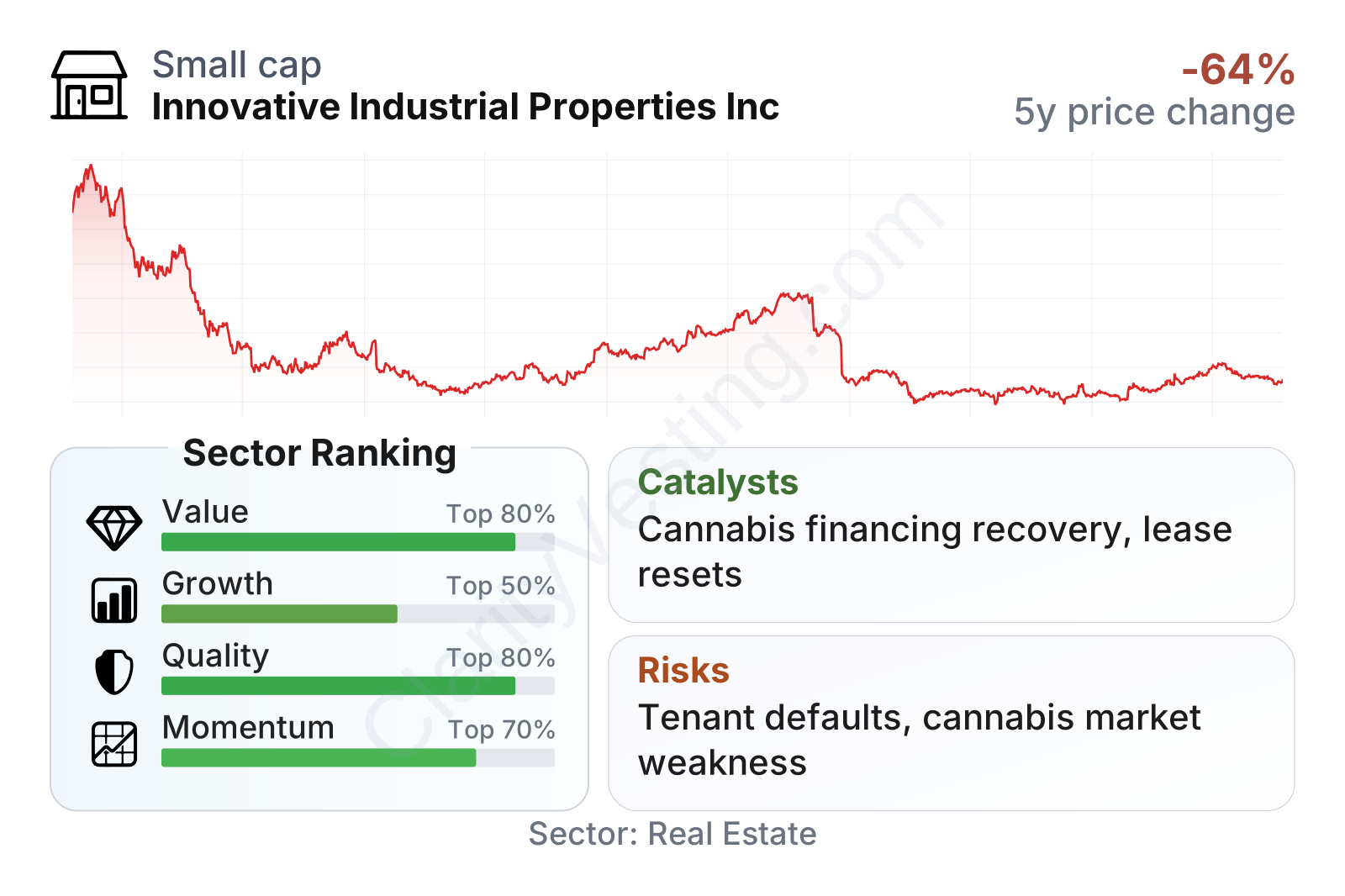
IIPR stands out for strong quality metrics and a mixed growth profile. Profitability, returns on assets, and balance-sheet leverage all compare well with much of the real estate sector. The company also offers a notably high dividend yield and solid free cash flow generation relative to its size. On the other hand, recent revenue growth has been weak, earnings growth over five years has been negative, and operating margins have come off their earlier peak. The stock’s recent rebound improves momentum, but the longer share-price history still reflects how sharply sentiment changed after the cannabis financing environment weakened.
Growth
IIPR operates in a sector with a complicated long-term setup. The broad cannabis market still has growth potential as more states permit medical or adult-use programs, and licensed operators continue to need cultivation, processing, and distribution facilities. In that sense, the underlying property niche can expand over time. The challenge is that growth in legal cannabis does not automatically translate into healthy tenant finances. Pricing pressure, taxes, oversupply in some states, and limited access to normal banking have made the industry far more difficult than its headline growth would suggest.
IIPR’s strategy still makes logical sense within that environment. It provides real estate capital to operators that may not be able to borrow cheaply from banks, and that financing gap remains an important reason tenants use sale-leasebacks. Long leases with built-in escalators can support predictable rent streams when tenants remain solvent. The company has also generally avoided the heavy leverage often seen elsewhere in real estate, which gives it more flexibility than some peers if conditions stay uneven.
Revenue per share illustrates both the opportunity and the slowdown. The company expanded rapidly through 2023, showing that its model worked well when new transactions were flowing and rent collections were stronger. But the decline after that points to a business that is no longer in straightforward expansion mode. For long-term analysis, that means future growth depends less on simply buying more properties and more on improving tenant quality, resolving troubled leases, and carefully selecting new deals.
The dividend record remains one of the company’s more visible strengths. Dividend per share has increased significantly over the last five years, even as industry conditions became tougher. That signals meaningful cash generation from the portfolio. Still, in a REIT, dividend durability depends on rent collection and property cash flow, so the trend is encouraging but not independent from tenant health.
A meaningful catalyst would be any improvement in U.S. cannabis financing conditions. If federal banking rules become more workable, if state markets stabilize, or if stronger operators gain share and become better tenants, IIPR could benefit from lower credit risk and renewed transaction activity. Another potential growth driver is redeploying capital from defaulted or vacated properties into better operators and better markets. Recent company communications have also emphasized asset management, lease restructuring, and selective investment rather than aggressive expansion at any price, which is a more disciplined approach for the current stage of the cycle.
Risks
This article is for informational purposes only and does not constitute financial advice. Some content is AI-generated. See Disclaimer


