Stock Analysis · IGO Limited (IIDDY)
Overview
IGO Limited is an Australian mining company focused on metals used in the energy transition, especially lithium, nickel, and copper. Its portfolio is built around producing and developing raw materials that go into electric vehicle batteries, energy storage systems, and electrification infrastructure. For U.S. readers, IIDDY is the ADR representing the Australian-listed company.
The business has changed meaningfully over the last few years. IGO previously had a larger direct exposure to nickel production, but its current profile is increasingly tied to lithium through its ownership interests in the Greenbushes lithium mine and the Kwinana lithium hydroxide refinery, both held through the Tianqi Lithium Energy Australia joint venture. It also keeps exposure to nickel and copper through the Nova operation in Western Australia.
Based on recent annual disclosures, revenue is mainly generated from product sales at Nova and from lithium-related earnings and distributions through major investments. Because reported revenue and profit can move differently from one year to the next, it is more useful to think about IGO economically as a company with the following exposure mix:
- Lithium-related interests: approximately 60% to 75% of the group’s economic value in the current portfolio. This includes IGO’s stake in the Greenbushes lithium mine, one of the world’s largest hard-rock lithium operations, and its share of the Kwinana refinery.
- Nickel sales: approximately 20% to 35% of operating revenue in recent periods, mainly from Nova concentrate production. This incorporates nickel as the main contributor, with by-product credits affecting reported results.
- Copper and cobalt by-products: approximately 5% to 15% of operating revenue, largely linked to Nova’s mixed metal output.
This is not a highly diversified miner. The company is relatively concentrated in a small number of assets, and that makes commodity prices, asset performance, and joint-venture execution especially important to the long-term case.
The broad financial picture shows a sharp shift from the stronger 2022-2023 period to much weaker reported earnings in 2024-2025, followed by some recovery in 2026. Revenue has fallen materially from prior peaks, while operating profitability has been volatile and recently negative, reflecting weaker lithium and nickel conditions, impairments, and the uneven contribution of major assets.
Key Figures
| Metric | Value | Sector ⓘ |
|---|---|---|
| Date | Oct 17, 2026 | |
| Context | ||
| Sector | Basic Materials | |
| Industry | Other Industrial Metals & Mining | |
| Market Cap ⓘ | $3.11B | |
| Beta ⓘ | 0.68 | |
Value (Cheapness) | ||
| P/E Ratio ⓘ | 31.58 | 16.90 |
| P/B Ratio ⓘ | 1.40 | 1.65 |
| FCF Yield ⓘ | 5.10% | 5.76% |
| Dividend Yield ⓘ | 0.85% | 2.13% |
| EBIT / EV ⓘ | N/A | 6.30% |
| PEG ⓘ | N/A | |
Growth (Business expansion) | ||
| Revenue Growth ⓘ | 10.30% | 11.10% |
| RPS Growth (5Y CAGR) ⓘ | -14.04% | 4.49% |
| EPS Growth (5Y CAGR) ⓘ | 80.39% | -13.47% |
| BVPS Growth (5Y CAGR) ⓘ | -10.20% | 5.51% |
| Margin Growth (5Y Trend) ⓘ | N/A | -1.54% |
| FCF Growth (5Y CAGR) ⓘ | N/A | 0.37% |
| DPS Growth (5Y CAGR) ⓘ | 56.50% | 6.08% |
Quality (Business durability) | ||
| ROIC (Latest) ⓘ | N/A | 9.26% |
| ROA (Latest) ⓘ | -32.80% | 4.91% |
| ROIC (5Y Median) ⓘ | -1.64% | 7.70% |
| ROA (5Y Median) ⓘ | 6.05% | 3.86% |
| Net Debt / EBIT (Latest) ⓘ | N/A | 1.40 |
| Net Debt / EBIT (5Y Median) ⓘ | N/A | 1.70 |
| Net Debt / EBITDA (Latest) ⓘ | -16.55 | 0.95 |
| Net Debt / Assets ⓘ | -15.11% | 13.69% |
| EBITDA / Interest ⓘ | 1.12 | 12.34 |
| Operating Margin (Latest) ⓘ | -52.40% | 13.20% |
| Operating Margin (5Y Median) ⓘ | -9.40% | 11.80% |
| Debt to Equity (Latest) ⓘ | 0.75% | 40.56% |
| Profit Margin (Latest) ⓘ | 31.39% | 6.43% |
| Free Cash Flow (Latest) ⓘ | $158.48M | |
Momentum (Price trend) | ||
| 3Y Return ⓘ | -41.45% | +68.89% |
| 12M Return (excl. last month) ⓘ | +60.19% | +30.21% |
| 6M Return ⓘ | -20.12% | -4.16% |
| Price vs. 200-Day MA ⓘ | -22.14% | -1.27% |
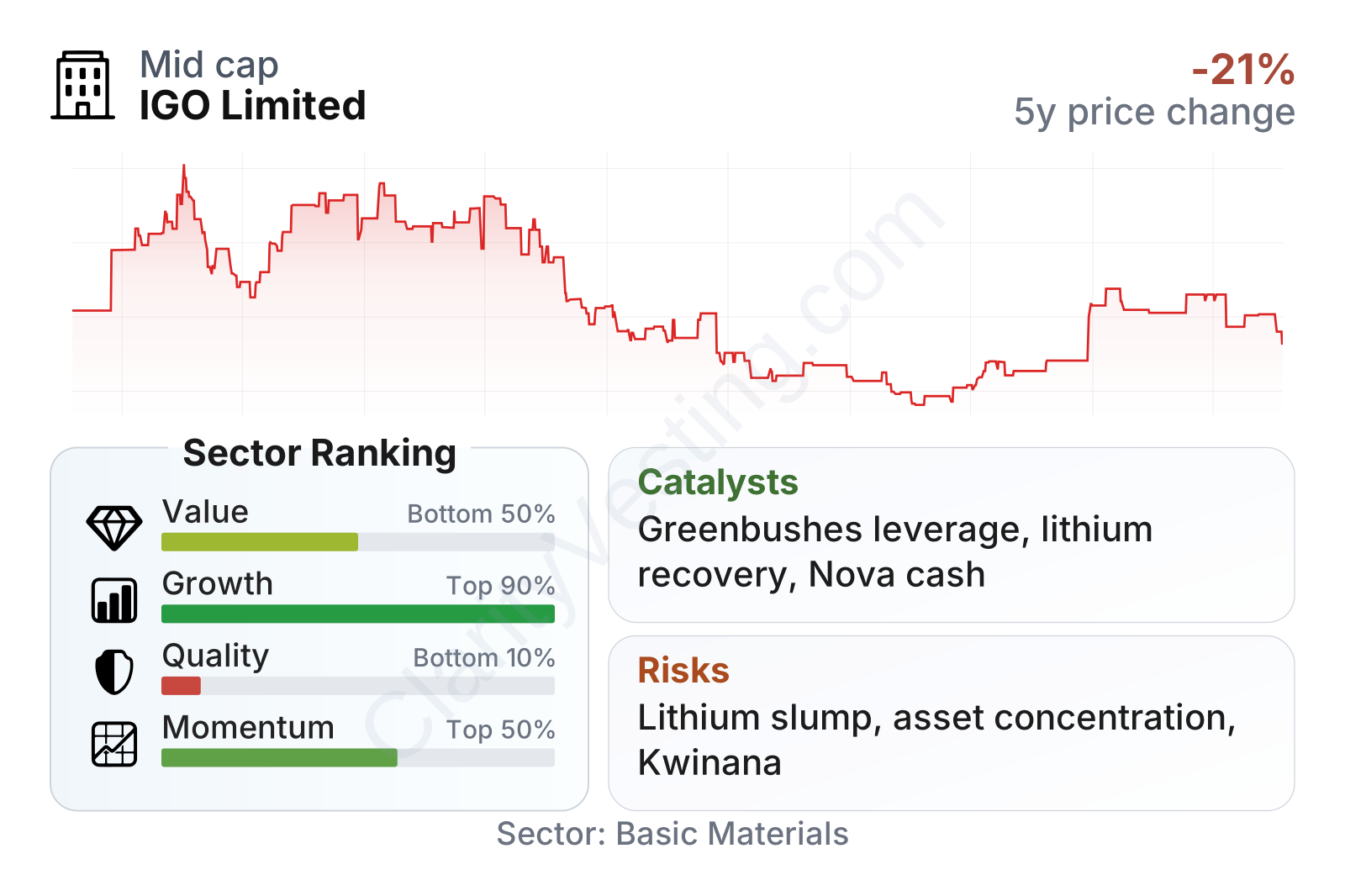
IGO is a mid-sized mining company with a stock that has been very volatile over the last five years. The share price surged during the battery-metals boom, then fell heavily as lithium and nickel prices weakened, before rebounding part of the way in 2026. Even after that rebound, the longer-term price record still trails much of the sector.
The latest metrics paint a mixed picture. On growth, IGO ranks strongly versus many sector peers, helped by year-over-year revenue improvement and very strong multi-year earnings-per-share expansion from a low base. On quality, however, the picture is weak: recent returns on assets and operating margins are far below sector norms, showing how hard the downturn in battery metals has hit profitability. Balance sheet leverage is not the main problem here; debt is very low and net cash remains a real support. The bigger issue is earnings volatility and the gap between asset value and current operating returns.
On valuation, the stock does not look obviously cheap on earnings-based measures, with the price-to-earnings ratio above the sector median, while cash flow yield and dividend yield are only modest. That combination suggests the market is still assigning meaningful value to a future recovery in lithium-related earnings rather than paying only for current operating strength.
Growth
IGO operates in a sector with clear long-term demand drivers. Lithium is essential for most current electric vehicle batteries, while nickel and copper remain important for electrification and power infrastructure. Even though commodity markets are cyclical and can be oversupplied for extended periods, the long-range direction of transport electrification, stationary storage, and grid investment still supports the relevance of the metals IGO produces or helps process.
The company’s strategy also makes industrial sense. Instead of trying to become a giant diversified miner, IGO has concentrated on a smaller number of battery-material assets in stable mining jurisdictions, especially Western Australia. Its most important growth exposure is Greenbushes, which is globally significant because of its scale, grade, and position on the cost curve. If lithium markets tighten again over time, a high-quality asset like that could matter more than broad diversification.
Another point in IGO’s favor is that its portfolio includes not only mining but also downstream processing through Kwinana. That does not guarantee better returns, and refining has had operational and market challenges, but it gives IGO a place in more than one step of the battery supply chain. If the refinery improves utilization and economics, that could become more important than it appears today.
Recent company updates have pointed to a few practical catalysts. Nova has continued to provide operating cash flow, Greenbushes remains a cornerstone lithium asset, and management has emphasized capital discipline and preserving balance sheet strength during the downturn. In a weak market, that matters: companies that can stay financially flexible often emerge in better shape when commodity prices recover. The move from the deep earnings hit seen in 2025 to positive net income in 2026 also suggests conditions have become less stressed, even if operating performance is still far from peak levels.
Risks
This article is for informational purposes only and does not constitute financial advice. Some content is AI-generated. See Disclaimer


