Stock Analysis · Informa PLC (IFJPY)
Overview
Informa PLC is a business-to-business information company best known for organizing trade shows, professional events, specialist publishing, industry data products, and academic research services. Rather than relying mainly on consumer media, it serves professionals, companies, researchers, and institutions that pay for access to audiences, knowledge, data, leads, and specialized content. Its portfolio spans large exhibitions, digital services for academics, and niche market intelligence products.
The business has become increasingly centered on live and hybrid events, especially after the combination with UBM and the post-pandemic recovery in exhibitions. Alongside events, Informa also owns a large academic publishing and knowledge platform business through Taylor & Francis, plus specialist data and market insight operations. This mix matters because it gives the group exposure to both recurring subscription-like revenue and more cyclical event activity.
Based on the company’s recent reporting structure, revenue is mainly generated from the following activities, with approximate shares using the latest full-year mix:
- Informa Markets and related exhibitions businesses: about 55% to 60% — trade shows, conferences, exhibitor services, sponsorships, buyer-seller matching, and other event-related services across industries such as health care, fashion, construction, and technology.
- Taylor & Francis: about 20% to 25% — academic journals, books, open research services, licensing, and institutional subscriptions used by universities, libraries, and researchers.
- Informa Connect: about 10% to 15% — specialist content, training, conferences, and professional learning in areas such as finance, pharma, and maritime.
- Informa TechTarget and other B2B digital/data activities: about 8% to 12% — digital demand generation, technology-focused media, intent data, specialist audience access, and marketing services for enterprise technology vendors.
This revenue mix shows a company built around professional knowledge and industry connections rather than mass advertising. It also helps explain why cash generation can stay strong even when accounting earnings are affected by acquisition-related charges, amortization, and restructuring items.
Over the last several years, revenue has expanded materially, and operating income has recovered strongly from the pandemic period. The broad pattern is positive, but the path from operating profit to net income has been uneven because interest costs, taxes, and non-operating items have had a meaningful effect on final earnings.
Key Figures
| Metric | Value | Sector ⓘ |
|---|---|---|
| Date | Oct 31, 2026 | |
| Context | ||
| Sector | Communication Services | |
| Industry | Publishing | |
| Market Cap ⓘ | $15.12B | |
| Beta ⓘ | 0.71 | |
Value (Cheapness) | ||
| P/E Ratio ⓘ | 48.39 | 18.47 |
| FCF Yield ⓘ | 9.83% | 14.23% |
| Dividend Yield ⓘ | 2.70% | 2.78% |
| EBIT / EV ⓘ | N/A | 4.73% |
| PEG ⓘ | 0.11 | |
Growth (Business expansion) | ||
| Revenue Growth ⓘ | 1.40% | 6.10% |
| RPS Growth (5Y CAGR) ⓘ | 30.25% | 4.57% |
| EPS Growth (5Y CAGR) ⓘ | -42.27% | -17.96% |
| Margin Growth (5Y Trend) ⓘ | 16.30% | 1.32% |
| FCF Growth (5Y CAGR) ⓘ | 17.96% | 5.75% |
| DPS Growth (5Y CAGR) ⓘ | 62.55% | 5.19% |
Quality (Business durability) | ||
| ROIC (Latest) ⓘ | N/A | 9.19% |
| ROIC (5Y Median) ⓘ | 5.00% | 8.24% |
| Net Debt / EBIT (Latest) ⓘ | 3.03 | 1.92 |
| Net Debt / EBIT (5Y Median) ⓘ | 4.05 | 2.88 |
| Net Debt / EBITDA (Latest) ⓘ | 1.74 | 1.22 |
| Net Debt / Assets ⓘ | 22.88% | 18.63% |
| EBITDA / Interest ⓘ | N/A | 8.36 |
| Operating Margin (Latest) ⓘ | 18.11% | 15.68% |
| Operating Margin (5Y Median) ⓘ | 14.04% | 13.39% |
| Debt to Equity (Latest) ⓘ | 64.99% | 59.65% |
| Profit Margin (Latest) ⓘ | 5.43% | 8.74% |
| Free Cash Flow (Latest) ⓘ | $1.49B | |
Momentum (Price trend) | ||
| 3Y Return ⓘ | +44.00% | +46.16% |
| 12M Return (excl. last month) ⓘ | -0.15% | +1.26% |
| 6M Return ⓘ | +7.45% | 0.00% |
| Price vs. 200-Day MA ⓘ | +1.16% | +0.87% |
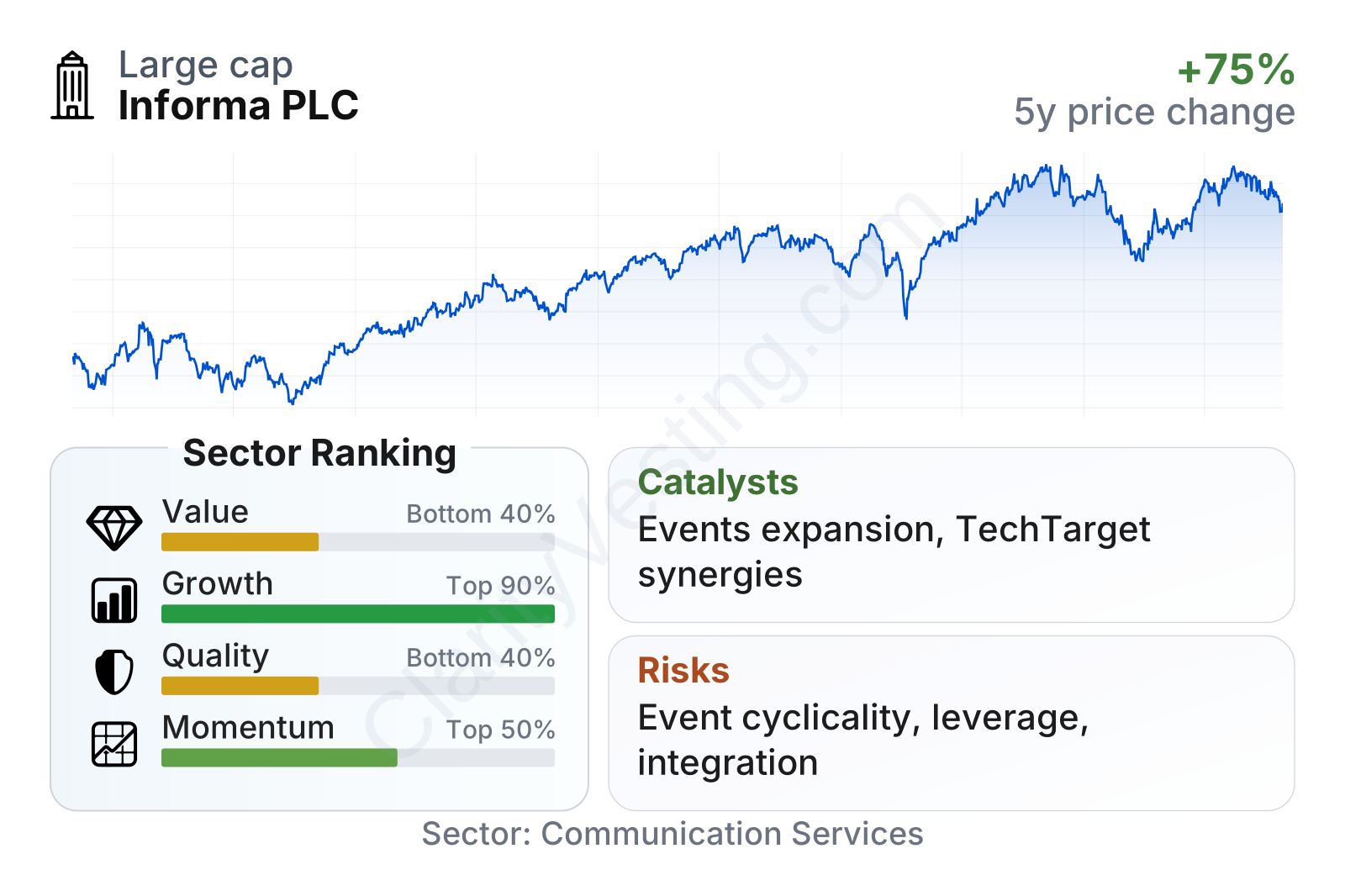
Informa is a large-cap communications and publishing company with relatively low share-price volatility, as reflected by a beta below 1. The factor picture is mixed. Growth characteristics stand out versus much of the sector, helped by strong multi-year revenue per share and free cash flow expansion, as well as a clear improvement in operating margins. Momentum has also been solid in recent months. On the other hand, value metrics look less favorable, with a high earnings multiple, a free cash flow yield below the sector median, and a dividend yield that is slightly lighter than many peers. Quality metrics are also somewhat mixed because margins are healthy, but leverage and returns on invested capital do not rank as strongly.
Growth
Informa operates in segments that still have room for long-term expansion, though not all for the same reason. The exhibitions business benefits from the enduring value of face-to-face commercial gatherings in industries where customers want lead generation, product launches, and relationship building. Academic publishing and research services benefit from structural demand for scholarly content, research workflows, and institutional access. Meanwhile, B2B digital marketing and data services are tied to the ongoing shift toward more measurable, targeted customer acquisition.
The company’s strategy broadly makes sense for future growth because it combines resilient knowledge assets with event platforms that can be scaled globally. Management has been focusing on building stronger brands in exhibitions, using data and digital tools to improve customer monetization, and expanding in markets where industry trade events remain important. The combination of physical events and digital audience intelligence can be especially attractive because exhibitors increasingly want year-round access to customers rather than a single annual event.
A notable catalyst is the company’s increased exposure to technology-focused demand generation after the integration of TechTarget-related assets. That can deepen Informa’s role in B2B marketing budgets and create more recurring digital revenue alongside exhibitions and publishing. Another growth support is the continued normalization and international expansion of events, particularly in regions and sectors where attendance, sponsorship, and premium services can still improve.
Recent corporate updates have also highlighted continued portfolio simplification and active capital allocation, including targeted acquisitions and business combinations designed to strengthen core verticals rather than spread the company into unrelated activities. That is generally a constructive sign for long-term business development.
Short-term year-over-year revenue growth appears modest relative to the sector median, but the longer-term picture is much stronger. That difference suggests the company is now growing from a much larger and more normalized base after a period of recovery and portfolio reshaping, rather than going through a weak structural phase.
Risks
This article is for informational purposes only and does not constitute financial advice. Some content is AI-generated. See Disclaimer


