Stock Analysis · IDEX Corporation (IEX)
Overview
IDEX Corporation is a diversified industrial company that designs and manufactures highly engineered products used in fluid handling, health and science applications, fire and rescue equipment, and precision technologies. In simple terms, it sells specialized components and systems that are often critical to how customers operate, even if those parts represent a small share of the customer’s total spending. That is important because products that are hard to replace and tied into customer workflows can support steady demand, recurring aftermarket sales, and solid pricing power.
The business is organized into three main segments, and the revenue mix is fairly balanced rather than dependent on a single end market. Based on the latest annual reporting, the approximate revenue breakdown is:
- Health & Science Technologies: about 37% of revenue. This includes precision fluidics, medical and laboratory components, water-related applications, and specialized technologies used in life sciences and analytical settings.
- Fluid & Metering Technologies: about 35% of revenue. This segment includes pumps, valves, meters, flow monitors, and other systems used in industrial, chemical, food, and energy-related applications.
- Fire & Safety / Diversified Products: about 28% of revenue. This includes firefighting equipment, rescue tools, and other specialized industrial products serving municipal, commercial, and niche industrial customers.
IDEX also has meaningful geographic diversification, with a substantial share of sales outside the United States, which helps reduce reliance on any single economy but also adds currency and regional demand exposure. The broader business model is built around engineered niche products, a decentralized operating structure, and bolt-on acquisitions that expand product lines and end markets.
Over the last several years, revenue has grown from roughly $2.8 billion to about $3.5 billion, while operating income and net income have remained solid even through periods of uneven industrial demand. Gross profit has stayed large relative to revenue, showing that the company operates in higher-value categories rather than commodity manufacturing.
The long-term pattern shows a business that converts a healthy portion of revenue into profit, although costs and overhead have risen over time and net income has softened from its earlier peak. Even so, the underlying economics still look stronger than those of many industrial peers.
Key Figures
| Metric | Value | Sector ⓘ |
|---|---|---|
| Date | Oct 24, 2026 | |
| Context | ||
| Sector | Industrials | |
| Industry | Specialty Industrial Machinery | |
| Market Cap ⓘ | $17.19B | |
| Beta ⓘ | 0.96 | |
Value (Cheapness) | ||
| P/E Ratio ⓘ | 33.55 | 22.29 |
| P/B Ratio ⓘ | 4.36 | 1.98 |
| FCF Yield ⓘ | 3.73% | 6.26% |
| Dividend Yield ⓘ | 1.23% | 1.92% |
| EBIT / EV ⓘ | 4.16% | 4.83% |
| PEG ⓘ | 1.72 | |
Growth (Business expansion) | ||
| Revenue Growth ⓘ | 6.40% | 9.30% |
| RPS Growth (5Y CAGR) ⓘ | 6.13% | 7.76% |
| EPS Growth (5Y CAGR) ⓘ | -15.52% | -13.17% |
| BVPS Growth (5Y CAGR) ⓘ | 9.89% | 6.13% |
| Margin Growth (5Y Trend) ⓘ | -2.18% | 0.74% |
| FCF Growth (5Y CAGR) ⓘ | 5.78% | 10.79% |
| DPS Growth (5Y CAGR) ⓘ | 7.57% | 9.41% |
Quality (Business durability) | ||
| ROIC (Latest) ⓘ | 9.65% | 10.75% |
| ROA (Latest) ⓘ | 7.47% | 5.41% |
| ROIC (5Y Median) ⓘ | 12.24% | 9.37% |
| ROA (5Y Median) ⓘ | 9.63% | 4.95% |
| Net Debt / EBIT (Latest) ⓘ | 1.70 | 2.04 |
| Net Debt / EBIT (5Y Median) ⓘ | 1.46 | 2.27 |
| Net Debt / EBITDA (Latest) ⓘ | 1.32 | 1.39 |
| Net Debt / Assets ⓘ | 18.24% | 19.27% |
| EBITDA / Interest ⓘ | 15.01 | 9.58 |
| Operating Margin (Latest) ⓘ | 20.78% | 10.49% |
| Operating Margin (5Y Median) ⓘ | 22.33% | 10.30% |
| Debt to Equity (Latest) ⓘ | 47.04% | 64.82% |
| Profit Margin (Latest) ⓘ | 14.49% | 6.67% |
| Free Cash Flow (Latest) ⓘ | $641.50M | |
Momentum (Price trend) | ||
| 3Y Return ⓘ | +27.34% | +67.77% |
| 12M Return (excl. last month) ⓘ | +40.25% | +12.05% |
| 6M Return ⓘ | +16.12% | 0.00% |
| Price vs. 200-Day MA ⓘ | +10.45% | +0.67% |
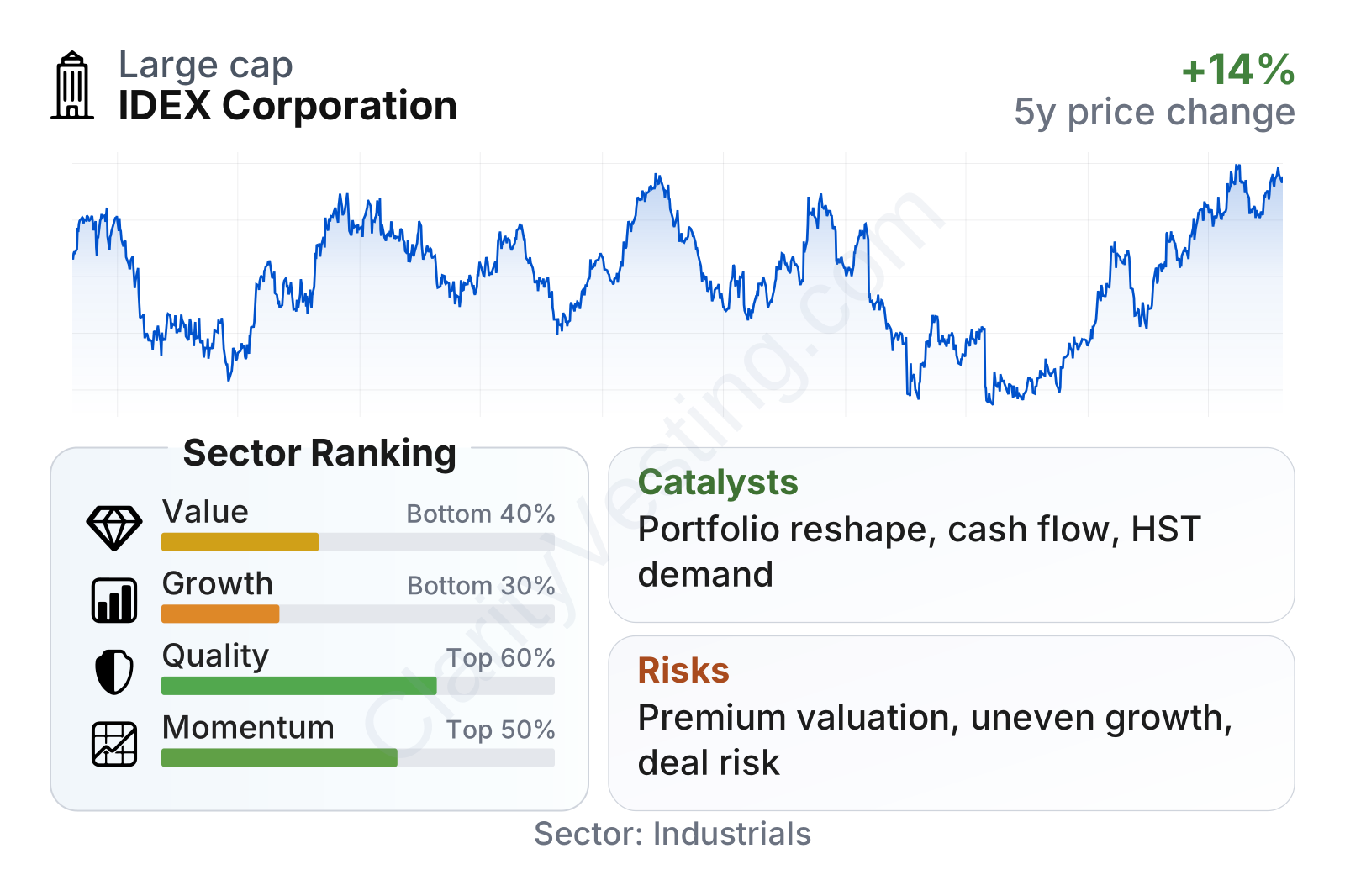
IDEX is a large industrial company with stock-price volatility close to the broader market rather than unusually high swings. The table suggests a mixed profile: profitability and balance-sheet quality remain relatively strong, while valuation looks richer than the sector and growth trends have been more modest. Recent share-price momentum has improved, but the longer three-year stock return has lagged many industrial peers, which helps explain why the market is watching for a clearer acceleration in operating performance.
Growth
IDEX operates in areas that have durable long-term demand drivers, even if growth is not likely to be smooth every year. Exposure to life sciences tools, medical technologies, water-related applications, industrial automation, precision fluid handling, and safety equipment places the company in markets supported by regulation, infrastructure needs, and the continuing need for higher accuracy and efficiency in industrial processes. These are not purely cyclical commodity businesses.
The company’s strategy also makes sense for long-term expansion. Management has historically focused on niche categories where technical know-how, switching costs, and aftermarket demand matter more than scale alone. That approach can support resilient margins and allows acquisitions to be integrated into existing platforms. IDEX has used bolt-on deals for years to deepen exposure to attractive verticals rather than pursuing broad, low-synergy diversification.
Revenue growth has not been linear. After very strong growth in 2021 and 2022, sales turned negative for part of 2023 and 2024 before returning to positive mid-single-digit to high-single-digit growth more recently. That pattern suggests the company is recovering from a softer industrial period rather than moving through a structural decline. Even so, current revenue growth remains below the sector median, so the market still needs proof that growth can become more consistent.
Cash generation remains one of the more encouraging parts of the picture. Free cash flow has stayed in a strong range over the last several years, dipped during the slower period, and then recovered. That matters because it gives IDEX flexibility to fund acquisitions, invest in product development, reduce debt pressure, and continue its dividend without depending heavily on outside financing.
A recent strategic catalyst is the planned combination of its fire and safety platform with a larger firefighting equipment business, which is intended to create a more focused and scaled public company in that category. If completed as planned, the transaction could simplify IDEX and leave a more concentrated portfolio around higher-margin engineered components and health/science technologies. That kind of portfolio reshaping can become an important driver of how the market values the remaining business.
Risks
This article is for informational purposes only and does not constitute financial advice. Some content is AI-generated. See Disclaimer