Stock Analysis · IDACORP Inc (IDA)
Overview
IDACORP is the parent company of Idaho Power, a regulated electric utility serving most of southern Idaho and parts of eastern Oregon. In simple terms, it generates, buys, transmits, and distributes electricity to homes, businesses, farms, and industrial customers. Because this is a regulated utility, a large part of its earnings power depends on the customer base in its service territory, the amount it is allowed to invest in infrastructure, and the returns authorized by state regulators.
The business is much more concentrated than many diversified utilities. Nearly all revenue and profit come from Idaho Power, while smaller non-utility activities play only a limited role. Based on recent annual reporting, the revenue mix is approximately as follows:
- Electric utility operations: about 98% to 99% of total revenue. This includes retail electricity sales to residential, commercial, industrial, and irrigation customers, plus transmission and other regulated electric services.
- Off-system sales and wholesale power transactions: about 1% to 2% of total revenue, although this can move meaningfully from year to year depending on power prices, water conditions, and market opportunities.
- Other operations: less than 1% of total revenue, mainly small non-regulated or miscellaneous activities.
Within the utility business, residential and commercial customers are the largest ongoing demand base, while irrigation and industrial demand can create seasonal swings. Idaho Power also has an important hydroelectric fleet, which helps keep fuel costs lower than many peers when water conditions are favorable. That is a notable feature because fuel and purchased power costs can be volatile across the utility sector.
Over the last several years, revenue has generally risen, and operating income has expanded faster than sales. That suggests rate growth and operating discipline have supported profitability, even as interest expense has also moved higher.
The broad pattern shows a steady increase in revenue from 2021 through 2025, with operating income and net income also improving. One pressure point stands out: financing costs have risen materially, which matters for a capital-intensive utility that must keep investing in generation, grids, and customer growth.
Key Figures
| Metric | Value | Sector ⓘ |
|---|---|---|
| Date | Oct 17, 2026 | |
| Context | ||
| Sector | Utilities | |
| Industry | Utilities - Regulated Electric | |
| Market Cap ⓘ | $7.93B | |
| Beta ⓘ | 0.48 | |
Value (Cheapness) | ||
| P/E Ratio ⓘ | 22.72 | 17.28 |
| P/B Ratio ⓘ | 2.08 | 1.51 |
| FCF Yield ⓘ | -13.95% | 0.65% |
| Dividend Yield ⓘ | 2.57% | 3.77% |
| EBIT / EV ⓘ | 4.80% | 5.01% |
| PEG ⓘ | 1.81 | |
Growth (Business expansion) | ||
| Revenue Growth ⓘ | 4.20% | 6.10% |
| RPS Growth (5Y CAGR) ⓘ | 3.53% | 3.87% |
| EPS Growth (5Y CAGR) ⓘ | -13.25% | -11.30% |
| BVPS Growth (5Y CAGR) ⓘ | 5.41% | 4.23% |
| Margin Growth (5Y Trend) ⓘ | 1.06% | 3.57% |
| FCF Growth (5Y CAGR) ⓘ | N/A | -8.84% |
| DPS Growth (5Y CAGR) ⓘ | 4.49% | 4.84% |
Quality (Business durability) | ||
| ROIC (Latest) ⓘ | 7.22% | 6.53% |
| ROA (Latest) ⓘ | 3.23% | 3.20% |
| ROIC (5Y Median) ⓘ | 6.96% | 5.95% |
| ROA (5Y Median) ⓘ | 3.32% | 2.75% |
| Net Debt / EBIT (Latest) ⓘ | 7.13 | 7.13 |
| Net Debt / EBIT (5Y Median) ⓘ | 6.14 | 7.23 |
| Net Debt / EBITDA (Latest) ⓘ | 4.77 | 4.31 |
| Net Debt / Assets ⓘ | 36.11% | 38.42% |
| EBITDA / Interest ⓘ | 4.30 | 4.58 |
| Operating Margin (Latest) ⓘ | 30.55% | 20.83% |
| Operating Margin (5Y Median) ⓘ | 24.14% | 20.08% |
| Debt to Equity (Latest) ⓘ | 106.18% | 137.69% |
| Profit Margin (Latest) ⓘ | 18.78% | 11.37% |
| Free Cash Flow (Latest) ⓘ | -$1.11B | |
Momentum (Price trend) | ||
| 3Y Return ⓘ | +54.71% | +52.37% |
| 12M Return (excl. last month) ⓘ | +9.61% | +8.84% |
| 6M Return ⓘ | -4.56% | -3.95% |
| Price vs. 200-Day MA ⓘ | -1.48% | -0.79% |
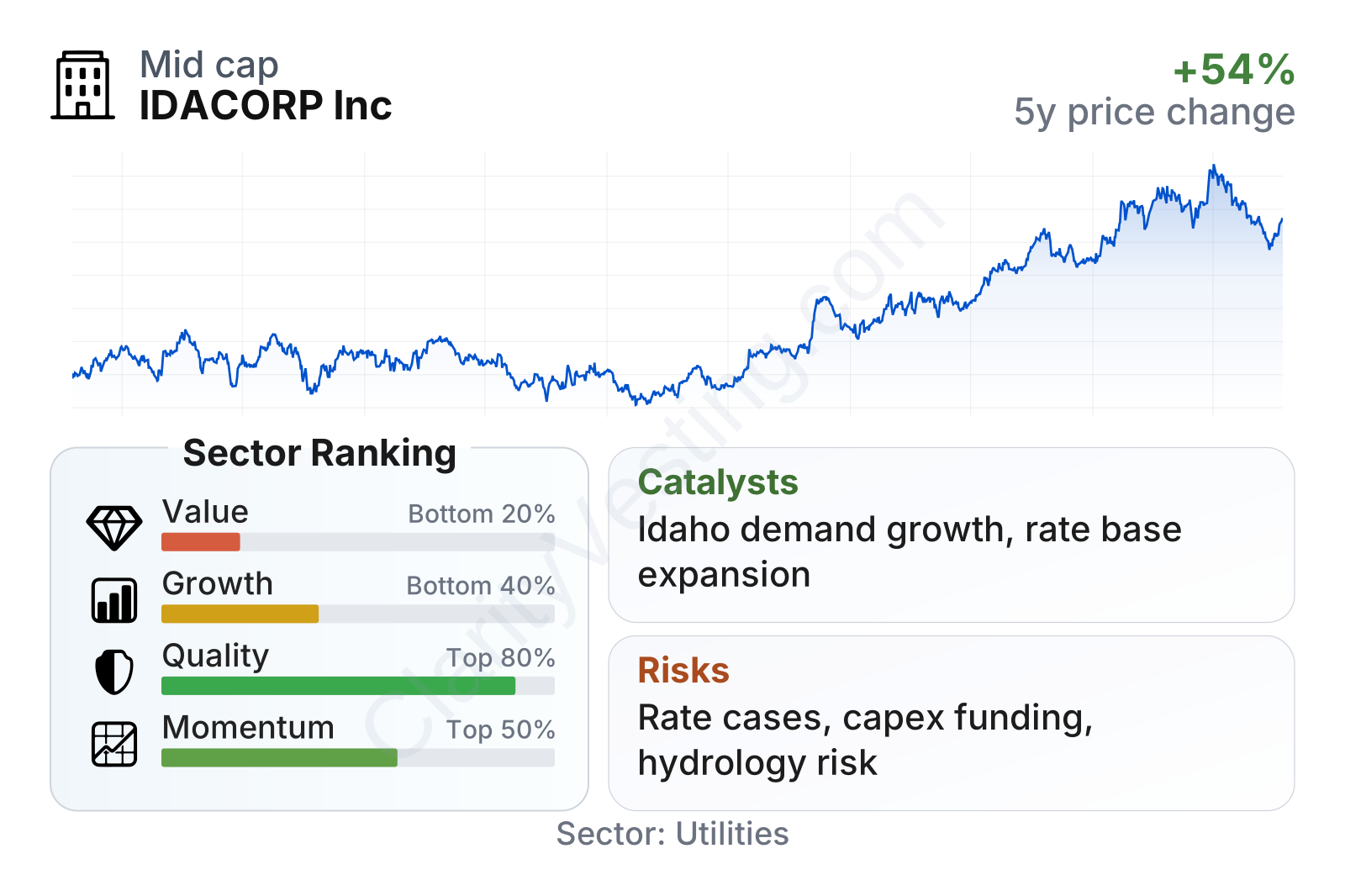
IDACORP is a mid-sized regulated electric utility with unusually low share-price volatility for a public stock, reflected in a beta well below 1. On profitability and capital efficiency, it stands above the sector median, especially on operating margin, profit margin, and returns on capital. The weaker areas are valuation and free cash flow: the stock trades above typical sector multiples, while free cash flow is deeply negative because capital spending is running well ahead of internally generated cash. Growth measures are mixed rather than strong, with modest revenue expansion but softer earnings-per-share trends compared with many peers.
Growth
The regulated electric utility sector is not a high-growth industry in the usual sense, but it can produce steady expansion when population, business activity, and infrastructure investment all move in the same direction. IDACORP operates in one of the more attractive utility territories in the country because Idaho has benefited from population inflows, business formation, and power demand growth. For a utility, that kind of customer growth matters because it can support higher rate base investment over time.
The company’s strategy is aligned with that backdrop. It continues to invest in transmission, distribution, generation resources, and grid reliability to serve a growing customer base. In a regulated model, these investments are important because they can eventually be reflected in customer rates, subject to approval by regulators. That does not create rapid growth, but it can create visible and durable earnings expansion when execution and regulation remain supportive.
Revenue per share climbed meaningfully from 2021 through 2023, then flattened and eased in 2024 and 2025. That pattern suggests the company has been growing, but not in a straight line. Part of the moderation likely reflects weather, usage patterns, and the normal variability that affects utilities from year to year. It points to a business with a solid base, though not one currently delivering standout top-line acceleration.
A major long-term catalyst is electricity demand from regional growth and system investment. Idaho Power has also been advancing plans around new generation and storage resources to maintain reliability as demand rises and the resource mix changes. For utilities, these projects matter because they expand the asset base on which regulated returns can be earned if approved.
Another supporting factor is the company’s hydro-heavy generation mix. Hydroelectric resources can be a structural advantage over time because they can lower fuel exposure and emissions intensity versus peers that depend more heavily on fossil generation. That does not eliminate volatility, since water conditions vary, but it can strengthen the utility’s long-run cost position.
Recent company communications have also emphasized continued customer growth and ongoing capital investment needs. That combination is generally constructive for future earnings visibility. The tradeoff is that heavy spending consumes cash now in exchange for expected regulated returns later.
That tradeoff is visible in cash generation. Free cash flow has moved sharply deeper into negative territory, which is common during periods of elevated utility construction. For a regulated utility, negative free cash flow is not automatically a sign of operational weakness, but it does mean future growth relies heavily on continued access to debt and equity-friendly financing conditions.
Risks
This article is for informational purposes only and does not constitute financial advice. Some content is AI-generated. See Disclaimer


