Stock Analysis · ICU Medical Inc (ICUI)
Overview
ICU Medical is a healthcare equipment company focused on products used to deliver fluids, medications, and blood-related therapies in hospitals and other care settings. In simple terms, it makes many of the devices and disposables that help clinicians infuse drugs, connect IV lines, manage vascular access, and run certain critical care procedures safely. The company expanded its scale significantly through the acquisition of Smiths Medical in 2022, which made it a broader player in infusion therapy and hospital consumables.
Its business is generally organized around infusion systems, consumable products used with those systems, and critical care products. Based on the company’s recent annual reporting structure and product mix, revenue is spread across a few large categories rather than one single product line.
- Consumables: approximately 45% to 50% of revenue. This includes IV sets, connectors, needlefree valves, and other single-use products that need regular replacement. This is an important category because recurring demand tends to be steadier than large equipment purchases.
- Infusion Systems: approximately 30% to 35% of revenue. This includes infusion pumps and related hardware/software used to deliver medications and fluids with controlled dosing.
- Vital Care: approximately 20% to 25% of revenue. This includes critical care, vascular access, and oncology-related products, including some port, catheter, and monitoring-related lines.
Geographically, the company generates most of its sales in the United States, with a meaningful international presence across Europe, Asia-Pacific, and other markets. The business model mixes capital equipment with recurring disposables, which is attractive when hospitals keep using installed systems over long periods.
The multi-year financial flow also shows a company that became much larger after the Smiths Medical deal, with revenue rising from about $1.3 billion in 2021 to above $2.2 billion afterward. The main issue is that the added scale did not translate smoothly into profits because interest expense, operating costs, and integration pressure weighed heavily on earnings for several years, even as gross profit improved.
Key Figures
| Metric | Value | Sector ⓘ |
|---|---|---|
| Date | Oct 03, 2026 | |
| Context | ||
| Sector | Healthcare | |
| Industry | Medical Instruments & Supplies | |
| Market Cap ⓘ | $4.01B | |
| Beta ⓘ | 0.76 | |
Value (Cheapness) | ||
| P/E Ratio ⓘ | 134.88 | 24.06 |
| P/B Ratio ⓘ | 1.83 | 3.08 |
| FCF Yield ⓘ | 3.81% | 3.07% |
| Dividend Yield ⓘ | N/A | 2.05% |
| EBIT / EV ⓘ | 0.86% | 0.63% |
| PEG ⓘ | 0.08 | |
Growth (Business expansion) | ||
| Revenue Growth ⓘ | 0.50% | 7.50% |
| RPS Growth (5Y CAGR) ⓘ | 10.33% | 8.70% |
| EPS Growth (5Y CAGR) ⓘ | -12.41% | -18.20% |
| BVPS Growth (5Y CAGR) ⓘ | 3.54% | 3.95% |
| Margin Growth (5Y Trend) ⓘ | -4.57% | -0.58% |
| FCF Growth (5Y CAGR) ⓘ | -16.22% | 0.88% |
| DPS Growth (5Y CAGR) ⓘ | N/A | 6.80% |
Quality (Business durability) | ||
| ROIC (Latest) ⓘ | 0.88% | 3.29% |
| ROA (Latest) ⓘ | 0.75% | 3.02% |
| ROIC (5Y Median) ⓘ | 0.72% | 4.75% |
| ROA (5Y Median) ⓘ | -0.67% | 1.93% |
| Net Debt / EBIT (Latest) ⓘ | 22.73 | 1.33 |
| Net Debt / EBIT (5Y Median) ⓘ | 21.44 | 1.83 |
| Net Debt / EBITDA (Latest) ⓘ | 3.27 | 0.99 |
| Net Debt / Assets ⓘ | 24.51% | 5.33% |
| EBITDA / Interest ⓘ | 3.59 | 9.63 |
| Operating Margin (Latest) ⓘ | 1.98% | 9.25% |
| Operating Margin (5Y Median) ⓘ | 1.70% | 7.80% |
| Debt to Equity (Latest) ⓘ | 59.09% | 28.99% |
| Profit Margin (Latest) ⓘ | 1.39% | 3.60% |
| Free Cash Flow (Latest) ⓘ | $152.83M | |
Momentum (Price trend) | ||
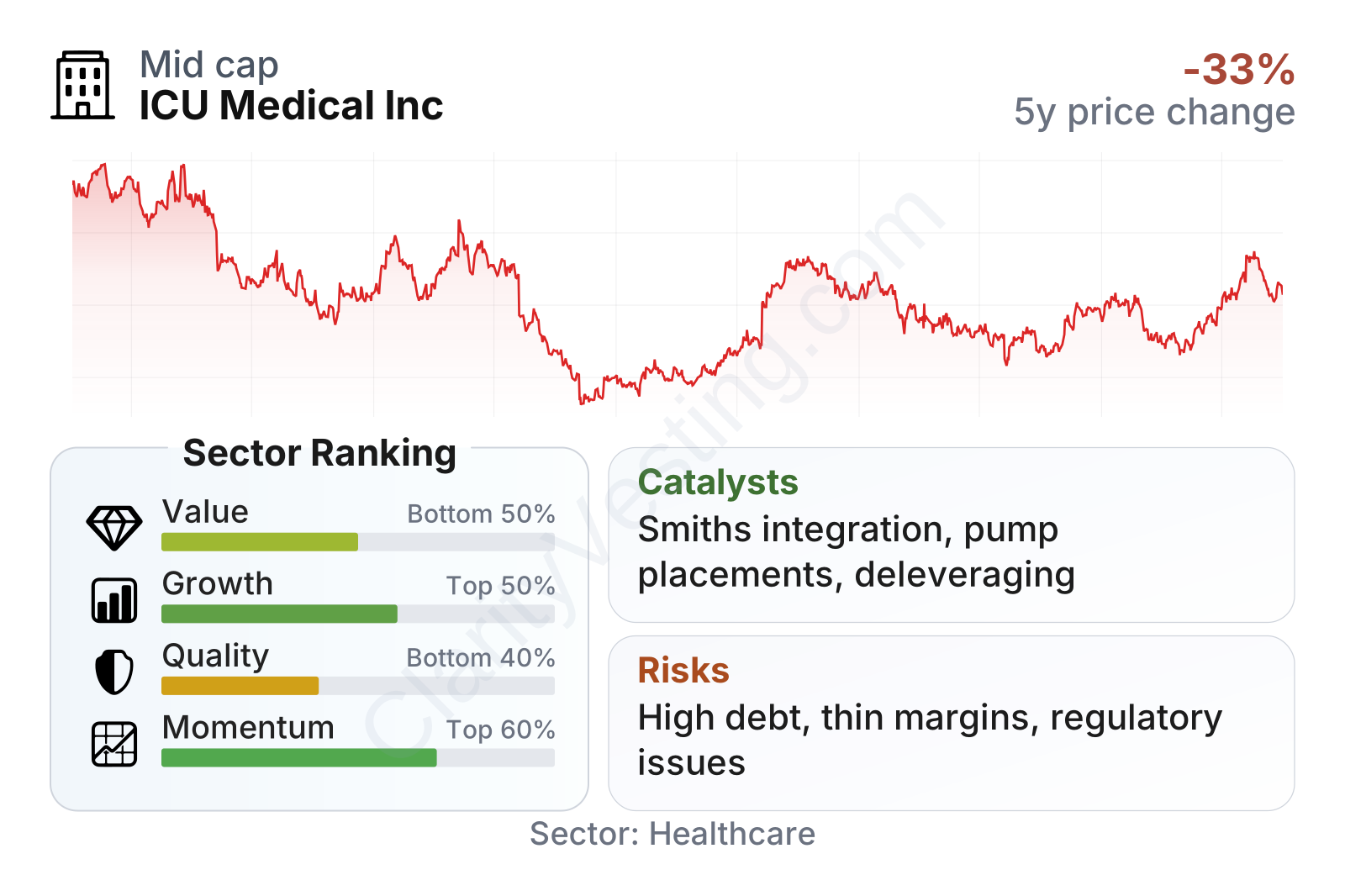
| 3Y Return ⓘ | +33.00% | +37.48% |
| 12M Return (excl. last month) ⓘ | +33.80% | +20.85% |
| 6M Return ⓘ | +25.52% | +9.73% |
| Price vs. 200-Day MA ⓘ | +6.95% | +4.69% |
ICU Medical is now a mid-sized healthcare equipment company with a market value a little above $4 billion and a below-market beta, which suggests the shares have historically moved somewhat less violently than the broader market. The factor profile is mixed: growth and momentum rank around the middle to upper half of the healthcare sector, while quality and valuation multiples look less favorable. The biggest contradiction is that cash generation remains positive, but profitability and returns on capital are still well below sector norms. That combination often points to a business still in the middle of an operating reset rather than one already running at full efficiency.
Growth
ICU Medical operates in a sector with durable long-term demand. Hospitals, clinics, and infusion centers consistently need IV therapy, vascular access, and medication delivery products regardless of the economic cycle. Aging populations, higher surgical volumes, chronic disease management, and the shift toward safer and more automated drug delivery all support the broader market over time.
The company’s strategy also has a logical industrial basis. By combining infusion pumps with the disposables attached to them, ICU Medical can participate in both equipment placements and repeat product usage. That installed-base model can create sticky customer relationships because once a hospital standardizes around a platform, changing systems can be disruptive and costly.
The central growth question is less about end-market demand and more about execution. Revenue growth was exceptionally strong in 2022 because of the acquisition, but recent year-over-year trends have been much weaker and at times negative. More recently, growth has stabilized close to flat, which suggests the company is still working through portfolio normalization and a tougher comparison base rather than entering a clearly accelerating phase.
Cash flow offers a somewhat better signal than reported earnings. Free cash flow turned negative during the more difficult post-acquisition period, then recovered into positive territory. Even though the latest trailing figure is below the prior peak, it still shows that the business can produce meaningful cash while profitability is being rebuilt.
A major catalyst is the integration and restructuring program tied to Smiths Medical. If management succeeds in simplifying manufacturing, purchasing, and commercial operations, margin improvement could matter more than top-line growth in the near term. Another visible opportunity is the company’s focus on infusion safety, connectivity, and consumables attached to its pump platforms. In hospital products, a modest improvement in utilization and cross-selling can have a significant effect because recurring disposables usually carry attractive economics once the installed base is in place.
Recent company communications have also highlighted regulatory and product progress in infusion systems, which matters because pump placements can support follow-on demand for tubing sets and related disposables. For a company like ICU Medical, this type of installed-base expansion is often more strategically important than a single quarter of revenue growth.
Risks
This article is for informational purposes only and does not constitute financial advice. Some content is AI-generated. See Disclaimer