Stock Analysis · International Container Terminal Services Inc (ICTEF)
Overview
International Container Terminal Services Inc. is a global port operator focused on container terminals. In simple terms, it runs key parts of seaports where shipping lines load, unload, and move containers. The company develops, manages, and operates terminals under long-term concession agreements, usually in emerging and trade-linked markets. Its network spans Asia-Pacific, the Americas, Europe, the Middle East, and Africa, which gives it exposure to global trade rather than to a single country.
The business is mainly built around charging shipping lines and cargo owners for the use of port infrastructure and related services. Based on company reporting, revenue is largely concentrated in container handling and other port-related fees, with additional income from ancillary services. A practical breakdown is:
- Cargo handling and related port services: approximately 85% to 90% of revenue. This includes quay-side loading and unloading, yard handling, storage, and vessel-related services.
- Ancillary and non-cargo services: approximately 10% to 15% of revenue. This can include storage, equipment use, reefer services, and other terminal-related charges.
What stands out is not just the top line, but how much of that revenue turns into operating profit. Over the last several years, revenue has climbed from roughly $1.9 billion to more than $3.3 billion, while operating income and net income expanded even faster. That suggests the company has been growing volumes, improving pricing, or both, while keeping costs under control.
The flow of revenue to profit has become noticeably stronger over time. Costs have risen, but much more slowly than revenue, which has allowed margins to expand. Interest expense remains meaningful, reflecting the capital-intensive nature of terminal operations, yet profit growth has still been substantial.
Key Figures
| Metric | Value | Sector ⓘ |
|---|---|---|
| Date | Oct 10, 2026 | |
| Context | ||
| Sector | Industrials | |
| Industry | Marine Shipping | |
| Market Cap ⓘ | $29.98B | |
| Beta ⓘ | 0.73 | |
Value (Cheapness) | ||
| P/E Ratio ⓘ | 26.52 | 22.32 |
| P/B Ratio ⓘ | 24.33 | 1.98 |
| FCF Yield ⓘ | 4.76% | 6.34% |
| Dividend Yield ⓘ | 2.06% | 1.95% |
| EBIT / EV ⓘ | 5.88% | 4.71% |
| PEG ⓘ | 0.95 | |
Growth (Business expansion) | ||
| Revenue Growth ⓘ | 25.40% | 9.25% |
| RPS Growth (5Y CAGR) ⓘ | 16.05% | 7.75% |
| EPS Growth (5Y CAGR) ⓘ | -1.06% | -13.37% |
| BVPS Growth (5Y CAGR) ⓘ | 29.49% | 6.12% |
| Margin Growth (5Y Trend) ⓘ | 7.93% | 0.81% |
| FCF Growth (5Y CAGR) ⓘ | 13.02% | 11.01% |
| DPS Growth (5Y CAGR) ⓘ | 23.60% | 9.48% |
Quality (Business durability) | ||
| ROIC (Latest) ⓘ | N/A | 10.70% |
| ROA (Latest) ⓘ | 12.34% | 5.38% |
| ROIC (5Y Median) ⓘ | 24.60% | 9.26% |
| ROA (5Y Median) ⓘ | 8.60% | 4.94% |
| Net Debt / EBIT (Latest) ⓘ | 2.48 | 2.08 |
| Net Debt / EBIT (5Y Median) ⓘ | 3.75 | 2.29 |
| Net Debt / EBITDA (Latest) ⓘ | 2.09 | 1.43 |
| Net Debt / Assets ⓘ | 47.77% | 19.34% |
| EBITDA / Interest ⓘ | 6.49 | 9.54 |
| Operating Margin (Latest) ⓘ | 53.23% | 10.34% |
| Operating Margin (5Y Median) ⓘ | 49.34% | 10.29% |
| Debt to Equity (Latest) ⓘ | 314.26% | 65.52% |
| Profit Margin (Latest) ⓘ | 31.67% | 6.63% |
| Free Cash Flow (Latest) ⓘ | $1.43B | |
Momentum (Price trend) | ||
| 3Y Return ⓘ | +372.42% | +61.33% |
| 12M Return (excl. last month) ⓘ | +77.03% | +14.82% |
| 6M Return ⓘ | +32.00% | +3.53% |
| Price vs. 200-Day MA ⓘ | +10.89% | +0.88% |
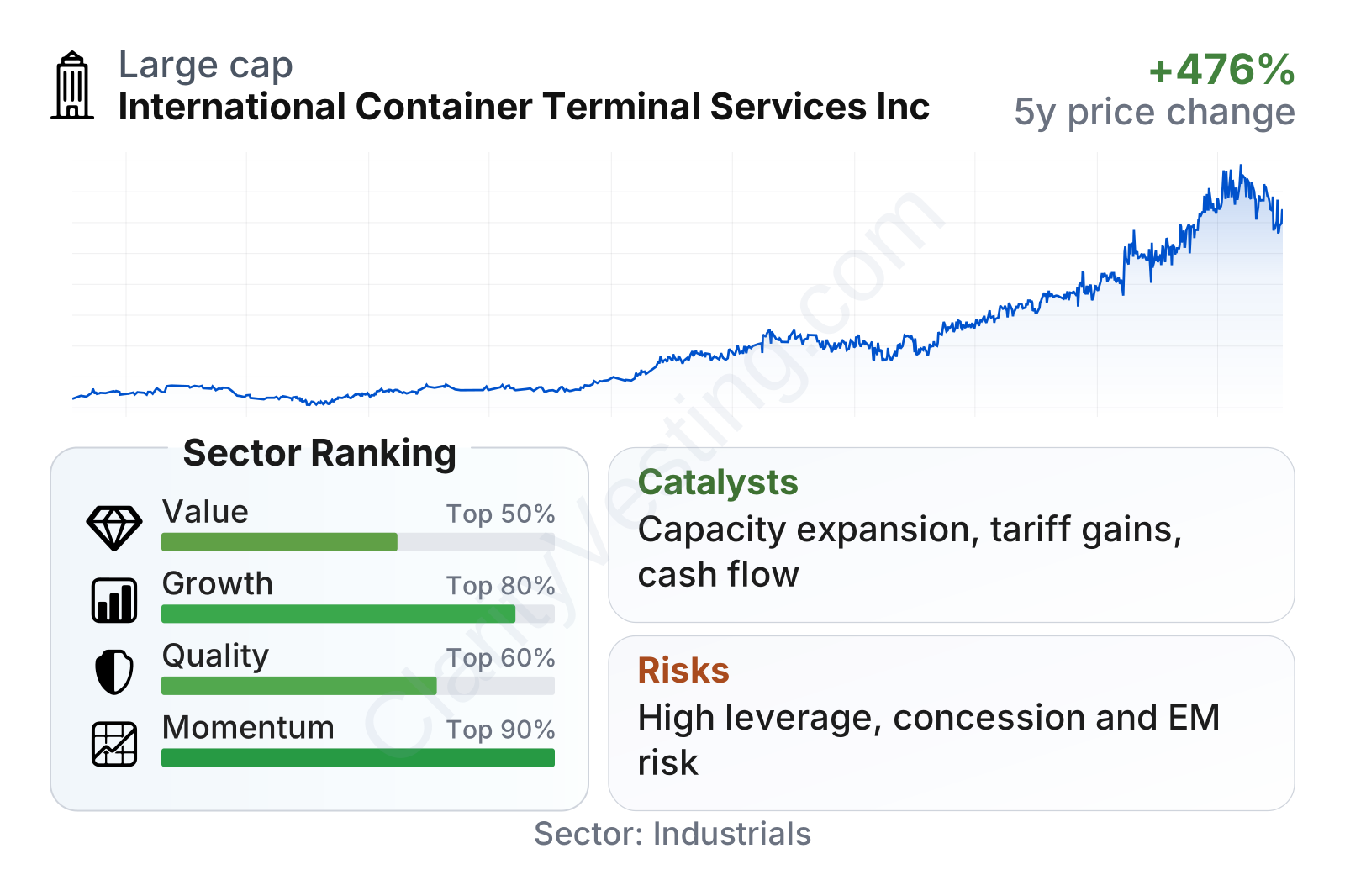
ICTEF ranks well on growth, profitability, and share-price momentum relative to much of the industrial sector. Revenue growth has been clearly ahead of the sector median, margins are unusually high for transport infrastructure, and returns on assets are strong. The main offset is leverage: debt-related measures remain elevated, and the valuation is no longer plainly cheap after the stock’s sharp multiyear rise. The company also has relatively low share-price volatility, with a beta below 1, which fits the steadier nature of infrastructure assets.
Growth
Container terminals are part of a sector that tends to grow with global trade, population growth, urbanization, and the shift of manufacturing and consumption across regions. The long-term backdrop is favorable because containerization remains one of the most efficient ways to move goods internationally, and ports are difficult assets to replicate. Even when trade flows fluctuate from year to year, strategically located terminals can still benefit from rising throughput over longer periods.
ICTSI’s strategy makes sense for future expansion because it focuses on obtaining long-duration concessions, improving underinvested terminals, and expanding capacity where returns justify additional capital. This model can be attractive: once a terminal is established and integrated into shipping networks, the operator can benefit from recurring traffic, limited local competition, and pricing power tied to service quality and congestion management.
Revenue growth has been consistently strong, often staying in the double digits and remaining well above the sector median. That matters because it suggests recent performance was not a one-quarter anomaly. The company has also posted a solid five-year revenue-per-share growth rate, which is more useful than raw revenue alone because it better reflects growth available to each share.
Cash generation has also improved materially. Free cash flow has moved from under $1 billion a few years ago to roughly $1.4 billion on a trailing basis. For a port operator, that is important because expansion projects, concession fees, and equipment upgrades require large capital commitments. Stronger free cash flow gives the company more flexibility to fund growth, reduce debt, and maintain dividends without relying as heavily on external financing.
A major catalyst is continued capacity expansion across its terminal portfolio, especially in faster-growing economies where port infrastructure often needs upgrading. Another is the company’s operating margin trend, which has improved far more than the sector median over five years. That indicates management has not only expanded the network, but also turned growth into higher-quality earnings.
Recent company updates have continued to emphasize volume growth, tariff improvements in certain markets, and ongoing capital expenditure programs to expand capacity. These are significant because terminal operators typically create value over many years, not just through annual cargo growth but through higher utilization of existing assets and the addition of adjacent services.
Risks
This article is for informational purposes only and does not constitute financial advice. Some content is AI-generated. See Disclaimer


