Stock Analysis · ICL Israel Chemicals Ltd (ICL)
Overview
ICL Israel Chemicals Ltd is a global specialty minerals and chemicals company. It produces potash, phosphate products, bromine and bromine-based specialties, food ingredients, and plant nutrition products. In simple terms, the company takes mineral resources and turns them into products used in agriculture, food production, industrial processes, flame retardants, water treatment, and other everyday applications. Its operations are spread across several continents, which gives it exposure to both farming demand and industrial demand.
Its revenue base is diversified across a few main business lines. Based on the company’s recent reporting structure, the largest sources of sales are generally the specialty phosphate and industrial segments, followed by potash, growing solutions, and other activities. A practical breakdown is:
- Industrial products: about 30% to 35% of revenue. This includes bromine and bromine-based specialties used in flame retardants, oil and gas fluids, water treatment, electronics, and other industrial applications.
- Phosphate solutions: about 25% to 30% of revenue. This covers phosphate-based products for food, technical uses, and certain industrial markets.
- Potash: about 20% to 25% of revenue. Potash is a key fertilizer ingredient used to improve crop yields.
- Growing solutions: about 10% to 15% of revenue. This segment includes specialty plant nutrition, fertigation, controlled-release fertilizers, and products aimed at higher-value agriculture.
- Other activities: usually less than 10% of revenue, including commodities, logistics-related items, and smaller business lines.
That mix matters for long-term analysis. ICL is not just a pure fertilizer producer. It has one foot in crop nutrients and another in specialty chemicals and food-related ingredients. That can soften the impact of weak fertilizer pricing in some periods, although it does not eliminate cyclicality.
Over the last few years, the business has clearly come off an exceptional 2022 peak. Revenue surged during the fertilizer and commodity upswing, then normalized as pricing cooled. More recently, sales have started to recover, but earnings remain well below the earlier high point because margins and financing costs are less favorable than they were during the boom.
The flow of revenue to profit shows a business that was extraordinarily strong in 2022, then moved back toward more typical profitability. Revenue has stabilized in the low- to mid-single-digit billions, but net income has compressed much more sharply than sales, which highlights how sensitive results are to pricing, margins, and interest expense.
Key Figures
| Metric | Value | Sector ⓘ |
|---|---|---|
| Date | Oct 24, 2026 | |
| Context | ||
| Sector | Basic Materials | |
| Industry | Agricultural Inputs | |
| Market Cap ⓘ | $6.41B | |
| Beta ⓘ | 1.05 | |
Value (Cheapness) | ||
| P/E Ratio ⓘ | 20.29 | 16.92 |
| P/B Ratio ⓘ | 1.05 | 1.66 |
| FCF Yield ⓘ | 4.54% | 5.83% |
| Dividend Yield ⓘ | 4.22% | 2.07% |
| EBIT / EV ⓘ | 8.56% | 6.38% |
| PEG ⓘ | 9.44 | |
Growth (Business expansion) | ||
| Revenue Growth ⓘ | 16.50% | 11.25% |
| RPS Growth (5Y CAGR) ⓘ | 0.62% | 4.49% |
| EPS Growth (5Y CAGR) ⓘ | -51.73% | -15.24% |
| BVPS Growth (5Y CAGR) ⓘ | 5.95% | 5.49% |
| Margin Growth (5Y Trend) ⓘ | -6.92% | -1.54% |
| FCF Growth (5Y CAGR) ⓘ | -26.85% | 0.37% |
| DPS Growth (5Y CAGR) ⓘ | -5.16% | 5.91% |
Quality (Business durability) | ||
| ROIC (Latest) ⓘ | 6.38% | 9.59% |
| ROA (Latest) ⓘ | 2.40% | 4.92% |
| ROIC (5Y Median) ⓘ | 9.71% | 7.91% |
| ROA (5Y Median) ⓘ | 5.54% | 3.92% |
| Net Debt / EBIT (Latest) ⓘ | 3.42 | 1.36 |
| Net Debt / EBIT (5Y Median) ⓘ | 2.12 | 1.69 |
| Net Debt / EBITDA (Latest) ⓘ | 1.92 | 0.93 |
| Net Debt / Assets ⓘ | 21.24% | 13.69% |
| EBITDA / Interest ⓘ | 4.41 | 12.38 |
| Operating Margin (Latest) ⓘ | 10.61% | 13.24% |
| Operating Margin (5Y Median) ⓘ | 15.05% | 11.82% |
| Debt to Equity (Latest) ⓘ | 53.64% | 40.30% |
| Profit Margin (Latest) ⓘ | 3.96% | 6.38% |
| Free Cash Flow (Latest) ⓘ | $290.95M | |
Momentum (Price trend) | ||
| 3Y Return ⓘ | +6.26% | +73.47% |
| 12M Return (excl. last month) ⓘ | -9.86% | +27.59% |
| 6M Return ⓘ | -6.57% | -4.02% |
| Price vs. 200-Day MA ⓘ | -10.72% | -0.65% |
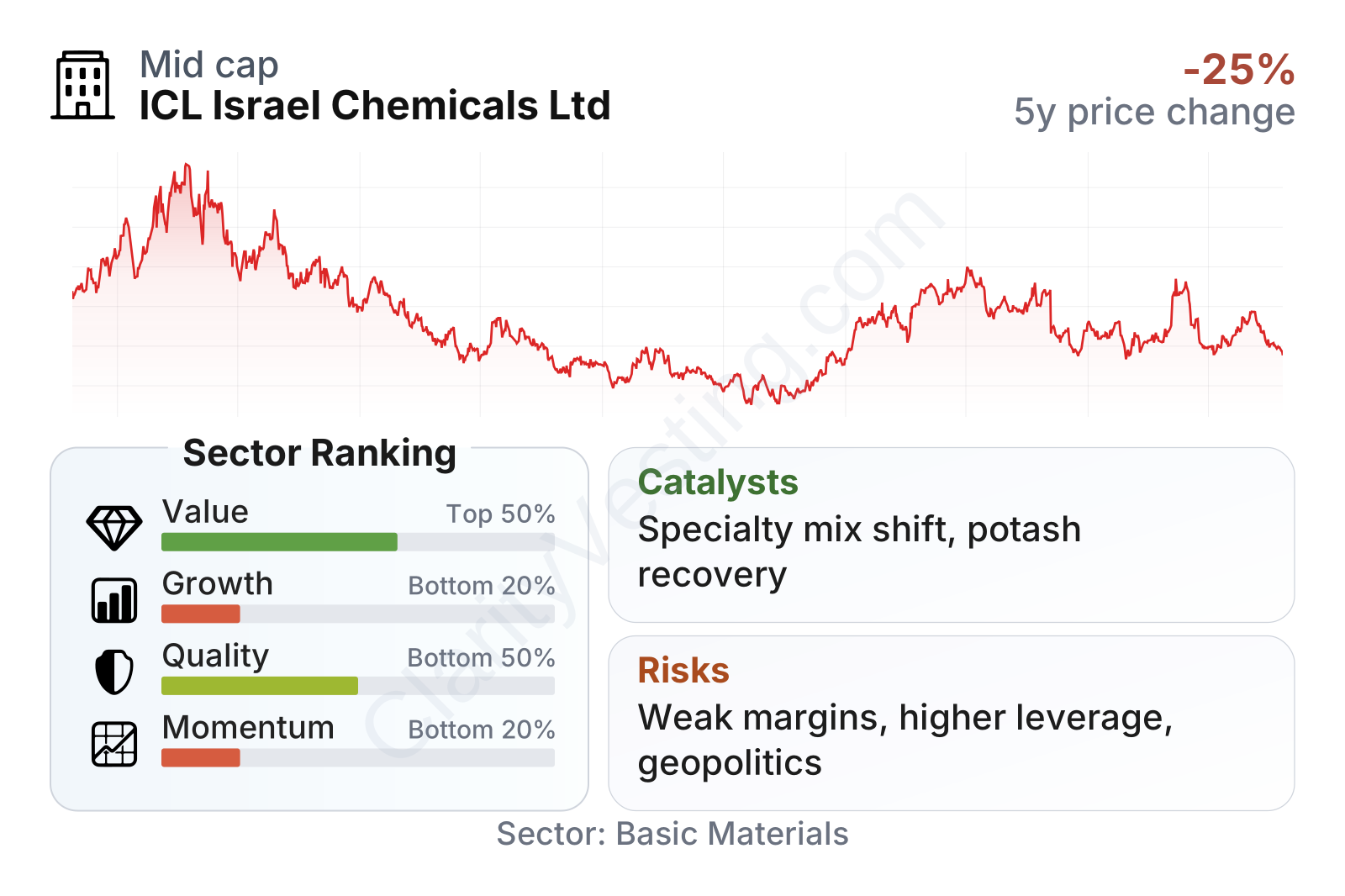
ICL is a mid-sized materials company with a market value in the mid-single-digit billions of dollars and a beta close to 1, which suggests its stock has moved broadly in line with the market. The table points to a mixed profile: valuation is not stretched on asset value and operating earnings measures, but growth, profitability, and share-price momentum rank below much of the sector. The dividend yield stands out as higher than the sector median, yet that income profile sits alongside weaker recent earnings quality and slower multi-year expansion.
The stock history also reflects the business cycle. Shares climbed sharply during the 2022 fertilizer and commodity spike, then gave back much of those gains as prices normalized. The more recent range suggests the market is waiting for clearer evidence that earnings have found a durable floor.
Growth
ICL operates in sectors that should remain relevant for many years. Global agriculture needs fertilizers to support crop yields, while food manufacturers and industrial customers continue to require specialty phosphate and bromine-based products. Those are not temporary markets. The question is less about whether demand exists and more about whether ICL can grow faster than commodity cycles and defend pricing in specialty niches.
The company’s long-term strategy makes sense on paper. Management has been emphasizing specialties over pure commodities, especially in areas like differentiated plant nutrition, food ingredients, and bromine specialties. That direction is important because specialty products can offer steadier margins, closer customer relationships, and less exposure to raw fertilizer price swings. The strategy is also supported by ICL’s resource base and processing know-how, which give it a starting point that newer entrants would struggle to replicate quickly.
Recent revenue growth shows a clear pattern: a powerful upswing in 2021 and 2022, a sharp contraction through 2023 and much of 2024, and then a return to positive year-over-year growth by 2025 and into 2026. The latest reading is ahead of the sector median, which is encouraging, but it comes after a weak base. For long-term analysis, the key issue is whether this rebound becomes a sustained trend rather than a short recovery from cyclical lows.
Cash generation tells a more cautious story. Free cash flow was very strong near the cycle peak and has trended down materially since then, even though it remains positive. Positive free cash flow is important because it supports debt service, dividends, and investment in future projects, but the decline shows that current operations are not converting into cash as comfortably as they did a few years ago.
A meaningful catalyst for future growth is the push toward higher-value specialty fertilizers and phosphate products. If ICL continues shifting its mix away from lower-margin commodity exposure and toward products tied to precision agriculture, food ingredients, and industrial specialties, the business could become less volatile over time. Another catalyst is any normalization in fertilizer pricing and farm economics, which would help the potash business recover profitability more strongly.
Recent company updates have also pointed to ongoing investment in specialty capacity and efficiency improvements. Those initiatives are not instant game changers, but they matter because ICL’s best long-term path is not simply waiting for the next commodity spike. It is building a larger share of earnings from products where formulation, customer relationships, and technical performance matter more than just raw tonnage.
Risks
This article is for informational purposes only and does not constitute financial advice. Some content is AI-generated. See Disclaimer


