Stock Analysis · Intermediate Capital Group PLC (ICGUF)
Overview
Intermediate Capital Group PLC, usually called ICG, is a global alternative asset manager. In simple terms, it manages money for large institutions such as pension funds, insurers, sovereign wealth funds, and wealthy clients, and invests that money in strategies that sit outside traditional public stock and bond funds. Its main focus is private credit, structured capital, private equity secondaries, and real assets. The business earns recurring management fees on assets under management and can also earn performance-related income when funds exceed return targets.
ICG’s business model is built around raising long-duration third-party capital and then deploying it across specialized investment strategies. That matters for long-term analysis because fee-related earnings are usually steadier than pure investment gains, while performance fees and balance-sheet returns can make results swing more from year to year.
Based on the latest annual reporting, ICG’s revenue mix is best understood in broad categories rather than one single product line. The largest sources are:
- Management fees: approximately 55% to 65% of total operating income in a typical year. This is the recurring income earned for managing client capital across private debt, structured capital, real assets, and private equity-related strategies.
- Performance fees and carried interest: approximately 15% to 25%. This is more variable and depends on investment realizations and fund performance.
- Investment income from the firm’s own balance sheet: approximately 20% to 30%. This includes returns from investments that ICG holds directly alongside clients or through its own capital base.
Within the platform, private debt and credit-related strategies are the core engine of the business, while private equity secondaries, structured capital, and real asset strategies broaden the fee base and give ICG more ways to grow assets under management.
The company has expanded revenue substantially over the last several years, and operating profitability has remained very strong. Even with a revenue pullback in the latest year, the overall picture still shows a business with high margins and relatively limited direct operating costs compared with many traditional financial firms.
Key Figures
| Metric | Value | Sector ⓘ |
|---|---|---|
| Date | Oct 17, 2026 | |
| Context | ||
| Sector | Financial Services | |
| Industry | Asset Management | |
| Market Cap ⓘ | $7.35B | |
| Beta ⓘ | 1.44 | |
Value (Cheapness) | ||
| P/E Ratio ⓘ | 11.50 | 12.26 |
| P/B Ratio ⓘ | 2.46 | 1.23 |
| FCF Yield ⓘ | 1.47% | 10.40% |
| Dividend Yield ⓘ | 3.82% | 3.02% |
| EBIT / EV ⓘ | N/A | 8.14% |
| PEG ⓘ | N/A | |
Growth (Business expansion) | ||
| Revenue Growth ⓘ | -21.80% | 9.35% |
| RPS Growth (5Y CAGR) ⓘ | -4.70% | 12.19% |
| EPS Growth (5Y CAGR) ⓘ | 2.36% | -9.53% |
| BVPS Growth (5Y CAGR) ⓘ | 0.87% | 4.99% |
| Margin Growth (5Y Trend) ⓘ | -5.69% | -3.86% |
| FCF Growth (5Y CAGR) ⓘ | N/A | 4.81% |
| DPS Growth (5Y CAGR) ⓘ | 2.54% | 8.79% |
Quality (Business durability) | ||
| ROIC (Latest) ⓘ | N/A | 9.49% |
| ROE (Latest) ⓘ | 37.29% | 13.90% |
| ROA (Latest) ⓘ | 9.78% | 1.55% |
| ROIC (5Y Median) ⓘ | 5.68% | 7.86% |
| ROE (5Y Median) ⓘ | 18.82% | 12.17% |
| ROA (5Y Median) ⓘ | 4.98% | 1.30% |
| Net Debt / EBIT (Latest) ⓘ | 3.74 | 0.96 |
| Net Debt / EBIT (5Y Median) ⓘ | 8.49 | 0.73 |
| Net Debt / EBITDA (Latest) ⓘ | 3.64 | 0.92 |
| Operating Margin (Latest) ⓘ | 72.86% | 22.30% |
| Operating Margin (5Y Median) ⓘ | 57.33% | 24.63% |
| Debt to Equity (Latest) ⓘ | 242.77% | 58.56% |
| Profit Margin (Latest) ⓘ | 48.94% | 26.57% |
| Free Cash Flow (Latest) ⓘ | $108.05M | |
Momentum (Price trend) | ||
| 3Y Return ⓘ | +47.74% | +88.33% |
| 12M Return (excl. last month) ⓘ | -15.93% | +19.38% |
| 6M Return ⓘ | +1.56% | +4.75% |
| Price vs. 200-Day MA ⓘ | +14.57% | +3.50% |
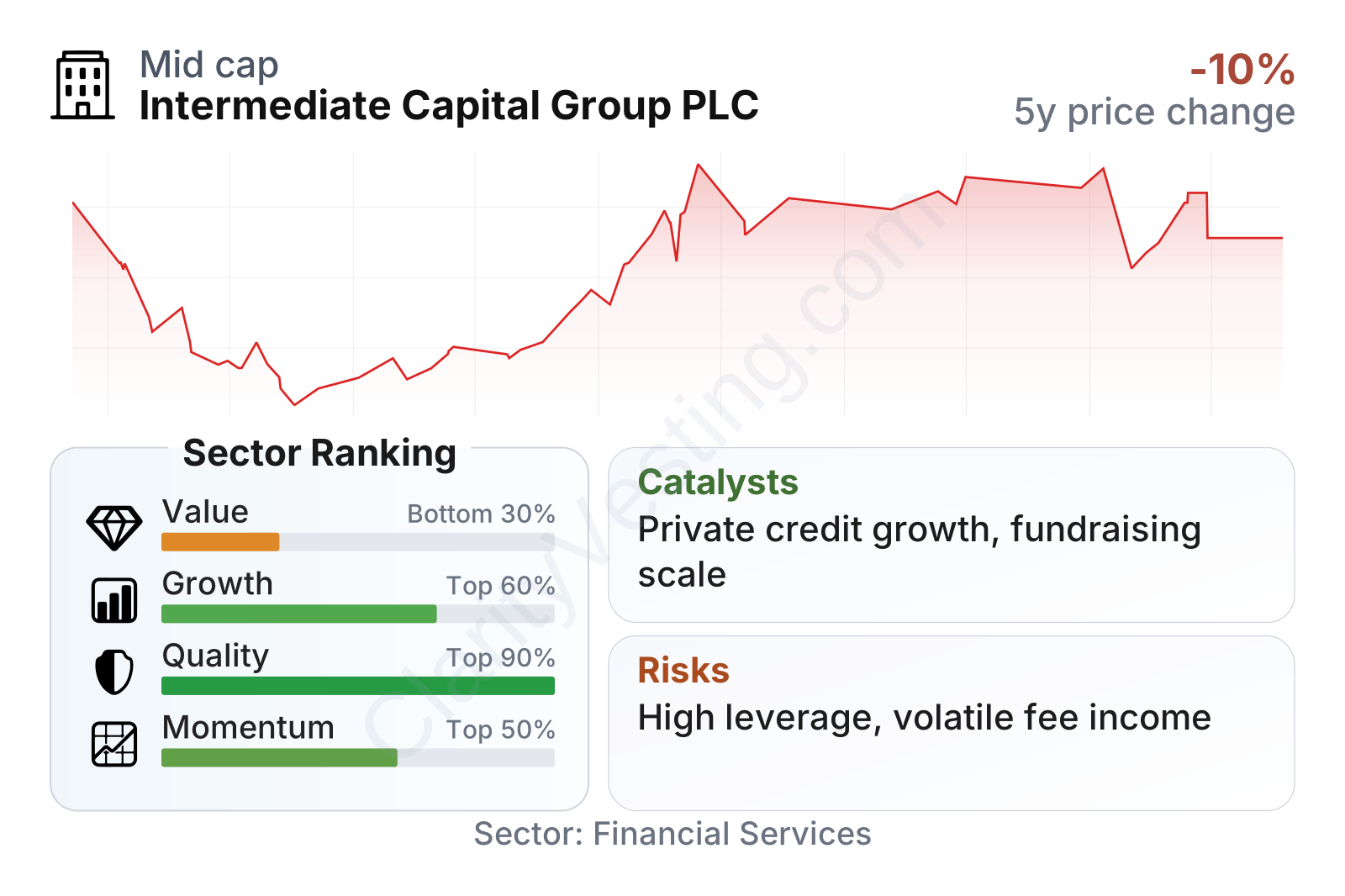
ICG stands out for quality more than for low valuation. Profitability is unusually high for the financial sector, with returns on equity and assets comfortably above sector medians and operating margins far stronger than most peers. Growth metrics are more mixed: earnings and dividends have grown over five years, but recent revenue has been under pressure and book value growth has been modest. On valuation, the earnings multiple is below the sector median, but the price-to-book ratio is well above it, which suggests the market still assigns a premium to the franchise quality. The share price has been choppy over the past year, although it remains above its longer-term trend line.
Growth
ICG operates in alternative asset management, a part of finance that has benefited from a long shift by institutions away from plain public markets and toward private assets. This remains a favorable industry backdrop. Pension funds, insurers, and other large allocators continue looking for yield, customized financing, and exposure to less crowded parts of the market. Private credit in particular has been one of the strongest areas of demand, helped by banks becoming more selective lenders after tighter regulation and higher capital requirements.
ICG’s strategy fits that backdrop well. The company has spent years building specialist teams in areas where scale, relationships, and track record matter. That makes future growth less dependent on one single strategy. Its credit franchise is especially important because private borrowers increasingly rely on non-bank lenders for acquisition finance, structured solutions, and flexible capital. If fundraising remains healthy, ICG can grow fee-earning assets without needing the same level of balance-sheet risk as a direct lender that keeps all loans for itself.
Earnings have not moved in a straight line, which is normal for an alternative manager with performance fees and investment income. Still, the broader multi-year trend has been constructive enough to support positive five-year earnings growth, even though near-term comparisons can be uneven.
Book value per share has increased over the long run but with noticeable fluctuations. That pattern reflects a business where valuation marks, realizations, and capital deployment can move reported equity from one year to the next. For a company like ICG, this makes fee-related growth and fundraising momentum at least as important as book value progression alone.
A meaningful catalyst is continued expansion in private credit and asset-backed strategies. These markets have been gaining relevance as companies seek financing outside traditional banks. Another support is ICG’s international platform, which gives it access to European and global institutional clients at a time when many allocators want broader manager diversification. Recent company communications also indicate continued focus on scaling newer strategies alongside established flagship funds, which can widen the earnings base over time if fundraising remains successful.
Risks
This article is for informational purposes only and does not constitute financial advice. Some content is AI-generated. See Disclaimer


