Stock Analysis · Intercontinental Exchange Inc (ICE)
Overview
Intercontinental Exchange, known as ICE, operates the market infrastructure that helps global finance and commodity markets function every day. The company owns and runs exchanges, clearing houses, and data platforms. It is best known for the New York Stock Exchange, but its business is broader than stock trading. ICE also powers futures and options markets in energy, interest rates, and other contracts, provides market data and connectivity to institutions, and owns mortgage technology platforms used across the U.S. home loan process.
This mix matters for long-term analysis because ICE is not dependent on one single market. Some activities benefit from trading volatility, while others are tied to recurring subscriptions, software, or long-cycle mortgage workflows. That gives the company a more diversified earnings base than a pure stock exchange operator.
Based on the latest full-year business mix reported by the company, ICE’s main revenue sources can be summarized approximately as follows:
- Exchanges: about 42% of revenue. This includes trading and clearing tied to futures, options, cash equities, fixed income execution, listings, and related services.
- Fixed Income and Data Services: about 33% of revenue. This area includes pricing, reference data, analytics, indices, desktop and workflow tools, and connectivity used by institutional clients.
- Mortgage Technology: about 25% of revenue. This segment includes software and network platforms supporting origination, underwriting, closing, servicing, and other mortgage-related functions.
Revenue has expanded meaningfully over the last several years, and profitability has recovered after the mortgage technology integration period. The business model also remains highly cash generative, which is typical of successful exchange and financial data operators.
The long-term picture shows rising revenue and operating income, with a visible rebound after the weaker 2022 period. Net income and cash generation have improved again, although interest expense remains an important item because the company still carries meaningful debt from acquisitions.
Key Figures
| Metric | Value | Sector ⓘ |
|---|---|---|
| Date | Oct 24, 2026 | |
| Context | ||
| Sector | Financial Services | |
| Industry | Financial Data & Stock Exchanges | |
| Market Cap ⓘ | $88.53B | |
| Beta ⓘ | 0.94 | |
Value (Cheapness) | ||
| P/E Ratio ⓘ | 22.24 | 12.46 |
| P/B Ratio ⓘ | 3.15 | 1.25 |
| FCF Yield ⓘ | 5.48% | 9.82% |
| Dividend Yield ⓘ | 1.26% | 2.94% |
| EBIT / EV ⓘ | 4.87% | 8.11% |
| PEG ⓘ | 2.16 | |
Growth (Business expansion) | ||
| Revenue Growth ⓘ | 4.80% | 9.10% |
| RPS Growth (5Y CAGR) ⓘ | 8.06% | 12.31% |
| EPS Growth (5Y CAGR) ⓘ | -5.77% | -6.97% |
| BVPS Growth (5Y CAGR) ⓘ | 5.92% | 5.02% |
| Margin Growth (5Y Trend) ⓘ | -26.54% | -4.00% |
| FCF Growth (5Y CAGR) ⓘ | 12.57% | 4.71% |
| DPS Growth (5Y CAGR) ⓘ | 9.99% | 8.92% |
Quality (Business durability) | ||
| ROIC (Latest) ⓘ | 8.10% | 9.18% |
| ROE (Latest) ⓘ | 13.92% | 13.93% |
| ROA (Latest) ⓘ | 2.56% | 1.57% |
| ROIC (5Y Median) ⓘ | 7.28% | 7.80% |
| ROE (5Y Median) ⓘ | 10.35% | 12.15% |
| ROA (5Y Median) ⓘ | 2.00% | 1.28% |
| Net Debt / EBIT (Latest) ⓘ | 3.78 | 1.02 |
| Net Debt / EBIT (5Y Median) ⓘ | 4.38 | 0.72 |
| Net Debt / EBITDA (Latest) ⓘ | 2.91 | 0.88 |
| Operating Margin (Latest) ⓘ | 41.25% | 22.30% |
| Operating Margin (5Y Median) ⓘ | 38.59% | 24.50% |
| Debt to Equity (Latest) ⓘ | 69.46% | 59.34% |
| Profit Margin (Latest) ⓘ | 38.25% | 26.42% |
| Free Cash Flow (Latest) ⓘ | $4.85B | |
Momentum (Price trend) | ||
| 3Y Return ⓘ | +57.90% | +95.73% |
| 12M Return (excl. last month) ⓘ | -8.91% | +17.30% |
| 6M Return ⓘ | +3.89% | +6.07% |
| Price vs. 200-Day MA ⓘ | +6.56% | +5.36% |
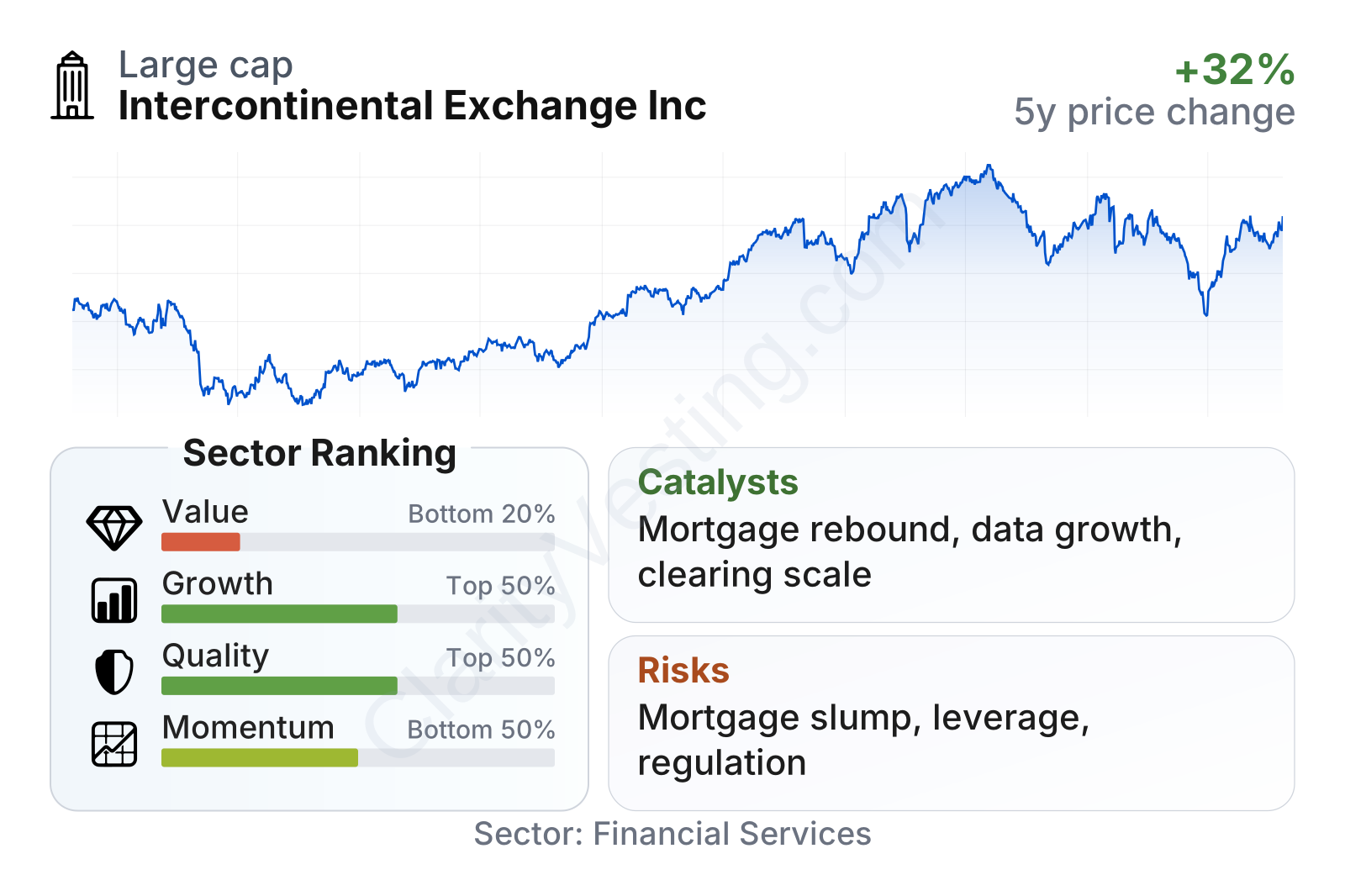
ICE is a very large financial infrastructure company with below-market volatility, which often reflects the steadier nature of exchange and data businesses. On valuation metrics, it screens as more expensive than the sector median, especially on earnings, book value, and cash flow yield. Growth is mixed: revenue expansion is positive but not especially fast, while free cash flow growth has been much stronger. Quality metrics remain solid overall, with high margins and profitability above many peers on an asset basis, though leverage is clearly heavier than the sector median. Recent stock performance has been softer than much of the financial services sector.
Growth
ICE operates in a sector with durable structural tailwinds. Financial markets continue to electronify, regulatory requirements continue to support clearing and data usage, and institutions increasingly rely on recurring pricing, analytics, and workflow platforms. That supports the company’s two most durable growth engines: market infrastructure and data services.
The strategy also makes sense on a portfolio level. Exchange and clearing businesses tend to benefit when volatility and hedging activity rise. Data services tend to be more subscription-based and recurring. Mortgage technology is more cyclical, but if U.S. housing finance activity recovers from depressed levels, it can add a separate leg of growth. ICE therefore has exposure to both resilient recurring revenue and potential cyclical upside.
Earnings per share have moved up steadily in recent years, showing that the company has been able to translate scale, integration work, and operating discipline into higher profit per share. That trend is more encouraging than the slower top-line growth alone would suggest.
Book value per share has also been trending upward, which points to gradual balance-sheet value creation over time. The pace is not dramatic, but it does support the view that ICE has continued to build business value while digesting acquisitions and investing in its platforms.
A major catalyst remains the mortgage segment. ICE spent heavily to build a broad mortgage software ecosystem, and that business has gone through a difficult housing cycle. If origination volumes normalize over time, the company could benefit from both higher transaction activity and better operating leverage on an already-built platform. Another catalyst is continued cross-selling between data, trading, and workflow tools, where customers often prefer integrated solutions.
Recent company updates have also highlighted ongoing product expansion in fixed income, data, and workflow services, which is important because these businesses typically carry recurring revenue characteristics and sticky customer relationships. For a long-term view, this is one of the more attractive parts of the ICE model.
Risks
This article is for informational purposes only and does not constitute financial advice. Some content is AI-generated. See Disclaimer


