Stock Analysis · International Bancshares Corporation (IBOC)
Overview
International Bancshares Corporation is a regional bank holding company that operates through its main subsidiary, International Bank of Commerce. It provides traditional banking services to consumers, small businesses, and commercial clients, with a strong presence in Texas and Oklahoma and a long-standing franchise near the U.S.-Mexico border. In simple terms, it makes money by taking deposits, making loans, processing payments, and offering related financial services.
The business is still centered on classic community and commercial banking rather than investment banking or highly complex capital-markets activities. That matters for long-term readers because the company’s results are driven mostly by credit quality, loan demand, deposit costs, and activity in the South Texas border economy.
Based on the company’s recent annual filing, revenue is mainly generated from net interest income, meaning the spread between what the bank earns on loans and securities and what it pays on deposits and borrowings. Non-interest income is smaller but still meaningful.
- Net interest income: approximately 75% to 80% of total revenue. This includes income from commercial loans, consumer loans, real estate lending, investment securities, and other interest-earning assets, net of funding costs.
- Service charges and other fee income: approximately 10% to 15%. This usually includes deposit account fees, card-related fees, treasury management services, and other banking charges.
- Insurance and other non-interest activities: approximately 5% to 10%. This can include insurance commissions, gains on asset sales, and miscellaneous banking-related income.
The earnings profile has improved materially since 2021, with revenue rising from roughly $620 million to just above $1.05 billion by 2025, while net income stayed above $400 million in both 2024 and 2025. That points to a bank that has grown into a more profitable earnings base, even as higher funding costs started to absorb part of the benefit.
The broad pattern is favorable: revenue expanded strongly over the last several years, operating expenses grew much more slowly, and profitability remained unusually high for a regional bank. The main offset is that interest expense increased sharply as industry funding costs normalized, which is now one of the key moving parts for future results.
Key Figures
| Metric | Value | Sector ⓘ |
|---|---|---|
| Date | Oct 24, 2026 | |
| Context | ||
| Sector | Financial Services | |
| Industry | Banks - Regional | |
| Market Cap ⓘ | $4.19B | |
| Beta ⓘ | 0.70 | |
Value (Cheapness) | ||
| P/E Ratio ⓘ | 10.16 | 12.46 |
| P/B Ratio ⓘ | 1.24 | 1.25 |
| FCF Yield ⓘ | 10.81% | 9.82% |
| Dividend Yield ⓘ | 2.19% | 2.94% |
| EBIT / EV ⓘ | 11.93% | 8.11% |
| PEG ⓘ | 0.98 | |
Growth (Business expansion) | ||
| Revenue Growth ⓘ | N/A | 9.10% |
| RPS Growth (5Y CAGR) ⓘ | 14.72% | 12.31% |
| EPS Growth (5Y CAGR) ⓘ | -10.29% | -6.97% |
| BVPS Growth (5Y CAGR) ⓘ | -31.96% | 5.02% |
| Margin Growth (5Y Trend) ⓘ | -2.56% | -4.00% |
| FCF Growth (5Y CAGR) ⓘ | 13.87% | 4.71% |
| DPS Growth (5Y CAGR) ⓘ | 5.07% | 8.92% |
Quality (Business durability) | ||
| ROIC (Latest) ⓘ | 12.23% | 9.18% |
| ROE (Latest) ⓘ | 12.71% | 13.93% |
| ROA (Latest) ⓘ | 2.46% | 1.57% |
| ROIC (5Y Median) ⓘ | 13.12% | 7.80% |
| ROE (5Y Median) ⓘ | 13.63% | 12.15% |
| ROA (5Y Median) ⓘ | 2.54% | 1.28% |
| Net Debt / EBIT (Latest) ⓘ | 0.53 | 1.02 |
| Net Debt / EBIT (5Y Median) ⓘ | -0.00 | 0.72 |
| Net Debt / EBITDA (Latest) ⓘ | 0.51 | 0.88 |
| Operating Margin (Latest) ⓘ | 49.20% | 22.30% |
| Operating Margin (5Y Median) ⓘ | 51.95% | 24.50% |
| Debt to Equity (Latest) ⓘ | 21.66% | 59.34% |
| Profit Margin (Latest) ⓘ | 49.34% | 26.42% |
| Free Cash Flow (Latest) ⓘ | $452.82M | |
Momentum (Price trend) | ||
| 3Y Return ⓘ | +69.90% | +95.73% |
| 12M Return (excl. last month) ⓘ | +3.38% | +17.30% |
| 6M Return ⓘ | -4.44% | +6.07% |
| Price vs. 200-Day MA ⓘ | -4.99% | +5.36% |
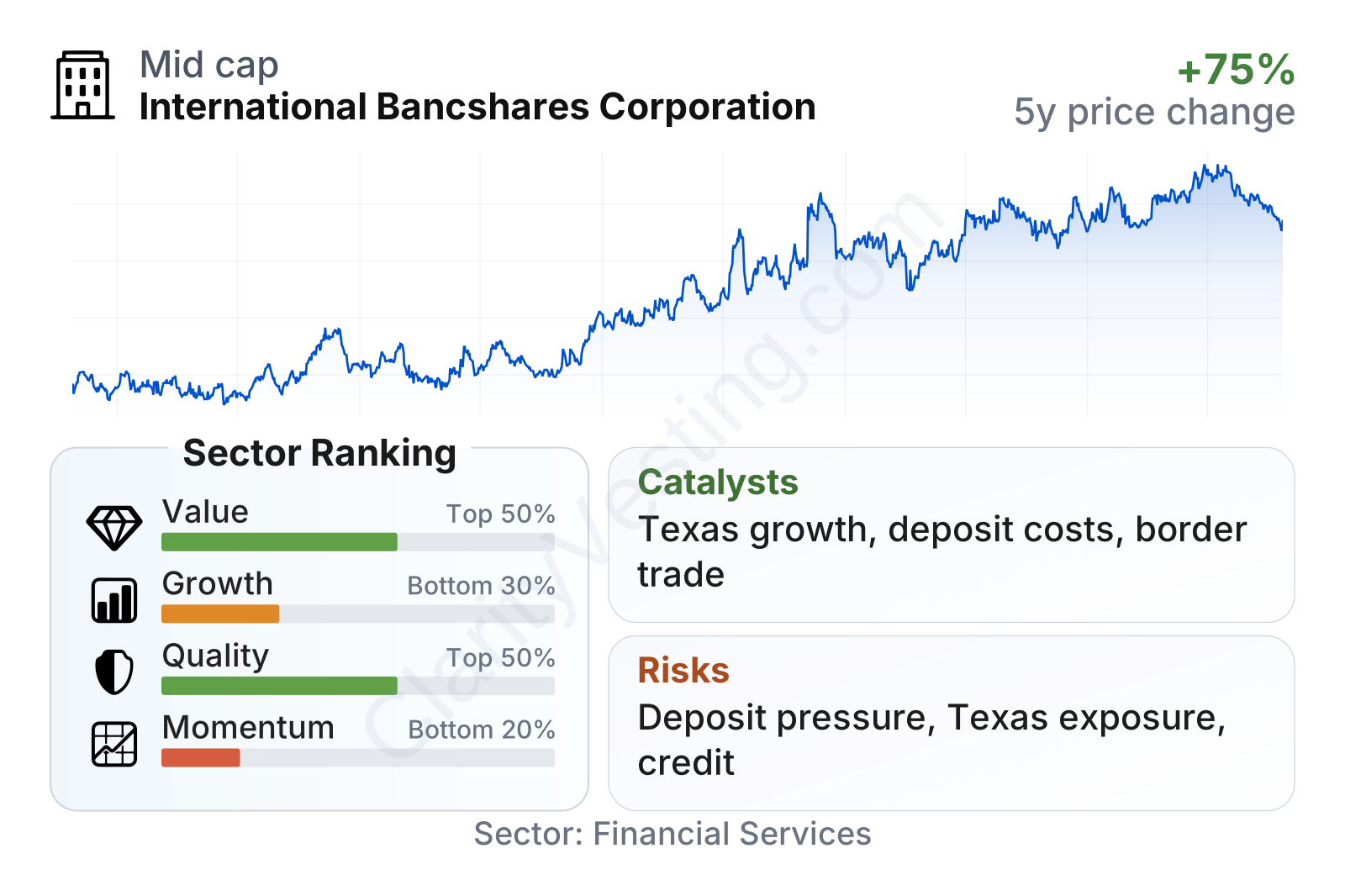
International Bancshares sits in the mid-sized regional bank range, with a stock that has been less volatile than the broader market, reflected by a beta well below 1. On valuation, the shares trade at a price-to-earnings ratio below the sector median, while the price-to-book ratio is slightly above the sector median. That combination usually suggests the market recognizes the company’s profitability, but is not pricing it like a high-growth bank.
Quality metrics are one of the stronger parts of the profile. Profit margin, operating margin, return on assets, and long-run returns on capital all compare well with many regional peers. Balance-sheet leverage also looks restrained relative to the sector, which adds a layer of resilience.
The weaker area is growth and market momentum. Recent revenue growth has been flat on a year-over-year basis, and the stock’s shorter-term performance has lagged much of the regional banking group. In other words, the company looks fundamentally solid, but not currently rewarded by the market as a fast-expanding franchise.
Growth
Regional banking is not a high-growth industry in the same sense as software or semiconductors, but it remains a necessary part of the economy. The better question is whether a bank operates in markets that can support steady expansion. On that point, International Bancshares has some attractive characteristics. Its footprint includes Texas, one of the strongest population and business-growth states in the country, and it has a differentiated position in border markets tied to trade, logistics, and cross-border commercial activity.
The company’s strategy is sensible for gradual long-term expansion: stay focused on relationship banking, maintain a conservative balance sheet, and use a strong local presence in markets where very large national banks may not be as entrenched in small and mid-sized business relationships. That approach generally does not create explosive growth, but it can support durable deposit gathering and repeat lending business over time.
Earnings per share climbed sharply from 2021 through 2023 and then largely stabilized at a high level in 2024 and 2025. That suggests the bank already captured much of the upside from the higher-rate environment, and the next phase may depend more on loan growth, funding discipline, and fee generation than on simple rate expansion.
Book value per share shows a much healthier trend in the most recent years than a simple five-year summary might suggest. After a distorted older figure, the path from 2022 through 2025 is clearly upward, which is important for a bank because book value growth often reflects retained earnings and capital accumulation. It indicates that the franchise has been building capital while remaining profitable.
One meaningful catalyst is any improvement in deposit costs or a favorable interest-rate shift that supports net interest margin. Another is continued economic activity in South Texas and cross-border trade corridors, where the company has established banking relationships. In 2026, management commentary and public filings have continued to show a business that is profitable, well-capitalized, and still anchored in markets with structural population and commercial growth.
Risks
This article is for informational purposes only and does not constitute financial advice. Some content is AI-generated. See Disclaimer


