Stock Analysis · Integra LifeSciences Holdings (IART)
Overview
Integra LifeSciences Holdings is a medical technology company focused on products used in surgery, wound care, and neurosurgery. Its portfolio is centered on tools, implants, and biologic materials that surgeons and hospitals use in operating rooms and in the treatment of complex wounds. The company has built its business around areas where physicians often prefer trusted brands, clinical familiarity, and products supported by regulatory clearances and hospital purchasing relationships.
Based on the company’s recent annual reporting structure, revenue is mainly generated from two operating segments:
- Codman Specialty Surgical: approximately 55% to 60% of revenue. This segment includes neurosurgery, instruments, and related specialty surgical products used in areas such as cranial procedures, monitoring, and operating room workflows.
- Tissue Technologies: approximately 40% to 45% of revenue. This segment includes regenerative tissue products, wound reconstruction offerings, and products used in soft tissue repair and advanced wound management.
Within those categories, the company’s sales are heavily tied to hospitals and surgical centers, with the United States remaining the largest market. That creates a business model driven less by consumer demand and more by procedure volumes, hospital budgets, product quality, and reimbursement conditions.
Over the last several years, revenue has stayed in a fairly narrow band around the mid-$1.5 billion range, but profitability has weakened sharply. Gross profit has remained substantial, yet rising operating costs, higher interest expense, and major charges have put pressure on earnings. In other words, the business still produces meaningful sales, but converting those sales into attractive profit has become much harder.
The long-term pattern is notable: revenue has been relatively stable to slightly higher since 2021, while operating income and net income have deteriorated much more significantly. That gap suggests the current challenge is not demand alone, but also execution, cost structure, and balance sheet pressure.
Key Figures
| Metric | Value | Sector ⓘ |
|---|---|---|
| Date | Oct 17, 2026 | |
| Context | ||
| Sector | Healthcare | |
| Industry | Medical Devices | |
| Market Cap ⓘ | $1.02B | |
| Beta ⓘ | 1.21 | |
Value (Cheapness) | ||
| P/E Ratio ⓘ | N/A | 24.79 |
| P/B Ratio ⓘ | 1.01 | 3.08 |
| FCF Yield ⓘ | 3.78% | 3.15% |
| Dividend Yield ⓘ | N/A | 1.94% |
| EBIT / EV ⓘ | 3.18% | 0.57% |
| PEG ⓘ | 0.71 | |
Growth (Business expansion) | ||
| Revenue Growth ⓘ | 0.80% | 7.45% |
| RPS Growth (5Y CAGR) ⓘ | 4.24% | 8.61% |
| EPS Growth (5Y CAGR) ⓘ | -25.76% | -17.81% |
| BVPS Growth (5Y CAGR) ⓘ | -8.87% | 3.72% |
| Margin Growth (5Y Trend) ⓘ | -44.92% | -0.62% |
| FCF Growth (5Y CAGR) ⓘ | N/A | 1.04% |
| DPS Growth (5Y CAGR) ⓘ | 289.99% | 6.77% |
Quality (Business durability) | ||
| ROIC (Latest) ⓘ | 1.61% | 3.24% |
| ROA (Latest) ⓘ | -0.20% | 3.01% |
| ROIC (5Y Median) ⓘ | 3.49% | 4.60% |
| ROA (5Y Median) ⓘ | 1.77% | 1.89% |
| Net Debt / EBIT (Latest) ⓘ | 19.00 | 1.34 |
| Net Debt / EBIT (5Y Median) ⓘ | 7.68 | 1.84 |
| Net Debt / EBITDA (Latest) ⓘ | 7.31 | 1.00 |
| Net Debt / Assets ⓘ | 50.89% | 5.45% |
| EBITDA / Interest ⓘ | 2.59 | 9.64 |
| Operating Margin (Latest) ⓘ | 5.83% | 9.27% |
| Operating Margin (5Y Median) ⓘ | 8.59% | 7.38% |
| Debt to Equity (Latest) ⓘ | 194.10% | 28.58% |
| Profit Margin (Latest) ⓘ | -0.44% | 3.59% |
| Free Cash Flow (Latest) ⓘ | $38.76M | |
Momentum (Price trend) | ||
| 3Y Return ⓘ | -64.75% | +42.80% |
| 12M Return (excl. last month) ⓘ | +4.11% | +18.50% |
| 6M Return ⓘ | +22.67% | +7.57% |
| Price vs. 200-Day MA ⓘ | -3.92% | +5.12% |
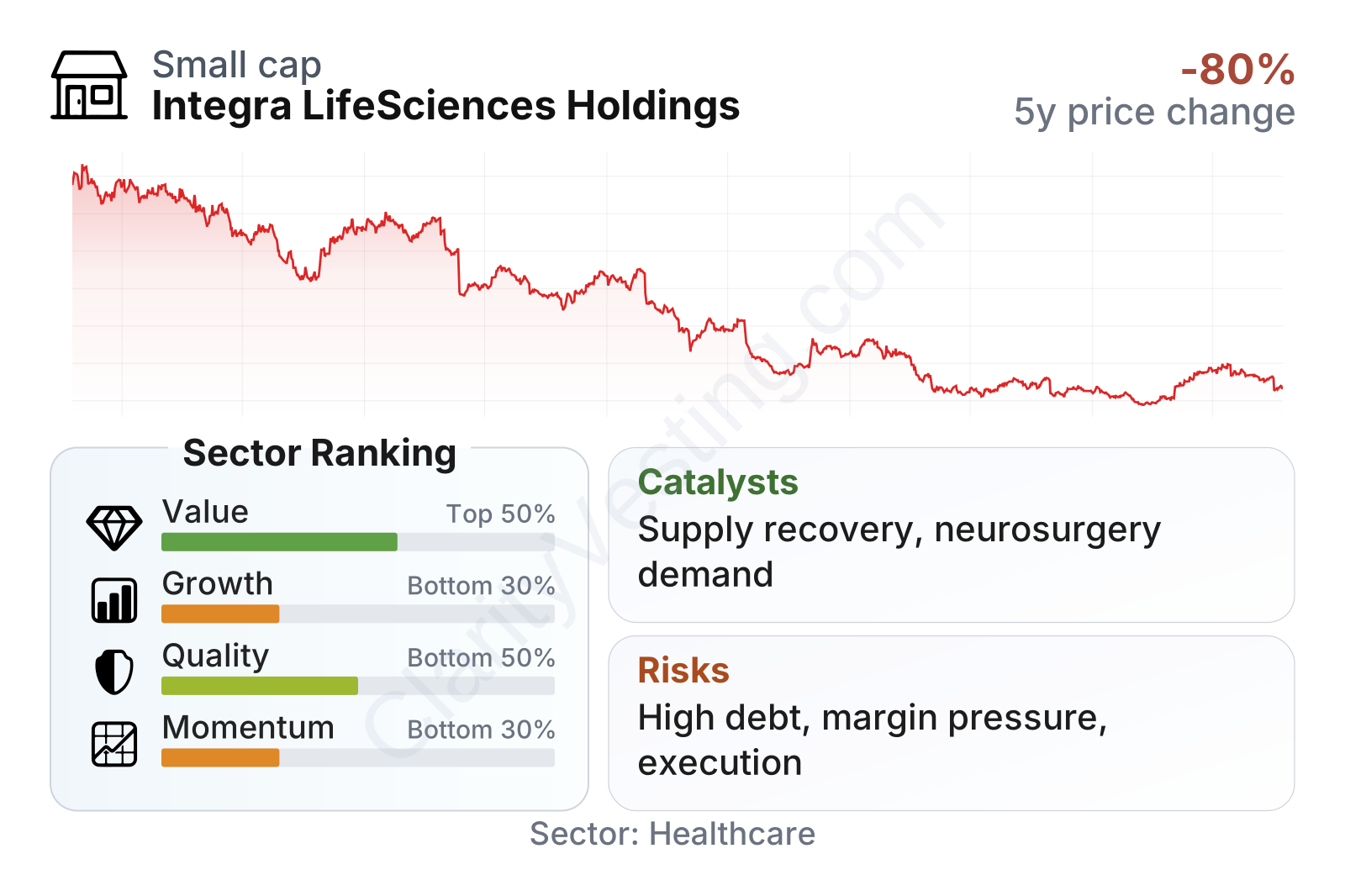
Integra is now a small-to-mid-sized healthcare company with a stock that has been extremely volatile. The share price collapse over the last few years shows how heavily sentiment has been affected by weaker earnings, operational issues, and concern about leverage. At the same time, the recent rebound from very depressed levels shows that the market is reacting quickly to any sign of stabilization.
The broader metric profile is mixed. Valuation measures look less demanding than many healthcare peers, with price-to-book well below the sector median and cash flow yield roughly in line with the group. However, growth ranks in the lower part of the sector, quality is also weak, and momentum only recently improved after a long period of underperformance. In short, the market is attaching a discounted valuation to a business that still has scale and cash-generation potential, but whose operating profile has clearly deteriorated.
Growth
Integra operates in parts of healthcare that should benefit from durable long-term demand. Neurosurgery, reconstructive procedures, tissue repair, and complex wound care are supported by aging populations, ongoing surgical needs, and the continued use of specialized devices in hospital settings. These are not fad-driven markets. They tend to grow with procedure volumes, clinical adoption, and product innovation.
The more difficult question is whether Integra itself is positioned to capture that sector growth efficiently. Recent revenue performance has been uneven rather than consistently expanding. The business has posted periods of decline and recovery, and the latest year-over-year trend suggests low single-digit growth rather than a strong acceleration.
This pattern points to a company that still has demand for its products, but has not yet established a reliable growth rhythm. Compared with the broader medical device space, that is an important weakness because many peers have delivered stronger and more consistent expansion over the same period.
Strategically, the company’s focus still makes sense. Specialty surgical tools and regenerative tissue products can offer sticky customer relationships because surgeons and hospitals often standardize around familiar systems. If product availability improves, execution becomes cleaner, and the company stabilizes its core franchises, growth could become more visible again. Its installed clinical presence remains valuable even after the recent setbacks.
Cash generation, however, has also become more fragile.
Free cash flow has fallen sharply from much healthier levels seen earlier in the period and has recently been around break-even to negative territory. That matters because cash is what supports debt reduction, investment in innovation, and recovery flexibility. A stronger turnaround would likely require not just revenue improvement, but also better margins and a normalization of cash conversion.
A meaningful catalyst is the possibility of operational recovery after a period marked by manufacturing and quality-related disruption. If the company can restore supply reliability, simplify execution, and rebuild physician and hospital confidence in affected product lines, the upside to results could be larger than the current revenue growth rate suggests. Another potential support is the essential nature of many of its products: hospitals may delay purchases of some equipment, but they cannot avoid many neurosurgical and wound-related procedures indefinitely.
Risks
This article is for informational purposes only and does not constitute financial advice. Some content is AI-generated. See Disclaimer


