Stock Analysis · Hycroft Mining Holding Corporation (HYMC)
Overview
Hycroft Mining Holding Corporation is a U.S. precious metals company centered on the Hycroft Mine in northern Nevada. The property is large, with gold and silver resources, but the key point for long-term readers is that Hycroft is not operating like a steady, established producer today. In recent years, the company has been focused more on technical studies, exploration, process testing, and plans for a potential restart or redevelopment than on generating recurring mining sales.
That business profile makes Hycroft very different from most mature mining companies. Rather than earning dependable cash flow from high-volume metal production, its value depends heavily on whether it can prove a workable mining plan, raise capital, and eventually turn its mineral resources into profitable output.
The company’s recent revenue mix is therefore unusually narrow and currently very limited. Based on recent filings and reported results, operating revenue has largely faded as mining activity has slowed and then stopped, leaving Hycroft with little to no ongoing sales from metal production.
- Gold and silver sales: historically the main source of revenue, representing approximately 100% of operating revenue when the mine was producing. These sales came from ore mined and processed at the Hycroft property.
- Other revenue sources: currently not a meaningful contributor based on recent filings. Hycroft does not appear to have a diversified commercial base such as royalties, streaming income, refining services, or major by-product businesses.
Financially, the recent pattern is striking: revenue moved down from a meaningful level in 2021 and 2022 to effectively 0% of the prior operating base in 2023 through 2025, while operating expenses, technical work, and corporate costs continued. That means the company is presently better understood as an advanced redevelopment project with a public listing, rather than as a conventional producing miner.
The operating picture shows a business that once had sales but is now spending mainly to evaluate and advance the asset. Losses have narrowed somewhat versus the worst earlier periods, but the absence of revenue remains the central feature.
Key Figures
| Metric | Value | Sector ⓘ |
|---|---|---|
| Date | Oct 17, 2026 | |
| Context | ||
| Sector | Basic Materials | |
| Industry | Gold | |
| Market Cap ⓘ | $1.64B | |
| Beta ⓘ | 2.79 | |
Value (Cheapness) | ||
| P/E Ratio ⓘ | N/A | 16.90 |
| P/B Ratio ⓘ | 5.96 | 1.65 |
| FCF Yield ⓘ | -6.67% | 5.76% |
| Dividend Yield ⓘ | N/A | 2.13% |
| EBIT / EV ⓘ | -4.66% | 6.30% |
| PEG ⓘ | N/A | |
Growth (Business expansion) | ||
| Revenue Growth ⓘ | -52.20% | 11.10% |
| RPS Growth (5Y CAGR) ⓘ | N/A | 4.49% |
| EPS Growth (5Y CAGR) ⓘ | -34.40% | -13.47% |
| BVPS Growth (5Y CAGR) ⓘ | N/A | 5.51% |
| Margin Growth (5Y Trend) ⓘ | N/A | -1.54% |
| FCF Growth (5Y CAGR) ⓘ | N/A | 0.37% |
| DPS Growth (5Y CAGR) ⓘ | N/A | 6.08% |
Quality (Business durability) | ||
| ROIC (Latest) ⓘ | -29.44% | 9.26% |
| ROA (Latest) ⓘ | -32.92% | 4.91% |
| ROIC (5Y Median) ⓘ | -23.32% | 7.70% |
| ROA (5Y Median) ⓘ | -31.09% | 3.86% |
| Net Debt / EBIT (Latest) ⓘ | N/A | 1.40 |
| Net Debt / EBIT (5Y Median) ⓘ | N/A | 1.70 |
| Net Debt / EBITDA (Latest) ⓘ | N/A | 0.95 |
| Net Debt / Assets ⓘ | -75.24% | 13.69% |
| EBITDA / Interest ⓘ | N/A | 12.34 |
| Operating Margin (Latest) ⓘ | N/A | 13.20% |
| Operating Margin (5Y Median) ⓘ | N/A | 11.80% |
| Debt to Equity (Latest) ⓘ | 0.01% | 40.56% |
| Profit Margin (Latest) ⓘ | N/A | 6.43% |
| Free Cash Flow (Latest) ⓘ | -$109.23M | |
Momentum (Price trend) | ||
| 3Y Return ⓘ | +457.85% | +68.89% |
| 12M Return (excl. last month) ⓘ | +221.60% | +30.21% |
| 6M Return ⓘ | -60.80% | -4.16% |
| Price vs. 200-Day MA ⓘ | -46.81% | -1.27% |
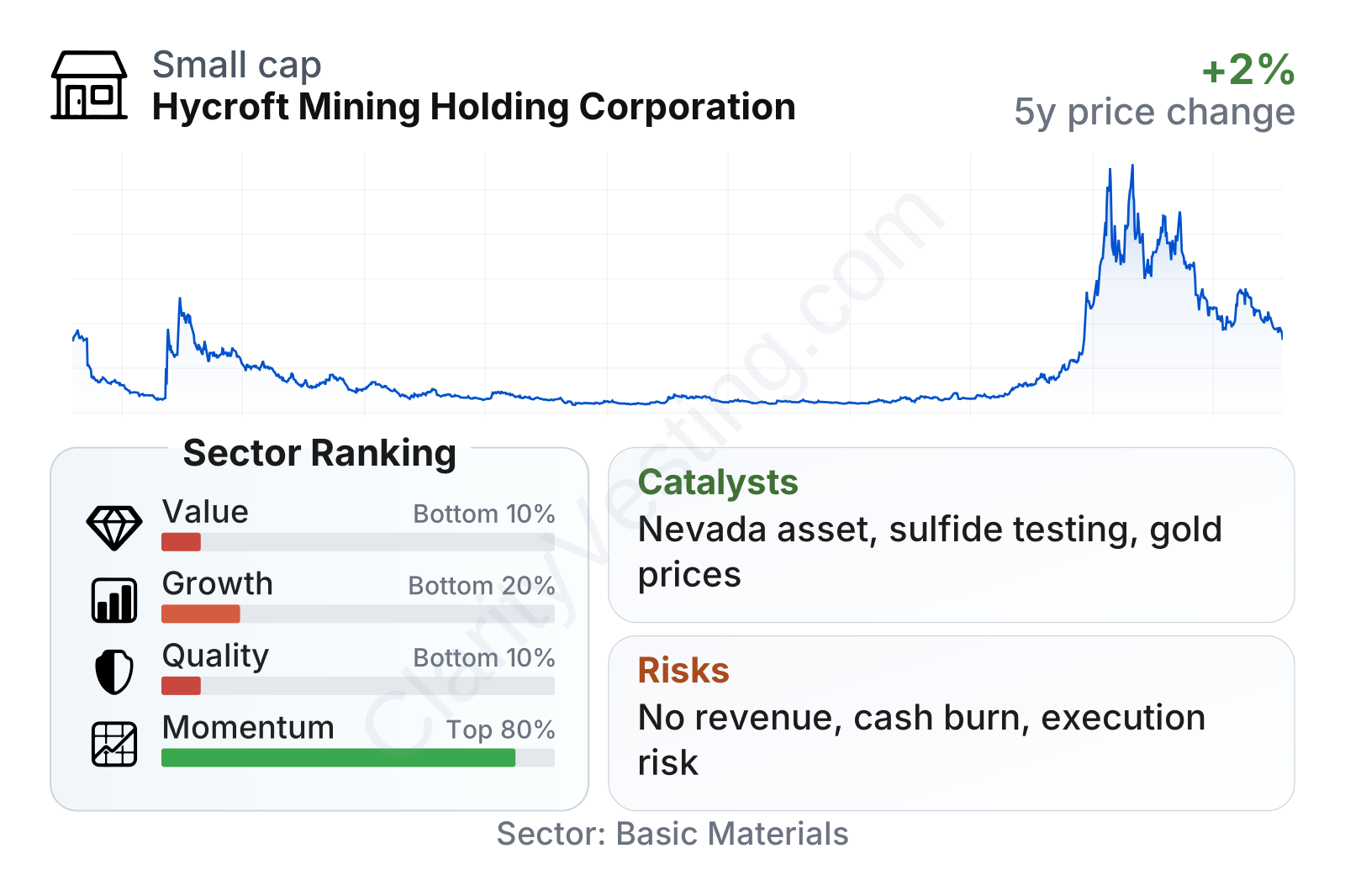
Hycroft’s market value places it in the small-to-mid-size range for listed mining names, but the share price has been far more volatile than the broader sector. A beta near 2.8 points to large swings, and the stock’s history confirms that. The factor summary is weak on value, growth, and quality relative to most basic materials peers, while momentum has been stronger over multi-year periods despite a much weaker short-term trend.
That combination usually reflects a company driven more by expectations, metal price sentiment, and project milestones than by current business performance. The relatively high price-to-book ratio and negative free cash flow yield suggest the market is assigning material value to the Hycroft asset base and its future potential, not to present earnings power.
Growth
Gold and silver remain part of a sector with long-term relevance. Gold benefits from its role as a store of value and from central bank demand, while silver has both precious metal and industrial uses, including electronics and solar applications. That gives Hycroft exposure to commodities that can attract capital over long cycles, especially when inflation, geopolitical stress, or industrial demand support prices.
For Hycroft specifically, growth does not currently come from expanding a running operation. It depends on a successful transition from study and testing work into a commercially viable mine plan. Management has been working on metallurgical testing, technical studies, and drilling intended to improve confidence in how ore can be processed and how the deposit could be developed on better economics than in the past. In plain terms, the company is trying to answer the most important question for the market: can this large Nevada resource be mined profitably at scale?
The revenue trend itself does not support a conventional growth case right now. Reported year-over-year performance has been deeply negative because operating sales have largely disappeared. So the growth angle is not about recent income expansion; it is about the possibility of future production from a large mineral inventory if the redevelopment plan works.
Cash flow is another reminder that Hycroft is still in the investment phase. Free cash flow has remained negative and has recently become more negative, which is consistent with a company funding studies, exploration, and project advancement without a producing mine to offset spending. For a long-term thesis, the positive interpretation is that capital is being used to move the project forward. The harder reality is that this phase can last longer than expected and often requires additional funding.
A meaningful catalyst came from the company’s continued technical progress around sulfide processing and mine planning, because Hycroft’s future depends on finding an economically workable route for its ore. The market has also treated the stock as a leveraged play on stronger gold and silver prices: when precious metals rise and financing conditions improve, the project can look much more attractive. In that sense, the strongest opportunity is a combination of better project economics and supportive metal prices rather than near-term operating growth.
Risks
This article is for informational purposes only and does not constitute financial advice. Some content is AI-generated. See Disclaimer


