Stock Analysis · Hexcel Corporation (HXL)
Overview
Hexcel Corporation is a materials company focused on advanced composites used mainly in aerospace. In simple terms, it makes lightweight but very strong materials that help aircraft and other high-performance equipment reduce weight, improve fuel efficiency, and maintain structural strength. Its products include carbon fiber, reinforcement fabrics, prepregs, honeycomb, adhesives, and engineered core materials that are built into aircraft structures such as fuselages, wings, nacelles, interior panels, and rotorcraft components.
The business is concentrated in a small number of end markets, with commercial aerospace clearly dominating. Based on recent company disclosures, revenue is mainly generated from the following areas:
- Commercial Aerospace: about 68% of revenue. This includes materials used in large commercial aircraft, business jets, and regional aircraft programs.
- Space & Defense: about 16% of revenue. This covers military aircraft, helicopters, satellites, launch systems, and other defense applications.
- Industrial: about 16% of revenue. This includes wind energy, recreation, marine, automotive, and other industrial uses for composite materials.
Hexcel’s operating model is specialized rather than broad. It is not a diversified aerospace giant; it is a focused supplier of mission-critical materials. That matters because customers often certify these materials into aircraft platforms for many years, which can create durable demand once production ramps up. At the same time, it also means the company is highly exposed to aerospace production cycles.
Over the last several years, revenue recovered strongly from the pandemic period, while profitability improved meaningfully before softening in 2025. The broad picture is a business with a large installed position in aerospace supply chains, but one that still shows sensitivity to customer build rates and manufacturing execution.
The long-term pattern shows a clear recovery in sales and gross profit from 2021 through 2024, followed by weaker earnings in 2025 even though revenue stayed near prior highs. That suggests margin pressure mattered more than demand alone, which is important when judging how durable the recent rebound really is.
Key Figures
| Metric | Value | Sector ⓘ |
|---|---|---|
| Date | Oct 24, 2026 | |
| Context | ||
| Sector | Industrials | |
| Industry | Aerospace & Defense | |
| Market Cap ⓘ | $6.91B | |
| Beta ⓘ | 1.10 | |
Value (Cheapness) | ||
| P/E Ratio ⓘ | 46.12 | 22.29 |
| P/B Ratio ⓘ | 5.20 | 1.98 |
| FCF Yield ⓘ | 2.56% | 6.26% |
| Dividend Yield ⓘ | 0.76% | 1.92% |
| EBIT / EV ⓘ | 3.14% | 4.83% |
| PEG ⓘ | 0.61 | |
Growth (Business expansion) | ||
| Revenue Growth ⓘ | 8.00% | 9.30% |
| RPS Growth (5Y CAGR) ⓘ | 10.89% | 7.76% |
| EPS Growth (5Y CAGR) ⓘ | -0.63% | -13.17% |
| BVPS Growth (5Y CAGR) ⓘ | -2.86% | 6.13% |
| Margin Growth (5Y Trend) ⓘ | 4.57% | 0.74% |
| FCF Growth (5Y CAGR) ⓘ | 25.51% | 10.79% |
| DPS Growth (5Y CAGR) ⓘ | 14.04% | 9.41% |
Quality (Business durability) | ||
| ROIC (Latest) ⓘ | 8.55% | 10.75% |
| ROA (Latest) ⓘ | 6.31% | 5.41% |
| ROIC (5Y Median) ⓘ | 6.49% | 9.37% |
| ROA (5Y Median) ⓘ | 4.03% | 4.95% |
| Net Debt / EBIT (Latest) ⓘ | 3.86 | 2.04 |
| Net Debt / EBIT (5Y Median) ⓘ | 3.55 | 2.27 |
| Net Debt / EBITDA (Latest) ⓘ | 2.54 | 1.39 |
| Net Debt / Assets ⓘ | 31.40% | 19.27% |
| EBITDA / Interest ⓘ | 7.12 | 9.58 |
| Operating Margin (Latest) ⓘ | 11.79% | 10.49% |
| Operating Margin (5Y Median) ⓘ | 11.79% | 10.30% |
| Debt to Equity (Latest) ⓘ | 70.59% | 64.82% |
| Profit Margin (Latest) ⓘ | 7.76% | 6.67% |
| Free Cash Flow (Latest) ⓘ | $177.10M | |
Momentum (Price trend) | ||
| 3Y Return ⓘ | +42.55% | +67.77% |
| 12M Return (excl. last month) ⓘ | +41.70% | +12.05% |
| 6M Return ⓘ | +3.43% | 0.00% |
| Price vs. 200-Day MA ⓘ | -0.70% | +0.67% |
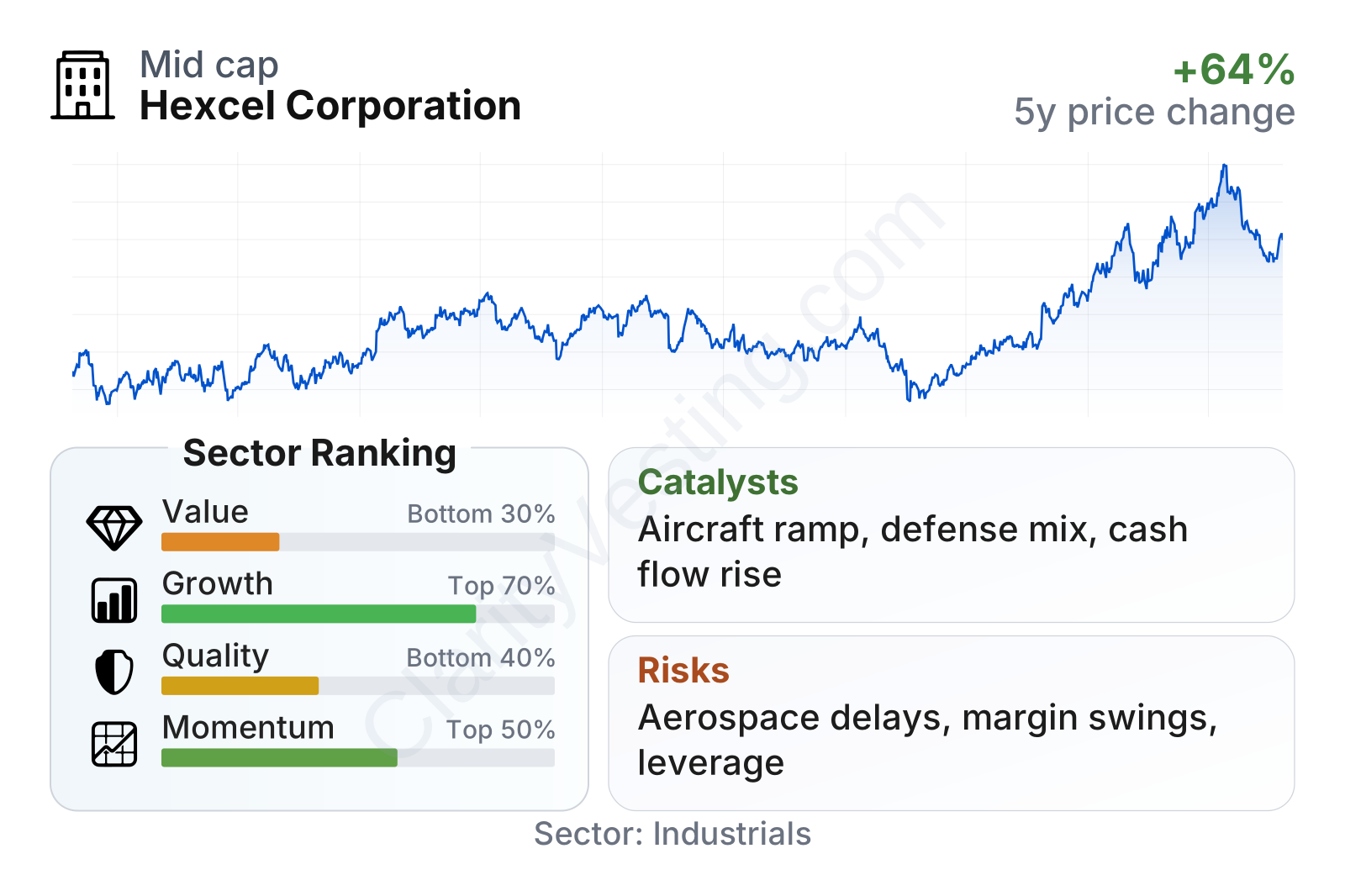
Hexcel is a mid-sized aerospace materials supplier with share-price momentum that has been strong over the last year, even after periods of volatility. The current profile is mixed: growth metrics are generally solid, especially over a five-year view for revenue per share and free cash flow, while valuation looks demanding versus the broader Industrials universe. Profitability is respectable, with operating margin above the sector median and net margin now roughly in line with the sector, but balance-sheet leverage is somewhat heavier than average. Overall, the table points to a company with decent operating improvement and good cash generation, but not one that currently looks cheap on traditional multiples.
Growth
Hexcel operates in a sector with structural growth drivers. Aircraft manufacturers continue to prioritize lighter materials because lower weight can improve fuel efficiency, range, and emissions performance. That supports long-term demand for carbon-fiber composites in newer aircraft designs. The aerospace industry also continues to work through a large commercial aircraft backlog, which can support suppliers like Hexcel for years if production rates keep rising.
The company’s strategy is logical for that backdrop. Hexcel is deeply tied to commercial aerospace programs where composite content is high, and it also maintains exposure to defense and space, which can help balance the cycle. It invests in product development and manufacturing capabilities rather than trying to compete across every part of the aerospace value chain. For a specialist materials producer, that narrow focus makes sense because qualification requirements, process know-how, and customer relationships are important barriers to entry.
Recent sales growth has not been perfectly smooth. The company posted very strong year-over-year expansion through 2022 and 2023, then growth slowed sharply in 2024 and briefly turned negative in parts of 2025 before returning to roughly 8% in the latest periods. That pattern suggests the long-term recovery remains intact, but near-term demand can still be uneven and tied to customer production timing.
Cash generation has been one of the more encouraging trends. Trailing free cash flow has climbed materially over the last few years and is now around $300 million. That matters because it shows the business is converting more of its recovery into actual cash, not just accounting profit. Stronger cash flow gives management more flexibility to manage debt, support capital spending, and maintain shareholder returns.
A major catalyst remains the commercial aerospace production ramp, especially on platforms where composite materials are heavily used. Another supportive factor is defense and space demand, where advanced materials remain important for weight, strength, and thermal performance. Public company communications in 2026 also indicate continued focus on productivity, operational discipline, and serving higher aircraft build rates. If those end markets continue improving at the same time as internal execution stabilizes, Hexcel has a credible path to better earnings leverage.
Risks
This article is for informational purposes only and does not constitute financial advice. Some content is AI-generated. See Disclaimer


