Stock Analysis · Howmet Aerospace Inc (HWM)
Overview
Howmet Aerospace Inc is a specialized manufacturer serving the aerospace, defense, and transportation markets. The company makes highly engineered metal components that are designed to handle extreme heat, pressure, and fatigue. Its products are used in jet engines, aircraft structures, fastening systems, and heavy-duty industrial applications. In simple terms, Howmet sits deep in the supply chain: it does not build airplanes or engines, but it provides many of the critical parts that those systems rely on.
Its business is organized into four operating segments. Based on recent annual reporting, revenue is spread roughly as follows:
- Engine Products – about 48%: precision castings and rotating parts used mainly in aircraft and industrial gas turbine engines. This is the company’s largest business and one of its most technically demanding areas.
- Fastening Systems – about 22%: aerospace fasteners and installation systems used in commercial aircraft and defense platforms.
- Engineered Structures – about 18%: structural parts and assemblies, including components for aircraft airframes and engines.
- Forged Wheels – about 12%: forged aluminum wheels primarily for commercial transportation, such as trucks and trailers.
End-market exposure matters here. Aerospace is the clear core of the company, with commercial aerospace representing the largest demand driver, followed by defense aerospace and then transportation and other industrial uses. That gives Howmet meaningful exposure to long-cycle aircraft production and aftermarket demand, which tend to be more durable than many short-cycle industrial businesses.
The financial flow has become noticeably stronger over the past several years. Revenue has risen steadily, but profits have grown even faster, showing that margin expansion has been a major part of the company’s progress rather than simple volume growth alone. Interest expense has also trended lower, which supports earnings quality.
Key Figures
| Metric | Value | Sector ⓘ |
|---|---|---|
| Date | Oct 24, 2026 | |
| Context | ||
| Sector | Industrials | |
| Industry | Aerospace & Defense | |
| Market Cap ⓘ | $84.40B | |
| Beta ⓘ | 1.20 | |
Value (Cheapness) | ||
| P/E Ratio ⓘ | 47.45 | 22.29 |
| P/B Ratio ⓘ | 14.60 | 1.98 |
| FCF Yield ⓘ | 2.12% | 6.26% |
| Dividend Yield ⓘ | 0.22% | 1.92% |
| EBIT / EV ⓘ | 2.57% | 4.83% |
| PEG ⓘ | 0.80 | |
Growth (Business expansion) | ||
| Revenue Growth ⓘ | 24.10% | 9.30% |
| RPS Growth (5Y CAGR) ⓘ | 15.48% | 7.76% |
| EPS Growth (5Y CAGR) ⓘ | 17.35% | -13.17% |
| BVPS Growth (5Y CAGR) ⓘ | 13.52% | 6.13% |
| Margin Growth (5Y Trend) ⓘ | 12.40% | 0.74% |
| FCF Growth (5Y CAGR) ⓘ | 54.68% | 10.79% |
| DPS Growth (5Y CAGR) ⓘ | 78.74% | 9.41% |
Quality (Business durability) | ||
| ROIC (Latest) ⓘ | 21.65% | 10.75% |
| ROA (Latest) ⓘ | 15.32% | 5.41% |
| ROIC (5Y Median) ⓘ | 12.16% | 9.37% |
| ROA (5Y Median) ⓘ | 7.40% | 4.95% |
| Net Debt / EBIT (Latest) ⓘ | 1.61 | 2.04 |
| Net Debt / EBIT (5Y Median) ⓘ | 2.70 | 2.27 |
| Net Debt / EBITDA (Latest) ⓘ | 1.43 | 1.39 |
| Net Debt / Assets ⓘ | 29.79% | 19.27% |
| EBITDA / Interest ⓘ | 16.39 | 9.58 |
| Operating Margin (Latest) ⓘ | 26.87% | 10.49% |
| Operating Margin (5Y Median) ⓘ | 17.97% | 10.30% |
| Debt to Equity (Latest) ⓘ | 78.68% | 64.82% |
| Profit Margin (Latest) ⓘ | 20.52% | 6.67% |
| Free Cash Flow (Latest) ⓘ | $1.79B | |
Momentum (Price trend) | ||
| 3Y Return ⓘ | +383.13% | +67.77% |
| 12M Return (excl. last month) ⓘ | +19.77% | +12.05% |
| 6M Return ⓘ | -15.90% | 0.00% |
| Price vs. 200-Day MA ⓘ | -16.50% | +0.67% |
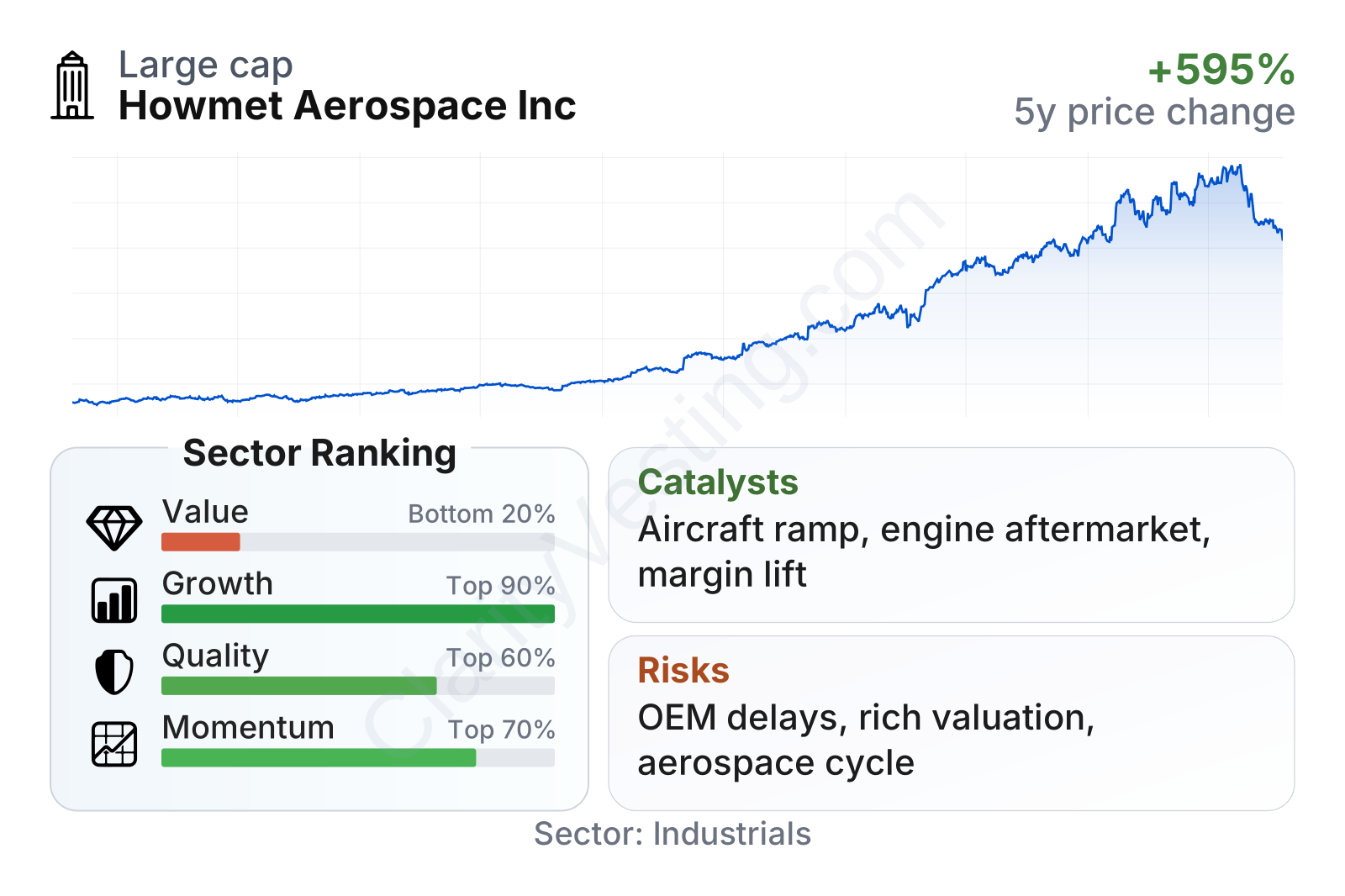
Howmet is now a very large aerospace supplier by market value, and its share price performance over the last three years has been exceptionally strong. In the broader industrial sector, the company stands out most on growth and remains solid on quality, while valuation is clearly its weakest area. Profitability metrics are well above sector norms, cash generation has improved sharply, and returns on capital are strong. The tradeoff is that the market is already assigning a premium multiple to those strengths.
Growth
Howmet operates in a sector with attractive long-term demand. Commercial aerospace continues to benefit from rising air travel, aging aircraft fleets, and the multi-year need to expand and modernize capacity. Defense demand also remains supportive, especially for engine-related and structural components used on military aircraft. On top of that, aerospace suppliers often enjoy long product cycles: once a part is qualified and integrated into an engine or airframe, it can generate business for many years through both original equipment production and replacement demand.
The company’s strategy fits that backdrop well. Management has focused on high-value components where technical know-how, certification requirements, and manufacturing precision create barriers to entry. This is important because it can support pricing discipline and margin resilience. Howmet is also positioned in the aircraft engine aftermarket, which is often more profitable and less volatile than original equipment production because airlines need maintenance regardless of new aircraft delivery timing.
Recent revenue growth has accelerated again, reaching a pace comfortably above the sector median. That suggests the company is not only benefiting from the aerospace recovery but also gaining from strong demand in the parts of the market where it is most competitive. Over a five-year period, revenue per share and earnings per share have both grown much faster than the industry median, which points to a business that has been expanding while also becoming more efficient.
Cash generation reinforces the growth case. Free cash flow has climbed from a few hundred million dollars to well above $1 billion over a relatively short period. That matters because cash can be used to fund capacity expansion, debt reduction, dividends, and share repurchases without relying heavily on outside financing. For a manufacturer, rising free cash flow alongside rising margins is usually a sign that execution is improving, not just sales volume.
One of the clearest catalysts is the continued production ramp in large commercial aircraft and the associated growth in engine output and maintenance activity. A second catalyst is the company’s exposure to next-generation, fuel-efficient aircraft platforms, where demand for advanced materials and precisely engineered parts tends to remain high. A third catalyst is operating leverage: if volumes keep rising, a meaningful portion of additional revenue can flow through to earnings because the business already operates at strong margins.
Risks
This article is for informational purposes only and does not constitute financial advice. Some content is AI-generated. See Disclaimer