Stock Analysis · Hawkins Inc (HWKN)
Overview
Hawkins Inc is a specialty chemicals and ingredients company that serves industrial, water treatment, and food customers across the United States. Its business is less about inventing blockbuster chemicals and more about sourcing, blending, distributing, and servicing essential products that customers need to keep operations running. That makes Hawkins a relatively practical and recurring-demand business tied to everyday needs such as municipal water treatment, industrial processing, and food and beverage formulation.
Based on the company’s latest annual filing for fiscal 2026, revenue comes from three main segments:
- Water Treatment: approximately 46% of revenue. This segment supplies chemicals, equipment, and related service used by municipalities and industrial customers to treat drinking water, wastewater, and process water.
- Industrial: approximately 35% of revenue. This includes bulk and specialty chemicals, blending, and distribution for industrial customers in areas such as manufacturing, agriculture, energy, and general processing.
- Health & Nutrition: approximately 19% of revenue. This segment provides ingredients and formulation support for food, beverage, nutraceutical, personal care, and other consumer-oriented applications.
The business mix matters because it gives Hawkins exposure to both steadier end markets and higher-value specialty activities. Water treatment tends to be more defensive because municipalities and industrial sites cannot easily postpone treatment needs. Health & Nutrition can offer better margins through formulation, technical support, and customer-specific solutions. Industrial is broader and can be more cyclical, but it adds scale and purchasing reach.
Over the last several years, Hawkins has also improved the amount of profit it keeps from each dollar of sales. Revenue has moved above the $1 billion mark, while gross profit and operating income have risen faster than sales over the medium term. More recently, interest expense has increased, showing that expansion has come with a higher financing cost than in earlier years.
Key Figures
| Metric | Value | Sector ⓘ |
|---|---|---|
| Date | Oct 24, 2026 | |
| Context | ||
| Sector | Basic Materials | |
| Industry | Specialty Chemicals | |
| Market Cap ⓘ | $2.73B | |
| Beta ⓘ | 0.74 | |
Value (Cheapness) | ||
| P/E Ratio ⓘ | 33.94 | 16.92 |
| P/B Ratio ⓘ | 4.96 | 1.66 |
| FCF Yield ⓘ | 3.35% | 5.83% |
| Dividend Yield ⓘ | 0.58% | 2.07% |
| EBIT / EV ⓘ | 4.24% | 6.38% |
| PEG ⓘ | 2.46 | |
Growth (Business expansion) | ||
| Revenue Growth ⓘ | 7.60% | 11.25% |
| RPS Growth (5Y CAGR) ⓘ | 9.11% | 4.49% |
| EPS Growth (5Y CAGR) ⓘ | -19.30% | -15.24% |
| BVPS Growth (5Y CAGR) ⓘ | 15.63% | 5.49% |
| Margin Growth (5Y Trend) ⓘ | 2.12% | -1.54% |
| FCF Growth (5Y CAGR) ⓘ | 56.57% | 0.37% |
| DPS Growth (5Y CAGR) ⓘ | 9.46% | 5.91% |
Quality (Business durability) | ||
| ROIC (Latest) ⓘ | 11.52% | 9.59% |
| ROA (Latest) ⓘ | 8.10% | 4.92% |
| ROIC (5Y Median) ⓘ | 14.35% | 7.91% |
| ROA (5Y Median) ⓘ | 10.27% | 3.92% |
| Net Debt / EBIT (Latest) ⓘ | 2.09 | 1.36 |
| Net Debt / EBIT (5Y Median) ⓘ | 1.31 | 1.69 |
| Net Debt / EBITDA (Latest) ⓘ | 1.45 | 0.93 |
| Net Debt / Assets ⓘ | 25.11% | 13.69% |
| EBITDA / Interest ⓘ | 13.44 | 12.38 |
| Operating Margin (Latest) ⓘ | 10.91% | 13.24% |
| Operating Margin (5Y Median) ⓘ | 11.34% | 11.82% |
| Debt to Equity (Latest) ⓘ | 47.55% | 40.30% |
| Profit Margin (Latest) ⓘ | 7.29% | 6.38% |
| Free Cash Flow (Latest) ⓘ | $91.69M | |
Momentum (Price trend) | ||
| 3Y Return ⓘ | +137.10% | +73.47% |
| 12M Return (excl. last month) ⓘ | -27.43% | +27.59% |
| 6M Return ⓘ | -20.52% | -4.02% |
| Price vs. 200-Day MA ⓘ | -9.04% | -0.65% |
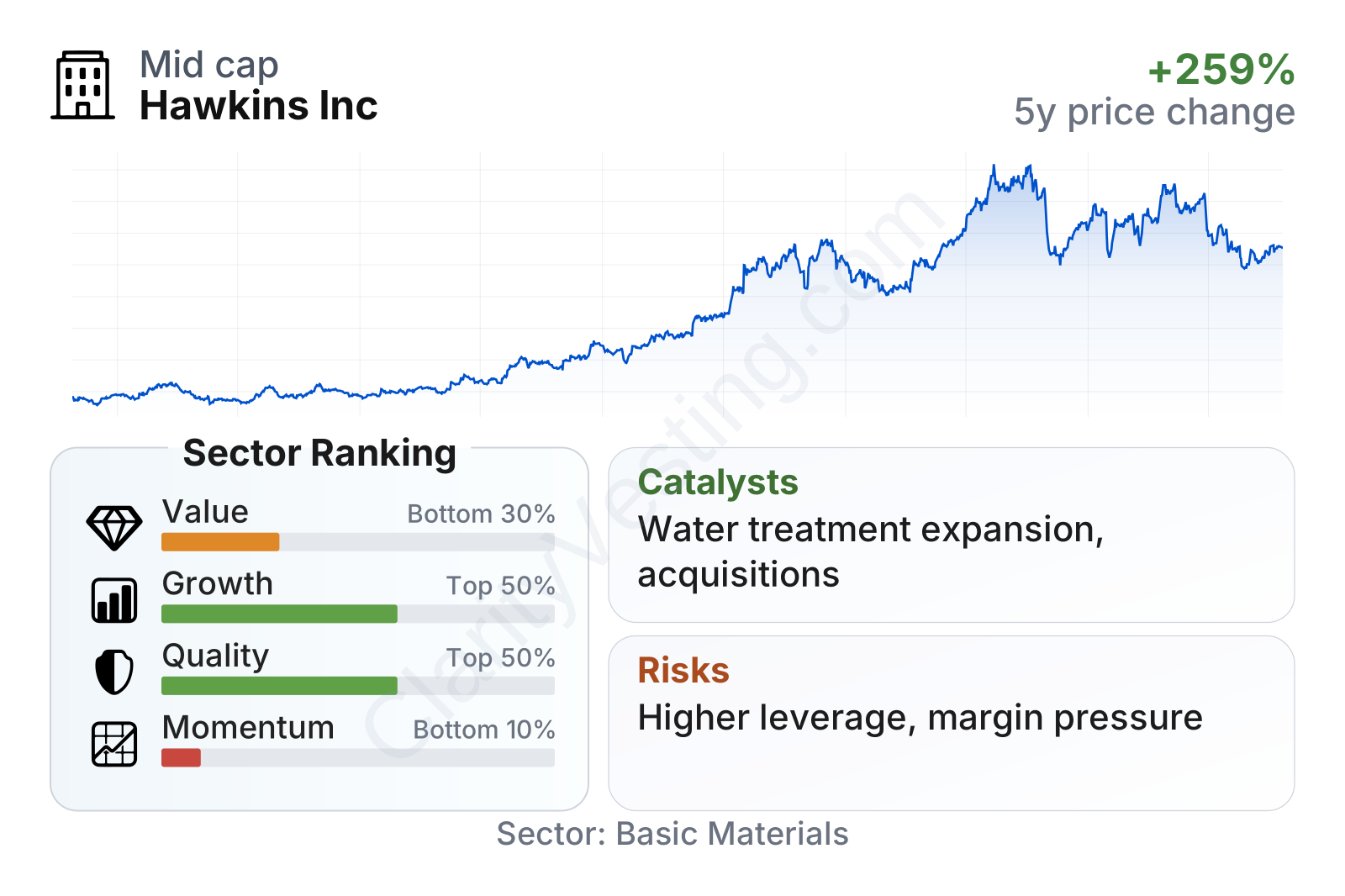
Hawkins is a mid-sized company with a market value around the low single-digit billions and a beta below 1, which points to lower share-price volatility than the broader market. In the factor breakdown, quality and growth rank around the upper half of the sector, helped by solid returns on capital, strong book value growth, and a strong multi-year rise in free cash flow. The weaker area is valuation: the stock trades at noticeably higher earnings and book multiples than the sector median, while cash flow and EBIT-based yields are lower than typical peers. Momentum is also weak after a sizable pullback from prior highs.
Growth
Hawkins operates in parts of the chemical industry that have attractive long-term demand drivers, especially water treatment and food-related ingredients. Water quality regulation, aging infrastructure, industrial water reuse, and population growth all support ongoing demand for treatment chemicals and related services. These are not flashy markets, but they are durable ones, and that is often important in a long-term business assessment.
The company’s strategy appears coherent. It has been building density in water treatment through acquisitions, local service expansion, and product breadth. That approach can work well because water treatment is partly a scale-and-route business: local presence, storage, delivery capability, and customer relationships matter. In Health & Nutrition, Hawkins is aiming for more value-added ingredient solutions rather than pure commodity distribution, which can support margins and customer retention.
Revenue growth has not been perfectly smooth, but the pattern shows resilience. After a strong growth burst in 2022, the company went through a softer stretch and then returned to positive expansion. The most recent annual pace remains positive, though below the sector median. More encouraging is the longer view: five-year revenue-per-share growth is well above the sector median, suggesting Hawkins has expanded in a way that has created real business scale rather than just short-lived price effects.
Cash generation is another constructive element. Free cash flow has increased sharply over the past five years, even if annual levels fluctuate. The current trailing figure remains healthy, which is important because this is the cash that can support acquisitions, debt service, dividends, and internal investment. The company’s operating margin trend over five years is also better than the sector median, indicating that expansion has not relied only on volume growth.
A notable catalyst is continued consolidation in water treatment. Many local and regional providers remain small, which can create room for Hawkins to add customers, geographies, and technical capabilities through acquisitions. The company’s recent filings and investor materials also point to ongoing investment in water treatment infrastructure and service capacity, which supports future volume growth if execution remains disciplined.
Risks
This article is for informational purposes only and does not constitute financial advice. Some content is AI-generated. See Disclaimer


