Stock Analysis · Huron Consulting Group Inc (HURN)
Overview
Huron Consulting Group is a professional services company that helps large organizations solve operational, financial, digital, and regulatory problems. Its client base is concentrated in industries where complexity is high and the cost of poor execution can be significant, especially healthcare, education, commercial industries, and public-sector related work. In simple terms, Huron is paid to help institutions improve performance, manage change, implement technology, and handle specialized challenges such as revenue cycle improvement, enterprise transformation, compliance, and restructuring-related needs.
The company reports revenue mainly through operating segments rather than product lines. Based on its most recent annual reporting structure, revenue is primarily generated from the following areas:
- Healthcare: approximately 54% of revenue. This includes consulting for hospitals and health systems, revenue cycle management, care transformation, finance and operations improvement, digital initiatives, and technology implementation.
- Education: approximately 22% of revenue. This business serves universities and research institutions with strategy, operations, enrollment, finance, research administration, and technology services.
- Commercial: approximately 17% of revenue. This segment includes advisory work for corporate clients, including digital transformation, strategy, and performance improvement.
- Other segments and managed services: approximately 7% of revenue. This includes smaller practices and service lines that support specialized transformation and operational projects.
That mix shows a company with a strong emphasis on healthcare and education, two sectors where clients often need outside help navigating regulation, cost pressure, labor issues, and technology modernization. Over the last several years, Huron has also expanded through acquisitions and by building more recurring managed-service capabilities, which can make revenue less dependent on one-off consulting engagements.
Revenue has risen sharply since 2021, while operating income has also improved, although interest expense has climbed as the company has taken on more debt. Even so, the overall picture remains one of a business that has been scaling meaningfully.
Key Figures
| Metric | Value | Sector ⓘ |
|---|---|---|
| Date | Oct 03, 2026 | |
| Context | ||
| Sector | Industrials | |
| Industry | Consulting Services | |
| Market Cap ⓘ | $2.49B | |
| Beta ⓘ | 0.07 | |
Value (Cheapness) | ||
| P/E Ratio ⓘ | 23.55 | 22.45 |
| P/B Ratio ⓘ | 6.68 | 1.98 |
| FCF Yield ⓘ | 6.47% | 6.31% |
| Dividend Yield ⓘ | N/A | 1.96% |
| EBIT / EV ⓘ | 6.09% | 4.81% |
| PEG ⓘ | 1.52 | |
Growth (Business expansion) | ||
| Revenue Growth ⓘ | 15.70% | 9.10% |
| RPS Growth (5Y CAGR) ⓘ | 22.80% | 7.75% |
| EPS Growth (5Y CAGR) ⓘ | 5.32% | -13.59% |
| BVPS Growth (5Y CAGR) ⓘ | 2.89% | 6.22% |
| Margin Growth (5Y Trend) ⓘ | 2.56% | 0.72% |
| FCF Growth (5Y CAGR) ⓘ | 201.06% | 10.98% |
| DPS Growth (5Y CAGR) ⓘ | -53.36% | 9.48% |
Quality (Business durability) | ||
| ROIC (Latest) ⓘ | N/A | 10.92% |
| ROA (Latest) ⓘ | 7.25% | 5.41% |
| ROIC (5Y Median) ⓘ | 12.38% | 9.21% |
| ROA (5Y Median) ⓘ | 6.52% | 4.94% |
| Net Debt / EBIT (Latest) ⓘ | 4.25 | 2.07 |
| Net Debt / EBIT (5Y Median) ⓘ | 2.99 | 2.28 |
| Net Debt / EBITDA (Latest) ⓘ | 3.57 | 1.43 |
| Net Debt / Assets ⓘ | 50.66% | 19.27% |
| EBITDA / Interest ⓘ | 5.82 | 9.53 |
| Operating Margin (Latest) ⓘ | 10.83% | 10.50% |
| Operating Margin (5Y Median) ⓘ | 9.96% | 10.27% |
| Debt to Equity (Latest) ⓘ | 224.70% | 65.48% |
| Profit Margin (Latest) ⓘ | 6.51% | 6.62% |
| Free Cash Flow (Latest) ⓘ | $161.00M | |
Momentum (Price trend) | ||
| 3Y Return ⓘ | +50.57% | +58.56% |
| 12M Return (excl. last month) ⓘ | +16.74% | +15.63% |
| 6M Return ⓘ | +23.01% | +4.19% |
| Price vs. 200-Day MA ⓘ | +13.32% | +0.93% |
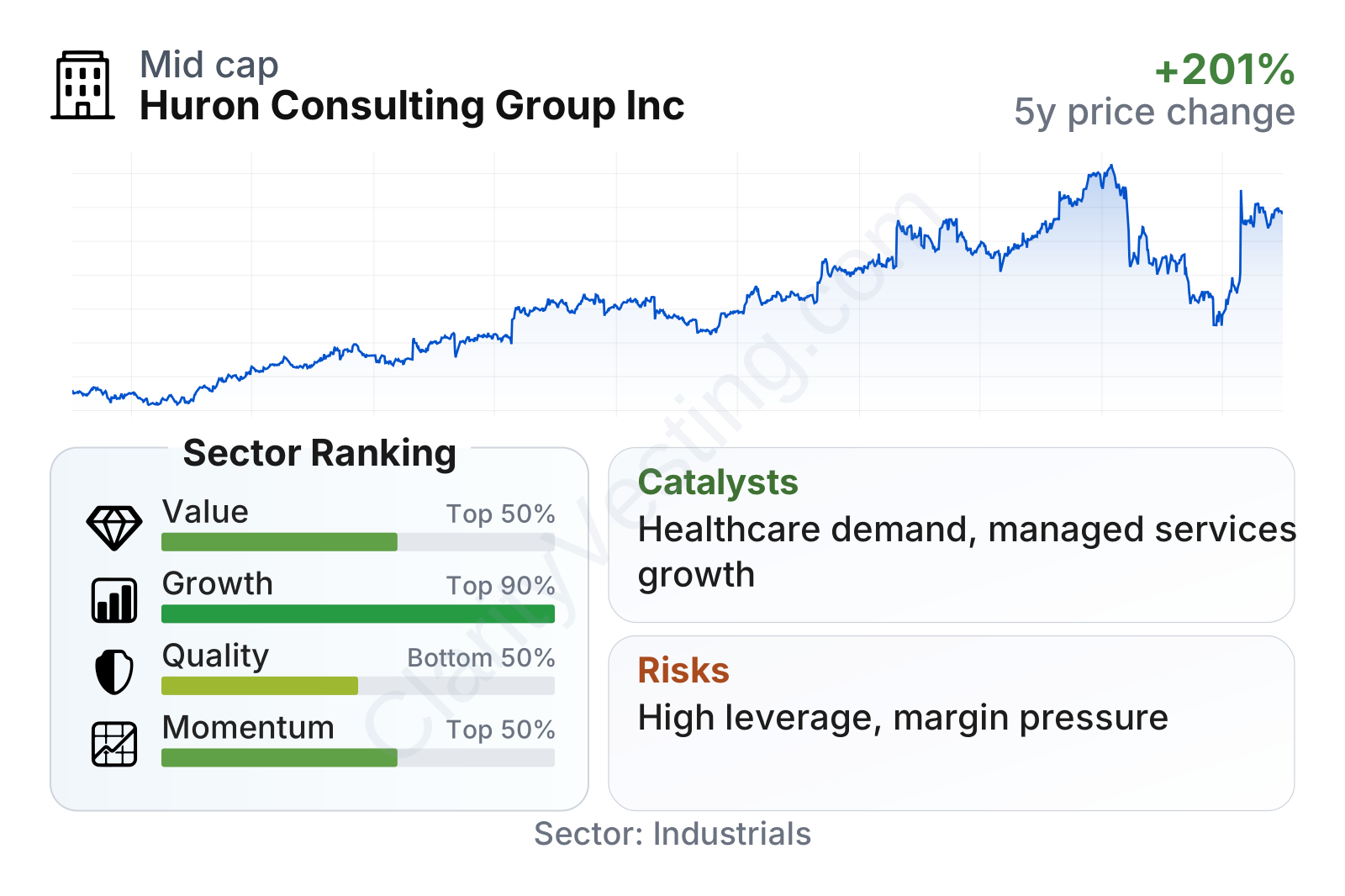
Huron is a mid-sized consulting company with a market value in the low single-digit billions of dollars. The stock has been volatile in 2026 after a very strong multi-year run, which is common for consulting names when expectations reset. In the factor breakdown, growth stands out as the company’s strongest area, ranking near the top of its sector. Value looks roughly middle of the pack, while quality is weaker mainly because leverage is noticeably above the sector median. Momentum remains decent despite the pullback, helped by the stock’s stronger medium-term trend.
Growth
Huron operates in consulting niches that still have favorable long-term demand drivers. Healthcare systems continue to deal with reimbursement pressure, staffing shortages, margin recovery, compliance requirements, and digital modernization. Universities are under pressure to improve efficiency, manage enrollment trends, and upgrade administrative technology. Corporate clients also continue to spend on transformation, especially where operations and data systems need modernization. Those are not short-lived themes, which gives Huron exposure to structural demand rather than only cyclical consulting projects.
The company’s strategy appears coherent for future growth. It has built deeper specialization in healthcare and education instead of trying to compete broadly across every advisory market. That focus matters because clients in these sectors often want domain expertise, not just generic consultants. Huron has also been expanding its digital and technology-related capabilities, including implementation and managed services, which can support larger engagements and potentially improve client retention.
Recent revenue growth has remained strong, generally in the low-to-high teens lately after several earlier quarters above 20%. That is better than the sector median and supports the idea that Huron is gaining business in its core markets rather than simply growing at the pace of the industry. Over a five-year period, revenue per share growth has also been far stronger than the sector norm, which suggests expansion has translated into meaningful business scaling.
Cash generation is another important point. Free cash flow improved dramatically over the last few years, although it has not moved in a straight line and has come off a recent peak. Even after that moderation, cash conversion remains meaningful for a consulting business of this size. This gives Huron flexibility to fund acquisitions, invest in capabilities, and manage debt, provided execution remains disciplined.
A notable catalyst is the continued need for complex transformation work in healthcare and higher education. Another is the company’s acquisition-driven expansion into adjacent capabilities, which can deepen client relationships and enlarge the addressable market. If Huron continues combining industry specialization with technology implementation and managed services, it may be able to capture larger and stickier contracts over time.
Risks
This article is for informational purposes only and does not constitute financial advice. Some content is AI-generated. See Disclaimer