Stock Analysis · Humana Inc (HUM)
Overview
Humana Inc. is a large U.S. health insurer focused mainly on government-sponsored healthcare, especially Medicare. The company offers Medicare Advantage plans, stand-alone Medicare prescription drug plans, and services for seniors that support care delivery at home, in clinics, and through pharmacy-related programs. Humana also has smaller operations in Medicaid and military healthcare, but its identity is closely tied to the aging U.S. population and the Medicare market.
Its revenue is generated primarily from insurance premiums and government payments tied to member enrollment. Based on recent company reporting, the business mix is heavily concentrated in the Insurance segment, with the remaining share coming from CenterWell, its healthcare services platform. A practical breakdown is:
- Insurance segment: about 81% to 83% of revenue. This includes Medicare Advantage, Medicare Part D prescription plans, Medicaid plans, and military services. Medicare products are the core driver inside this segment.
- CenterWell segment: about 17% to 19% of revenue. This includes pharmacy services, primary care, and home health operations that support Humana’s insured population and also serve broader healthcare needs.
The business model is straightforward in principle: Humana collects premium revenue, pays medical claims and care-related costs, and tries to earn a narrow margin by pricing risk correctly, managing care efficiently, and keeping administrative costs under control. One notable pattern in recent years is that revenue has continued to rise strongly, while net income has come under pressure, showing that scale alone is not enough when medical costs increase faster than expected.
The long-term picture is one of a much larger company than it was a few years ago, but also one operating with thinner earnings than before. That combination is important for understanding both the opportunity and the risk.
Key Figures
| Metric | Value | Sector ⓘ |
|---|---|---|
| Date | Oct 17, 2026 | |
| Context | ||
| Sector | Healthcare | |
| Industry | Healthcare Plans | |
| Market Cap ⓘ | $51.32B | |
| Beta ⓘ | 0.74 | |
Value (Cheapness) | ||
| P/E Ratio ⓘ | 39.72 | 24.79 |
| P/B Ratio ⓘ | 2.73 | 3.08 |
| FCF Yield ⓘ | -0.86% | 3.15% |
| Dividend Yield ⓘ | 0.84% | 1.94% |
| EBIT / EV ⓘ | 4.10% | 0.57% |
| PEG ⓘ | 1.25 | |
Growth (Business expansion) | ||
| Revenue Growth ⓘ | 26.20% | 7.45% |
| RPS Growth (5Y CAGR) ⓘ | 13.51% | 8.61% |
| EPS Growth (5Y CAGR) ⓘ | -8.70% | -17.81% |
| BVPS Growth (5Y CAGR) ⓘ | 4.05% | 3.72% |
| Margin Growth (5Y Trend) ⓘ | -2.87% | -0.62% |
| FCF Growth (5Y CAGR) ⓘ | -20.65% | 1.04% |
| DPS Growth (5Y CAGR) ⓘ | 6.80% | 6.77% |
Quality (Business durability) | ||
| ROIC (Latest) ⓘ | 6.29% | 3.24% |
| ROA (Latest) ⓘ | 2.39% | 3.01% |
| ROIC (5Y Median) ⓘ | 10.37% | 4.60% |
| ROA (5Y Median) ⓘ | 5.49% | 1.89% |
| Net Debt / EBIT (Latest) ⓘ | 3.17 | 1.34 |
| Net Debt / EBIT (5Y Median) ⓘ | 2.63 | 1.84 |
| Net Debt / EBITDA (Latest) ⓘ | 2.37 | 1.00 |
| Net Debt / Assets ⓘ | 12.86% | 5.45% |
| EBITDA / Interest ⓘ | 4.40 | 9.64 |
| Operating Margin (Latest) ⓘ | 1.59% | 9.27% |
| Operating Margin (5Y Median) ⓘ | 3.58% | 7.38% |
| Debt to Equity (Latest) ⓘ | 74.15% | 28.58% |
| Profit Margin (Latest) ⓘ | 0.88% | 3.59% |
| Free Cash Flow (Latest) ⓘ | -$443.00M | |
Momentum (Price trend) | ||
| 3Y Return ⓘ | -14.66% | +42.80% |
| 12M Return (excl. last month) ⓘ | +46.08% | +18.50% |
| 6M Return ⓘ | +118.39% | +7.57% |
| Price vs. 200-Day MA ⓘ | +44.25% | +5.12% |
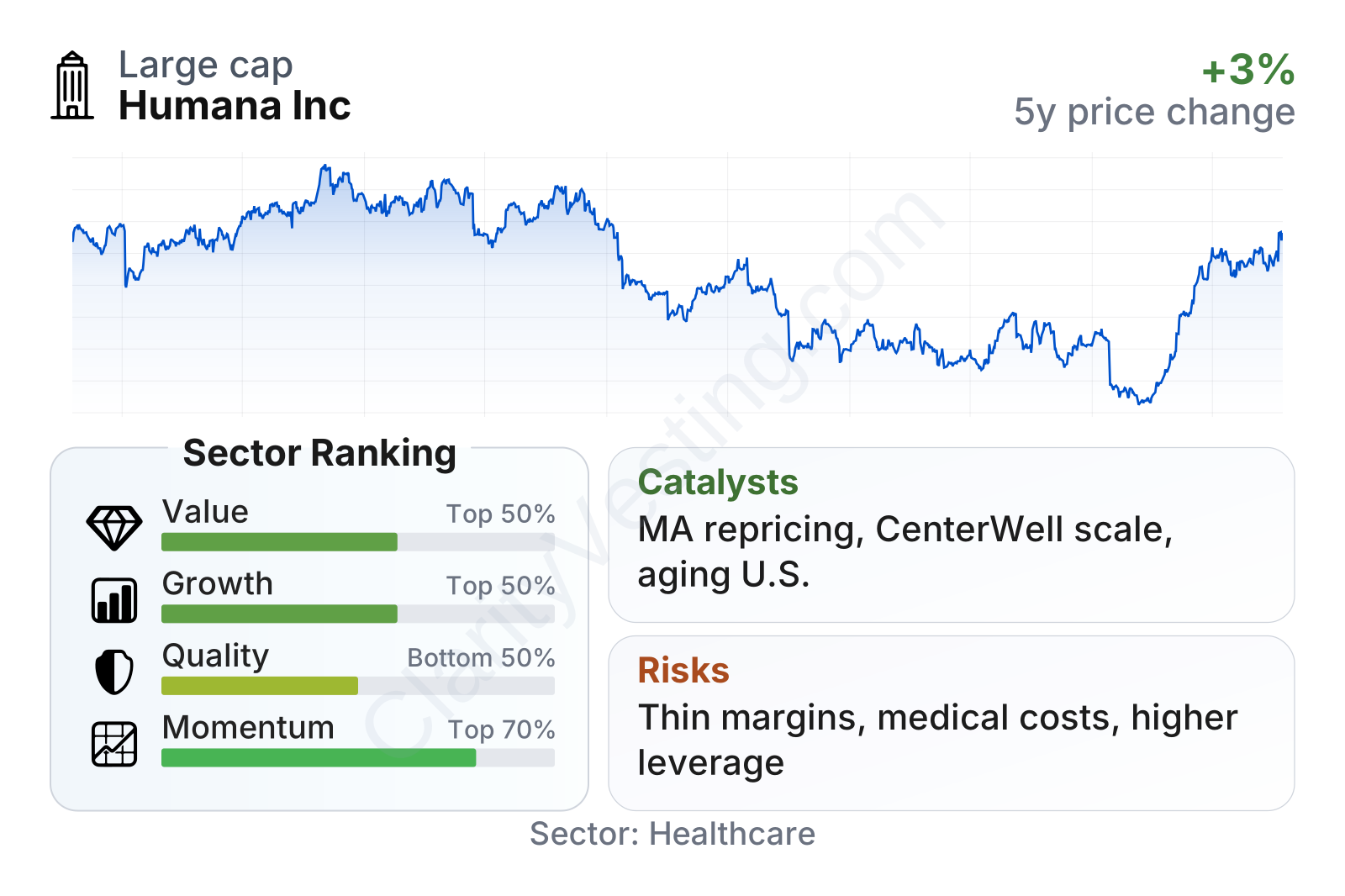
Humana is a large healthcare company with a market value in the tens of billions of dollars and a stock that has recently been very volatile after a long decline and a sharp rebound. In the factor summary, growth and momentum look relatively solid versus much of the healthcare sector, while quality is weaker because profitability and cash generation have been under pressure. Value metrics send a mixed message: the earnings multiple is above the sector median, but book value is below the median and operating earnings relative to enterprise value remain respectable. The biggest weak spot in the table is cash flow, with recent free cash flow turning negative and leverage staying noticeably above typical sector levels.
Growth
Humana operates in a part of healthcare with an attractive structural tailwind: the U.S. senior population continues to grow, and Medicare Advantage has taken share from traditional Medicare for years. That gives the company exposure to a market where enrollment can expand over a long period, even if annual profitability moves up and down. This is one reason Humana remains closely watched as a long-duration healthcare business rather than a purely cyclical insurer.
The company’s strategy also makes industrial sense. Humana is not only selling insurance; it has been building a more integrated care platform through CenterWell, combining pharmacy services, primary care, and home health. In theory, that can improve patient outcomes, keep members inside the Humana ecosystem, and help manage medical costs more efficiently. If this model works as intended, it can strengthen retention and support margins over time, especially in Medicare Advantage where care coordination matters.
Recent revenue growth has been strong, with year-over-year growth accelerating into the low-20% range by mid-2026, well above the broader healthcare sector median. That indicates the company is still expanding its top line at a healthy pace despite the pressure that has hit the managed-care industry. Over a five-year view, revenue per share growth has also outpaced the sector median, reinforcing that Humana has continued to scale even through a difficult earnings cycle.
Cash generation has been much less steady. Free cash flow has swung sharply from strong positive levels to negative territory and then back to modestly positive levels before turning negative again on a trailing basis. For a long-term view, that matters because insurers need financial flexibility when medical cost trends shift unexpectedly. Revenue growth is clearly present, but the quality of that growth is not as convincing as it would be if margins and cash flow were moving in the same direction.
One of the main catalysts is Medicare Advantage rate updates and Humana’s ability to reprice plans after a period of unusually high utilization. If pricing, benefit design, and care management begin to better match the current medical cost environment, earnings could recover meaningfully from depressed levels. Another potential opportunity is stronger operating leverage from CenterWell if its care and pharmacy businesses continue to expand alongside the insurance base.
Recent company updates in 2026 have also kept attention on enrollment positioning and margin recovery efforts rather than on a major strategic reset. The opportunity is less about discovering a new business line and more about restoring profitability in a franchise that is already large and well established.
Risks
This article is for informational purposes only and does not constitute financial advice. Some content is AI-generated. See Disclaimer


