Stock Analysis · Huabao International Holdings Ltd (HUIHY)
Overview
Huabao International Holdings Ltd is a China-based specialty ingredients company best known for flavors and fragrances used in consumer products. Its business sits between raw materials and end markets such as tobacco, food and beverages, personal care, and household products. In practical terms, the company develops formulations that help customers shape taste, aroma, and product experience, and it also operates in aroma raw materials and condiment-related ingredients.
Based on the company’s recent annual reporting structure, revenue mainly comes from three operating segments.
- Flavors and fragrances: the largest business, contributing approximately 60% to 70% of group revenue in recent years. This segment includes products for tobacco, food, beverages, daily-use products, and related applications.
- Aroma raw materials: roughly 20% to 30% of revenue. This business supplies upstream fragrance and flavor ingredients used internally and sold to external customers.
- Condiment and food ingredients-related activities: generally around 10% of revenue, including savory ingredients and seasonings-oriented products.
The business mix matters because it gives Huabao exposure to recurring industrial demand rather than direct consumer retail sales. At the same time, a meaningful part of its business has historically been tied to tobacco-related applications, which can support scale but also adds regulatory sensitivity.
The company’s recent financial flow also shows a business that still generates substantial gross profit on multi-billion revenue, but profitability after operating costs has become much thinner than it was a few years ago. Revenue has been relatively stable since 2021, while selling and administrative expenses remain heavy and earnings have been volatile.
One visible trend is that revenue has held in a fairly narrow range over the past several years, but the conversion of sales into operating profit and net profit has weakened sharply. Gross profit remains meaningful, yet expense pressure and profit volatility have reduced the earnings power that the company used to show.
Key Figures
| Metric | Value | Sector ⓘ |
|---|---|---|
| Date | Oct 17, 2026 | |
| Context | ||
| Sector | Basic Materials | |
| Industry | Specialty Chemicals | |
| Market Cap ⓘ | $1.61B | |
| Beta ⓘ | 0.06 | |
Value (Cheapness) | ||
| P/E Ratio ⓘ | 49.02 | 16.90 |
| P/B Ratio ⓘ | 0.14 | 1.65 |
| FCF Yield ⓘ | 45.63% | 5.76% |
| Dividend Yield ⓘ | 0.04% | 2.13% |
| EBIT / EV ⓘ | N/A | 6.30% |
| PEG ⓘ | N/A | |
Growth (Business expansion) | ||
| Revenue Growth ⓘ | 15.90% | 11.10% |
| RPS Growth (5Y CAGR) ⓘ | -3.57% | 4.49% |
| EPS Growth (5Y CAGR) ⓘ | N/A | -13.47% |
| BVPS Growth (5Y CAGR) ⓘ | -9.36% | 5.51% |
| Margin Growth (5Y Trend) ⓘ | -30.34% | -1.54% |
| FCF Growth (5Y CAGR) ⓘ | -6.09% | 0.37% |
| DPS Growth (5Y CAGR) ⓘ | -9.90% | 6.08% |
Quality (Business durability) | ||
| ROIC (Latest) ⓘ | N/A | 9.26% |
| ROA (Latest) ⓘ | -1.51% | 4.91% |
| ROIC (5Y Median) ⓘ | 1.32% | 7.70% |
| ROA (5Y Median) ⓘ | -2.49% | 3.86% |
| Net Debt / EBIT (Latest) ⓘ | -22.48 | 1.40 |
| Net Debt / EBIT (5Y Median) ⓘ | -4.63 | 1.70 |
| Net Debt / EBITDA (Latest) ⓘ | -5.36 | 0.95 |
| Net Debt / Assets ⓘ | -29.49% | 13.69% |
| EBITDA / Interest ⓘ | N/A | 12.34 |
| Operating Margin (Latest) ⓘ | 3.00% | 13.20% |
| Operating Margin (5Y Median) ⓘ | 1.31% | 11.80% |
| Debt to Equity (Latest) ⓘ | 1.53% | 40.56% |
| Profit Margin (Latest) ⓘ | -10.76% | 6.43% |
| Free Cash Flow (Latest) ⓘ | $735.13M | |
Momentum (Price trend) | ||
| 3Y Return ⓘ | +39.61% | +68.89% |
| 12M Return (excl. last month) ⓘ | +66.63% | +30.21% |
| 6M Return ⓘ | +2.81% | -4.16% |
| Price vs. 200-Day MA ⓘ | +1.92% | -1.27% |
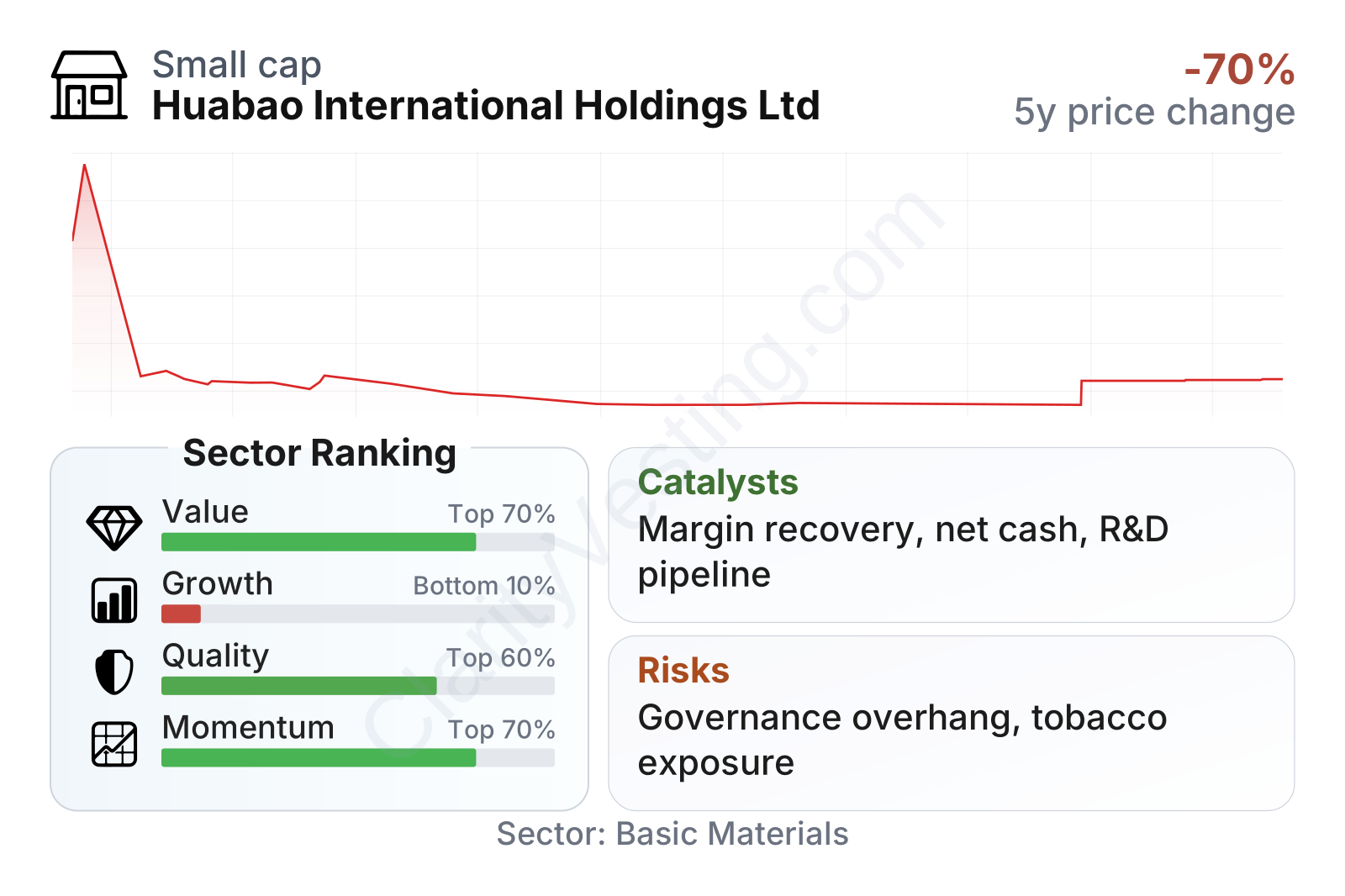
Huabao is a mid-sized company by market value, and the share price has recovered from much lower levels reached after the sharp decline from 2021. The stock has shown stronger 12-month momentum than the sector median, but the longer three-year performance still reflects that earlier collapse.
The metric profile is unusual. On one hand, the shares look optically cheap on asset-based measures, with a price-to-book ratio far below the sector median, and the balance sheet appears very conservative with very low leverage and a net cash position. Free cash flow is also strong relative to the current market value. On the other hand, earnings-based valuation looks demanding because recent profits have been weak and inconsistent, which pushes the price-to-earnings ratio well above the sector median.
The table also points to the core contradiction in the case: balance sheet strength and cash generation look solid, but long-term growth, returns on assets, profit margin, and margin trend have all been weak versus the broader specialty chemicals group. That combination often means the market is not valuing the company as a straightforward growth business, but rather as a business with recovery potential that still needs to prove earnings quality.
Growth
Huabao operates in a sector with durable long-term demand drivers. Flavor, fragrance, and ingredients markets usually benefit from rising consumer spending, product premiumization, new product launches, and customers outsourcing formulation work to specialized suppliers. These are generally supportive industry characteristics because they create repeat demand and can reward companies with formulation know-how, customer relationships, and regulatory experience.
For Huabao specifically, the growth picture is mixed rather than straightforward. Recent yearly revenue growth has been better than the sector median, showing that sales have not stalled. However, the longer five-year record is much less encouraging: revenue per share, book value per share, free cash flow growth, dividend growth, and operating margin trend have all been weak. That suggests the company has been able to keep business volume relatively stable, but has had more difficulty turning that activity into durable per-share value creation.
The strategy still has a logical industrial basis. Having positions in both flavors and fragrances and aroma raw materials can create internal sourcing links, technical know-how, and customer stickiness. If the company can improve cost discipline, stabilize margins, and make better use of its cash-rich balance sheet, that structure could support a more durable recovery in profitability.
A notable potential catalyst is margin normalization. The company’s recent numbers show that even modest improvement in operating efficiency could have an outsized effect on earnings because gross profit remains substantial. Another positive point is financial flexibility: very low debt and net cash reduce pressure from interest costs and give the company room to absorb volatility or invest selectively.
Recent public company materials have also continued to emphasize product innovation and technology capabilities in flavor and fragrance applications. In a specialized ingredients business, that matters because formulation expertise can deepen customer relationships and support new product opportunities over time, even when near-term profits are under pressure.
Risks
This article is for informational purposes only and does not constitute financial advice. Some content is AI-generated. See Disclaimer


