Stock Analysis · Hilltop Holdings Inc (HTH)
Overview
Hilltop Holdings Inc. is a Texas-based financial holding company centered on banking and mortgage operations. Its main businesses are PlainsCapital Bank, which provides commercial and consumer banking services, and PrimeLending, a national mortgage origination platform. The group also has a smaller investment and corporate segment. In simple terms, Hilltop earns money by gathering deposits, making loans, collecting interest, generating fees from mortgage production, and earning income from securities and other financial activities.
The company’s revenue mix can move meaningfully from year to year because mortgage activity is cyclical and banking results are sensitive to interest rates. Based on recent annual reporting, the largest sources of revenue are broadly organized as follows:
- Net interest income from banking: approximately 45% to 55% of total revenue in a typical recent year. This is the spread between what PlainsCapital earns on loans and securities and what it pays on deposits and borrowings.
- Mortgage-related income: approximately 25% to 35%. This mainly comes from loan origination fees, gain-on-sale income when mortgages are sold, and mortgage servicing-related activity through PrimeLending.
- Other noninterest income: approximately 15% to 25%. This includes service charges, wealth and treasury-related fees, securities income, and other banking fees.
- Broker-dealer and corporate/investment activities: generally less than 10%. This is the smallest piece and can vary depending on market conditions and one-time items.
That mix matters because Hilltop is not a pure bank and not a pure mortgage lender. It sits in between, which can help diversify revenue but also exposes results to two different cycles at the same time: credit and funding conditions on one side, and housing and refinancing activity on the other.
Over the last several years, total revenue fell sharply from the unusually strong 2021 level and then began to rebuild. Profitability also compressed as interest expense rose and the mortgage market cooled, although 2025 showed a visible improvement in revenue and net income compared with 2024. That pattern suggests a company still recovering from a difficult rate environment rather than one already operating at peak earnings power.
The business has recently shown a gradual rebound in revenue and net income after a steep post-2021 reset, but a larger share of revenue is being absorbed by interest expense and operating costs than during the stronger cycle.
Key Figures
| Metric | Value | Sector ⓘ |
|---|---|---|
| Date | Oct 24, 2026 | |
| Context | ||
| Sector | Financial Services | |
| Industry | Financial Conglomerates | |
| Market Cap ⓘ | $2.09B | |
| Beta ⓘ | 0.89 | |
Value (Cheapness) | ||
| P/E Ratio ⓘ | 13.52 | 12.46 |
| P/B Ratio ⓘ | 1.03 | 1.25 |
| FCF Yield ⓘ | -3.01% | 9.82% |
| Dividend Yield ⓘ | 2.07% | 2.94% |
| EBIT / EV ⓘ | 6.09% | 8.11% |
| PEG ⓘ | 0.61 | |
Growth (Business expansion) | ||
| Revenue Growth ⓘ | 5.20% | 9.10% |
| RPS Growth (5Y CAGR) ⓘ | 3.21% | 12.31% |
| EPS Growth (5Y CAGR) ⓘ | -6.29% | -6.97% |
| BVPS Growth (5Y CAGR) ⓘ | 2.63% | 5.02% |
| Margin Growth (5Y Trend) ⓘ | -13.59% | -4.00% |
| FCF Growth (5Y CAGR) ⓘ | N/A | 4.71% |
| DPS Growth (5Y CAGR) ⓘ | 10.81% | 8.92% |
Quality (Business durability) | ||
| ROIC (Latest) ⓘ | 6.40% | 9.18% |
| ROE (Latest) ⓘ | 7.60% | 13.93% |
| ROA (Latest) ⓘ | 1.02% | 1.57% |
| ROIC (5Y Median) ⓘ | 4.53% | 7.80% |
| ROE (5Y Median) ⓘ | 5.33% | 12.15% |
| ROA (5Y Median) ⓘ | 0.69% | 1.28% |
| Net Debt / EBIT (Latest) ⓘ | 3.85 | 1.02 |
| Net Debt / EBIT (5Y Median) ⓘ | -2.67 | 0.72 |
| Net Debt / EBITDA (Latest) ⓘ | 3.68 | 0.88 |
| Operating Margin (Latest) ⓘ | 13.48% | 22.30% |
| Operating Margin (5Y Median) ⓘ | 11.54% | 24.50% |
| Debt to Equity (Latest) ⓘ | 74.17% | 59.34% |
| Profit Margin (Latest) ⓘ | 12.73% | 26.42% |
| Free Cash Flow (Latest) ⓘ | -$63.03M | |
Momentum (Price trend) | ||
| 3Y Return ⓘ | +44.83% | +95.73% |
| 12M Return (excl. last month) ⓘ | +15.10% | +17.30% |
| 6M Return ⓘ | +0.34% | +6.07% |
| Price vs. 200-Day MA ⓘ | -0.33% | +5.36% |
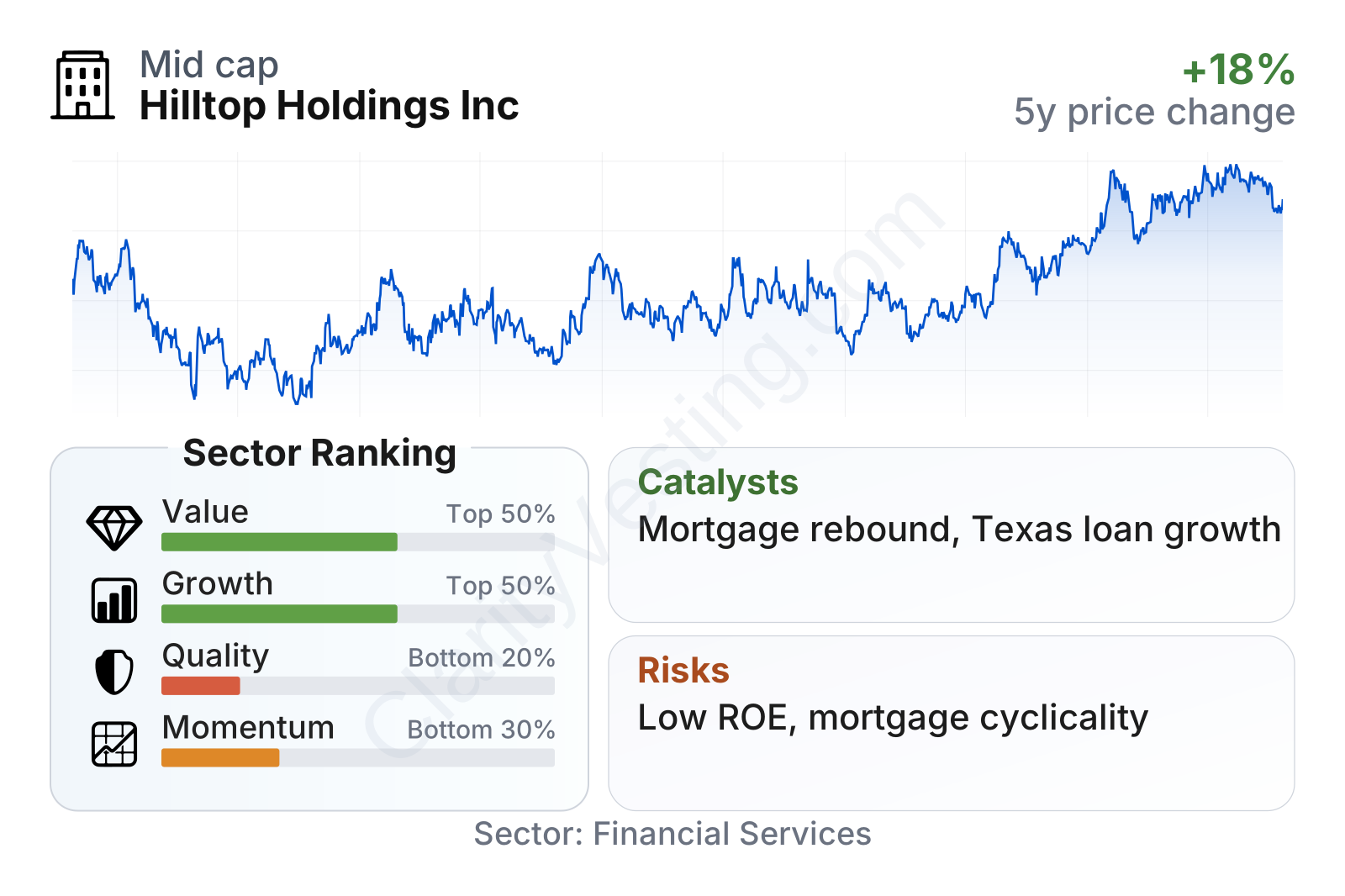
Hilltop sits in the middle of the pack on valuation and growth, but its profitability and efficiency remain weaker than much of the sector. The company’s earnings multiple is not extreme, and its price-to-book ratio is below the sector median, which points to restrained market expectations. At the same time, returns on equity and assets are notably lower than typical peers, and recent share-price momentum has been positive but not especially strong compared with other financial stocks.
The stock has trended upward since 2025 and has reached levels above its earlier range from 2022 through 2024. Even so, the market still appears to be valuing Hilltop more conservatively than many financial peers, likely because the company’s recovery in earnings quality has lagged the share-price improvement.
Growth
Hilltop operates in sectors that can grow over time, but they are not straightforward high-growth markets. Traditional banking benefits from population growth, business formation, and rising financial activity, especially in economically active regions such as Texas. Mortgage banking can expand when home sales, construction, and refinancing improve, but it is highly sensitive to interest rates. That makes Hilltop more of a cyclical growth company than a structurally fast-growing one.
The company’s strategy is logical: use a stable regional bank to fund and support broader customer relationships while keeping exposure to the mortgage market through a national platform. If rates stabilize or decline, PrimeLending could benefit from stronger origination volume, while the bank could gain from better loan demand and less pressure on funding costs. This is one of the clearest reasons Hilltop has upside in a more favorable rate environment.
Earnings per share show how dramatic the cycle has been. After a very strong 2021, profit dropped sharply and then slowly recovered through 2025. That recovery matters because it suggests the company is no longer falling deeper into the downcycle, but it also shows that earnings remain well below the earlier peak. In other words, the business has improved, yet it has not fully rebuilt its prior earning power.
Book value per share has moved up steadily after the 2022 dip, which is an encouraging sign for a financial company. For banks and financial holding companies, book value is a useful indicator because it reflects the capital base supporting lending and other activities. Hilltop’s growth here has been positive, though still modest compared with stronger operators in the sector.
A meaningful catalyst is the housing and mortgage cycle. If affordability improves, existing home sales recover, or mortgage rates decline enough to support refinancing, PrimeLending could see better volumes and improved operating leverage. On the banking side, loan growth in Texas and surrounding markets, along with easing deposit-cost pressure, could lift net interest income. The company has also continued returning capital through dividends, with dividend growth over five years running ahead of the sector median, which signals some confidence in balance-sheet resilience even if headline profitability remains moderate.
Risks
This article is for informational purposes only and does not constitute financial advice. Some content is AI-generated. See Disclaimer


