Stock Analysis · Heartflow Inc (HTFL)
Overview
Heartflow is a healthcare technology company focused on helping doctors diagnose and manage coronary artery disease, the most common form of heart disease. Its core offering combines coronary CT scans with artificial intelligence, advanced image analysis, and computational modeling to create a personalized, noninvasive view of blood flow and plaque in the heart. In simple terms, the company aims to give cardiologists more useful information than a standard scan alone, while potentially reducing the need for invasive diagnostic procedures.
The business is largely built around services and software used by hospitals, health systems, and imaging centers. Based on company filings, Heartflow’s revenue comes mainly from the commercial use of its cardiac test platform and related offerings. The broad revenue mix appears to be concentrated in a few categories:
- Heartflow FFRct Analysis and related core diagnostic services: the main revenue driver, likely representing the large majority of total revenue. This includes the company’s flagship analysis used after a coronary CT scan to assess whether arterial narrowing is likely to restrict blood flow.
- Heartflow Plaque Analysis and other newer clinical applications: a smaller but growing contribution, tied to additional insights from CT imaging such as plaque characterization and disease assessment.
- Other revenue: a limited portion from items such as service-related arrangements, collaborations, and ancillary activities where applicable.
Revenue is still concentrated around one clinical workflow rather than being broadly diversified across many unrelated products. That concentration increases dependence on adoption, reimbursement, and continued physician use of the Heartflow platform. At the same time, it gives the company a clear identity in a large medical need area where better diagnosis can have meaningful clinical value.
Over the last three reported full years, revenue expanded strongly while gross profit also improved in absolute dollars. The main pattern is encouraging on the top line, but operating expenses have grown even faster, especially in selling, general, and administrative costs and research and development, showing that Heartflow is still in a scale-building phase rather than a mature profit-harvesting phase.
The operating picture shows a business with rising sales and a healthy gross profit structure, but one that continues to spend heavily to expand commercially and develop its platform. That combination is common in younger healthcare technology companies, but it also means the path to sustained profitability remains an important issue.
Key Figures
| Metric | Value | Sector ⓘ |
|---|---|---|
| Date | Oct 24, 2026 | |
| Context | ||
| Sector | Healthcare | |
| Industry | Health Information Services | |
| Market Cap ⓘ | $4.85B | |
| Beta ⓘ | N/A | |
Value (Cheapness) | ||
| P/E Ratio ⓘ | N/A | 25.42 |
| P/B Ratio ⓘ | 17.12 | 3.08 |
| FCF Yield ⓘ | -1.22% | 3.12% |
| Dividend Yield ⓘ | N/A | 1.85% |
| EBIT / EV ⓘ | -2.88% | 0.56% |
| PEG ⓘ | N/A | |
Growth (Business expansion) | ||
| Revenue Growth ⓘ | 47.60% | 7.50% |
| RPS Growth (5Y CAGR) ⓘ | 22.95% | 8.60% |
| EPS Growth (5Y CAGR) ⓘ | N/A | -17.73% |
| BVPS Growth (5Y CAGR) ⓘ | N/A | 3.72% |
| Margin Growth (5Y Trend) ⓘ | N/A | -0.57% |
| FCF Growth (5Y CAGR) ⓘ | -15.41% | 0.96% |
| DPS Growth (5Y CAGR) ⓘ | N/A | 6.69% |
Quality (Business durability) | ||
| ROIC (Latest) ⓘ | -32.02% | 3.17% |
| ROA (Latest) ⓘ | -33.40% | 2.98% |
| ROIC (5Y Median) ⓘ | N/A | 4.56% |
| ROA (5Y Median) ⓘ | N/A | 1.87% |
| Net Debt / EBIT (Latest) ⓘ | N/A | 1.34 |
| Net Debt / EBIT (5Y Median) ⓘ | N/A | 1.86 |
| Net Debt / EBITDA (Latest) ⓘ | N/A | 1.00 |
| Net Debt / Assets ⓘ | -2.10% | 5.06% |
| EBITDA / Interest ⓘ | N/A | 9.55 |
| Operating Margin (Latest) ⓘ | -54.23% | 9.25% |
| Operating Margin (5Y Median) ⓘ | -58.51% | 7.33% |
| Debt to Equity (Latest) ⓘ | 9.70% | 26.68% |
| Profit Margin (Latest) ⓘ | -55.82% | 3.34% |
| Free Cash Flow (Latest) ⓘ | -$59.18M | |
Momentum (Price trend) | ||
| 3Y Return ⓘ | N/A | +51.61% |
| 12M Return (excl. last month) ⓘ | +59.62% | +19.90% |
| 6M Return ⓘ | +68.33% | +10.10% |
| Price vs. 200-Day MA ⓘ | +66.18% | +6.44% |
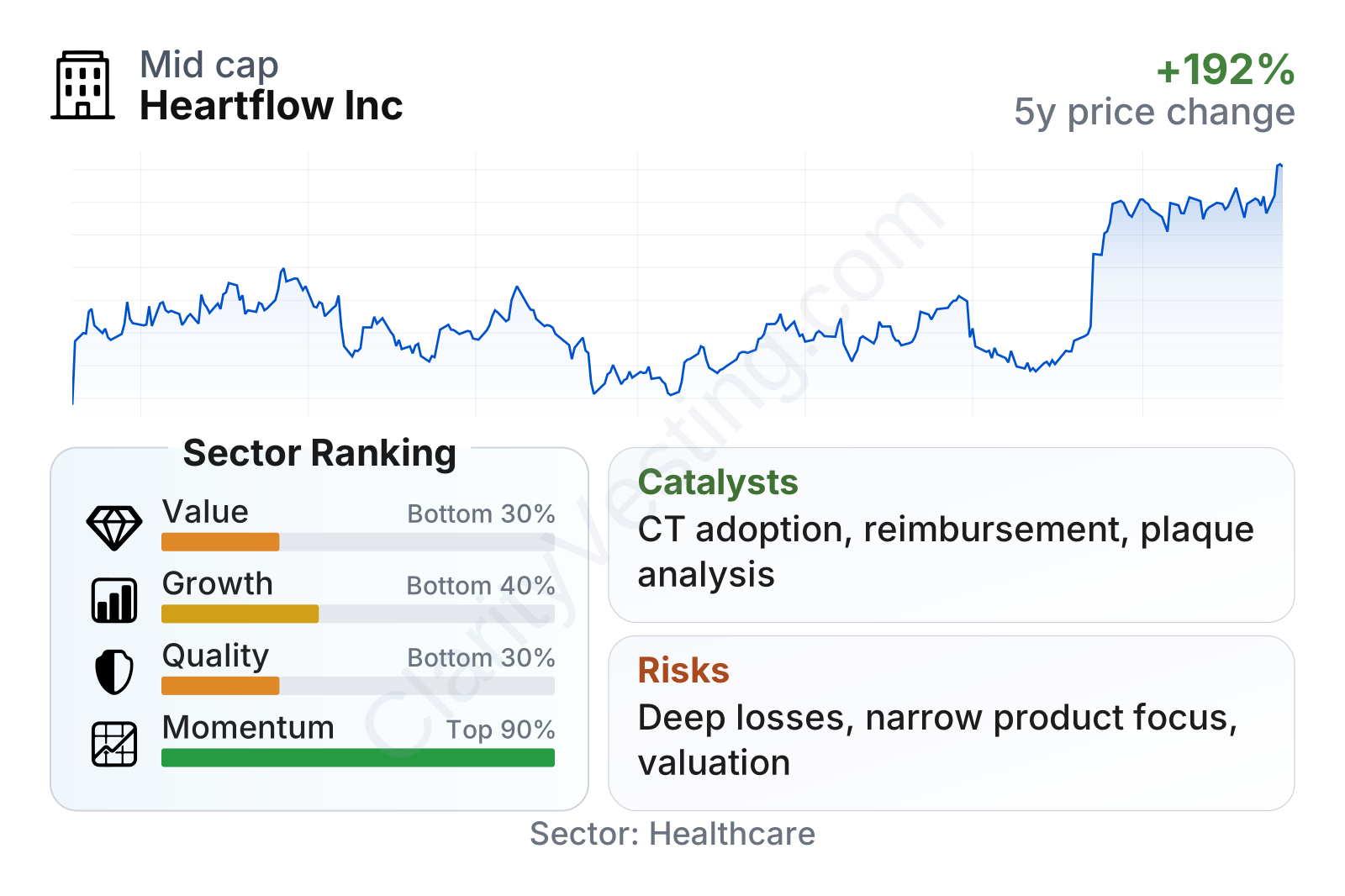
Heartflow currently stands out more for growth and market momentum than for traditional valuation or profitability measures. Revenue growth is far above the sector median, and its multi-year revenue-per-share trend also looks strong. By contrast, profitability, returns on capital, and free cash flow remain well below typical healthcare peers, which explains why the quality and value profiles rank weakly. The market has clearly rewarded the growth narrative, with share-price performance over the last 6 to 12 months materially stronger than the broader sector.
In size terms, Heartflow is now a mid-cap healthcare company rather than an early micro-cap name, which gives it more visibility but also raises expectations. The stock’s premium price-to-book ratio and negative cash flow metrics suggest the market is valuing future commercial progress well ahead of current earnings power.
Growth
Heartflow operates in an attractive part of healthcare: cardiovascular disease diagnosis, imaging-enabled decision support, and AI-assisted clinical workflow. Coronary artery disease remains one of the largest and most expensive health burdens worldwide, so a tool that can improve triage, reduce uncertainty, and guide treatment has a sizable addressable market. That makes the sector itself supportive for long-term expansion, especially as health systems look for noninvasive tools that can improve care pathways.
The company’s strategy also makes sense on paper. It starts with a focused use case, analyzing coronary CT data, and then expands the value of that same imaging workflow through added modules such as plaque analysis and broader disease insights. This approach can deepen revenue per patient and make the product more useful to clinicians without requiring a completely new sales motion. In healthcare, this kind of platform extension can be powerful because it builds on existing clinical habits and installed relationships.
Recent business momentum appears meaningful. Full-year revenue rose from about $87 million in 2023 to about $126 million in 2024 and then to about $176 million in 2025. That is a substantial acceleration in a short period. Gross profit also climbed, indicating that sales growth is not being achieved through a collapsing unit economics profile. Year-over-year revenue growth near 48% in the latest metrics is especially strong for a company that is already beyond the earliest commercialization stage.
A major catalyst is reimbursement and guideline adoption. For a diagnostic platform like Heartflow, broader payer coverage and stronger clinical acceptance can unlock usage at scale. The company has also been positioning itself around evidence generation, physician adoption, and expanded use of coronary CT as a front-line diagnostic tool. If more health systems incorporate CT-based pathways earlier in cardiac evaluation, Heartflow could benefit because its software is designed to add actionable insight directly to that workflow.
Another visible opportunity is the combination of AI and imaging in a real clinical setting, not just as a research concept. Many healthcare AI companies are still trying to prove practical relevance. Heartflow already sells a product tied to a common disease area and a known diagnostic pathway, which gives it a more concrete commercial foundation than many earlier-stage medical AI businesses.
Risks
This article is for informational purposes only and does not constitute financial advice. Some content is AI-generated. See Disclaimer


