Stock Analysis · Hershey Co (HSY)
Overview
The Hershey Company is one of the largest snack and confectionery groups in North America. It is best known for chocolate brands such as Hershey’s, Reese’s, Kit Kat in the U.S. under license, Kisses, and Twizzlers, but the business also includes salty snacks and popcorn through brands such as Dot’s Homestyle Pretzels, SkinnyPop, and Pirate’s Booty. Its products are sold mainly through supermarkets, convenience stores, club stores, drugstores, mass retailers, and e-commerce channels.
Hershey’s revenue base is still heavily centered on confectionery, with North America driving most of the business. Based on recent company reporting, the revenue mix is approximately as follows:
- North America Confectionery: about 82% to 85% of revenue. This includes chocolate, candy, gum, and mint products sold mainly in the U.S. and Canada.
- North America Salty Snacks: about 10% to 13% of revenue. This includes ready-to-eat popcorn, pretzels, puffs, and other savory snacks.
- International: about 5% to 7% of revenue. This includes confectionery and snack sales outside North America, with operations in markets such as Brazil, Mexico, India, and selected export markets.
This mix matters for long-term analysis because it shows that Hershey is still primarily a branded U.S. confectionery company, with salty snacks and international operations acting more as expansion platforms than equal-sized profit engines. The business has historically generated strong gross profit and operating income from this focused model, although recent periods have shown more pressure from input costs and earnings volatility.
The long-term picture shows revenue rising from roughly $9 billion in 2021 to nearly $11.7 billion in 2025, but it also shows how sensitive profits can be to cost inflation. Gross profit and net income improved through 2024, then weakened sharply in 2025 as costs absorbed a much larger share of sales. That contrast is central to understanding Hershey today: the company still has pricing power and scale, but margins are not immune to commodity swings.
Key Figures
| Metric | Value | Sector ⓘ |
|---|---|---|
| Date | Nov 14, 2026 | |
| Context | ||
| Sector | Consumer Defensive | |
| Industry | Confectioners | |
| Market Cap ⓘ | $34.87B | |
| Beta ⓘ | 0.07 | |
Value (Cheapness) | ||
| P/E Ratio ⓘ | 19.62 | 18.98 |
| P/B Ratio ⓘ | 7.20 | 2.42 |
| FCF Yield ⓘ | 5.88% | 6.95% |
| Dividend Yield ⓘ | 3.22% | 2.68% |
| EBIT / EV ⓘ | 6.27% | 7.79% |
| PEG ⓘ | 0.89 | |
Growth (Business expansion) | ||
| Revenue Growth ⓘ | 3.00% | 4.00% |
| RPS Growth (5Y CAGR) ⓘ | 7.43% | 6.22% |
| EPS Growth (5Y CAGR) ⓘ | -5.51% | -10.65% |
| BVPS Growth (5Y CAGR) ⓘ | 14.50% | 3.24% |
| Margin Growth (5Y Trend) ⓘ | -9.09% | -0.23% |
| FCF Growth (5Y CAGR) ⓘ | 2.46% | 4.88% |
| DPS Growth (5Y CAGR) ⓘ | 12.77% | 6.57% |
Quality (Business durability) | ||
| ROIC (Latest) ⓘ | 19.19% | 11.61% |
| ROA (Latest) ⓘ | 12.98% | 6.27% |
| ROIC (5Y Median) ⓘ | 26.80% | 10.52% |
| ROA (5Y Median) ⓘ | 15.40% | 5.46% |
| Net Debt / EBIT (Latest) ⓘ | 1.79 | 1.82 |
| Net Debt / EBIT (5Y Median) ⓘ | 2.26 | 2.31 |
| Net Debt / EBITDA (Latest) ⓘ | 1.47 | 1.25 |
| Net Debt / Assets ⓘ | 32.03% | 20.03% |
| EBITDA / Interest ⓘ | 13.95 | 9.67 |
| Operating Margin (Latest) ⓘ | 20.25% | 8.97% |
| Operating Margin (5Y Median) ⓘ | 20.90% | 9.61% |
| Debt to Equity (Latest) ⓘ | 105.14% | 67.67% |
| Profit Margin (Latest) ⓘ | 14.63% | 5.40% |
| Free Cash Flow (Latest) ⓘ | $2.05B | |
Momentum (Price trend) | ||
| 3Y Return ⓘ | -2.13% | +19.66% |
| 12M Return (excl. last month) ⓘ | -10.68% | +3.06% |
| 6M Return ⓘ | -7.00% | +3.17% |
| Price vs. 200-Day MA ⓘ | -6.41% | +2.91% |
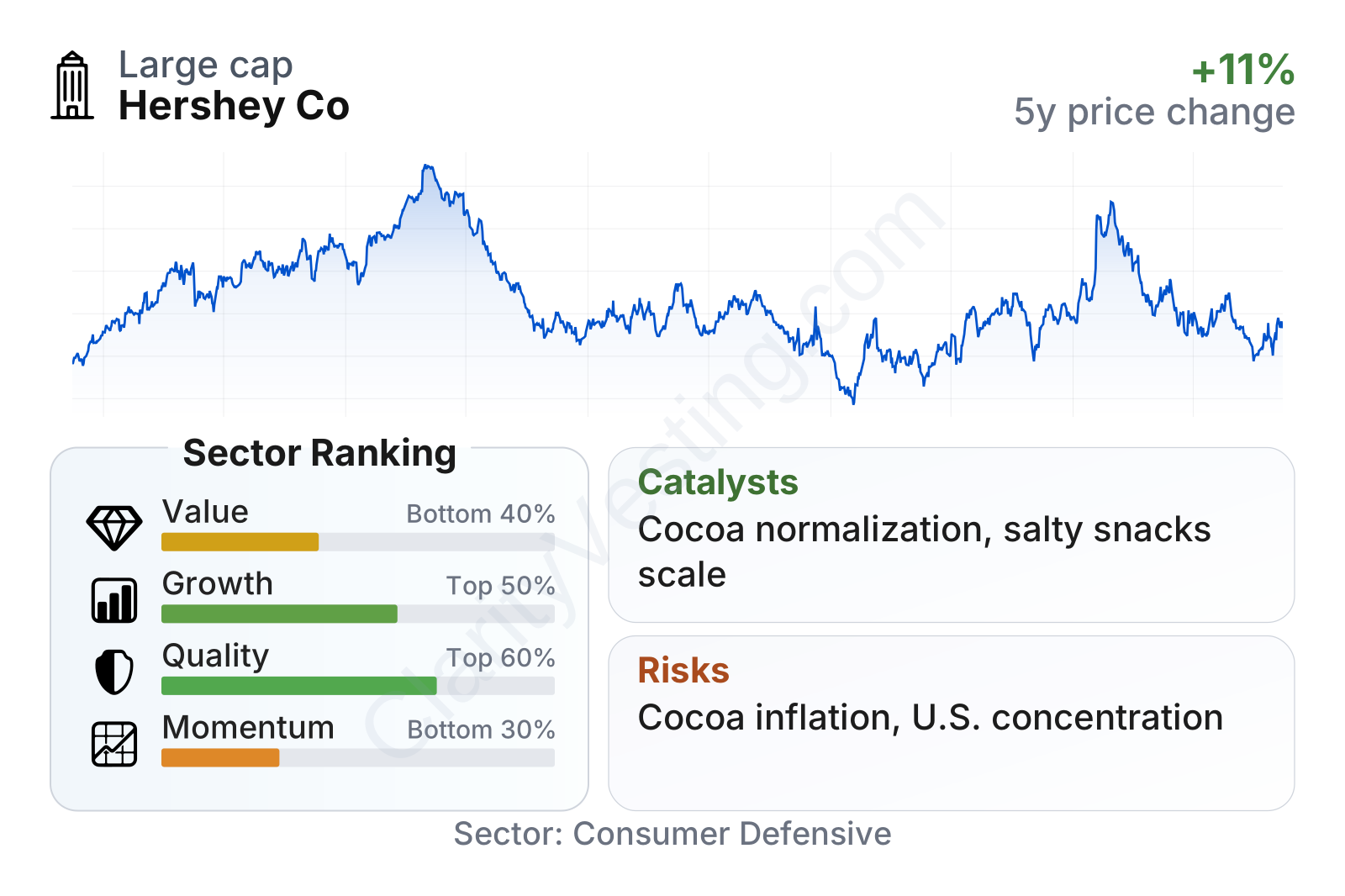
Hershey remains a large, low-volatility consumer staples company, as reflected by its very low beta. On quality, it stands above much of the sector, with returns on capital, returns on assets, operating margin, and profit margin all clearly stronger than median levels. Growth is more mixed: five-year revenue per share growth has been solid, but free cash flow growth has been slower and earnings have been uneven. Value metrics do not point to a clear bargain or clear premium overall. The earnings multiple is close to the sector median, while the price-to-book ratio is much higher, which is common for strong branded businesses but still signals that the market continues to place a premium on Hershey’s brand base and profitability.
Growth
The confectionery sector is usually not a high-growth area, but it tends to be durable. Demand for chocolate and candy is relatively resilient across economic cycles, and companies with strong shelf presence can grow through a combination of pricing, product mix, seasonal events, and innovation. That makes Hershey more of a steady compounder type of business than an aggressive expansion company.
Its strategy for future growth is logical. In core confectionery, the company continues to rely on brand strength, merchandising, seasonal products, and category leadership in U.S. chocolate. Outside that core, management has spent the last several years broadening the portfolio into salty snacks, which gives Hershey more access to adjacent snack occasions and reduces dependence on chocolate alone. International expansion also offers room for growth, although it remains a relatively small part of the group.
Recent sales growth has not been smooth, but the broader pattern suggests the business is still expanding. After very strong growth in 2022, the pace became more uneven, including periods of decline and rebound. More recently, year-over-year growth moved back into positive territory, but at a slower rate, ending in the low single digits. That points to a business that is still growing, though no longer benefiting from the exceptional pricing tailwinds seen earlier.
Cash generation remains one of Hershey’s most important strengths. Free cash flow has recovered from a softer 2024 level and has moved back above $2 billion on a trailing basis. For a consumer staples company, that matters because it supports dividends, debt service, brand investment, and acquisitions without requiring constant outside financing.
A major catalyst for the next phase is margin normalization if cocoa and other input costs stabilize. Hershey has historically shown an ability to pass through part of inflation via price increases, but there is usually a lag. If commodity pressure eases while pricing and mix remain supportive, earnings can recover faster than revenue. Another catalyst is the continued scaling of salty snacks, where acquired brands can benefit from Hershey’s distribution reach. Seasonal demand remains important too, especially around Halloween, Easter, and holiday periods, where merchandising power can lift volume and mix.
Recent company updates have also highlighted continued investment in capacity, digital selling tools, and brand support. Those are not dramatic headline events, but they are relevant for a long-term view because Hershey’s category position depends on execution at the shelf and consistent product availability more than on disruptive technology.
Risks
This article is for informational purposes only and does not constitute financial advice. Some content is AI-generated. See Disclaimer