Stock Analysis · HealthStream Inc (HSTM)
Overview
HealthStream is a healthcare technology company focused on workforce solutions for hospitals, health systems, and other care providers. In simple terms, it sells software and related services that help healthcare organizations train employees, manage compliance, assess clinical skills, support credentialing, and improve staffing decisions. Its customers use these tools to keep their workforce qualified, reduce administrative burden, and document that employees meet regulatory and professional requirements.
The business is largely built around subscription-based software and recurring services, which tends to make revenue more stable than one-time project work. HealthStream has also expanded through acquisitions and product development into adjacent areas such as credentialing, provider enrollment, scheduling, and workforce analytics. That broadens its role from employee education into a wider operating platform for healthcare employers.
Based on recent company reporting, revenue is organized across workforce-related applications and professional services, with subscription revenue representing the large majority of the total. A practical breakdown is:
- Subscription and recurring platform revenue: approximately 85% to 90% — software sold on ongoing contracts for learning management, credentialing, competency assessment, scheduling, and related workforce applications.
- Professional services and other revenue: approximately 10% to 15% — implementation, support, consulting, and other non-recurring services tied to customer deployments and platform use.
Within that mix, the core economic engine is workforce software for healthcare organizations, especially products tied to compliance, training, and credentialing. Those functions are not optional for hospitals, which gives HealthStream exposure to spending that is usually more resilient than purely discretionary technology budgets.
Revenue has grown steadily over the last several years, while profitability improved meaningfully from 2021 through 2024 before moderating somewhat in 2025. Gross profit remains strong, and research and development spending has stayed significant, showing that the company continues to invest in product expansion rather than simply harvesting mature assets.
The business model appears efficient: revenue has climbed from roughly $257 million in 2021 to about $304 million in 2025, while net income and cash generation improved faster than sales over much of that period. That pattern suggests a company benefiting from recurring revenue and operating leverage, even if margin progression is not perfectly smooth year to year.
Key Figures
| Metric | Value | Sector ⓘ |
|---|---|---|
| Date | Oct 17, 2026 | |
| Context | ||
| Sector | Healthcare | |
| Industry | Health Information Services | |
| Market Cap ⓘ | $1.03B | |
| Beta ⓘ | 0.42 | |
Value (Cheapness) | ||
| P/E Ratio ⓘ | 46.88 | 24.79 |
| P/B Ratio ⓘ | 2.78 | 3.08 |
| FCF Yield ⓘ | 4.73% | 3.15% |
| Dividend Yield ⓘ | 0.39% | 1.94% |
| EBIT / EV ⓘ | 3.30% | 0.57% |
| PEG ⓘ | 2.82 | |
Growth (Business expansion) | ||
| Revenue Growth ⓘ | 12.50% | 7.45% |
| RPS Growth (5Y CAGR) ⓘ | 5.58% | 8.61% |
| EPS Growth (5Y CAGR) ⓘ | 10.08% | -17.81% |
| BVPS Growth (5Y CAGR) ⓘ | 2.30% | 3.72% |
| Margin Growth (5Y Trend) ⓘ | 4.61% | -0.62% |
| FCF Growth (5Y CAGR) ⓘ | 36.78% | 1.04% |
| DPS Growth (5Y CAGR) ⓘ | 278.79% | 6.77% |
Quality (Business durability) | ||
| ROIC (Latest) ⓘ | 5.92% | 3.24% |
| ROA (Latest) ⓘ | 4.15% | 3.01% |
| ROIC (5Y Median) ⓘ | 4.51% | 4.60% |
| ROA (5Y Median) ⓘ | 3.05% | 1.89% |
| Net Debt / EBIT (Latest) ⓘ | -1.20 | 1.34 |
| Net Debt / EBIT (5Y Median) ⓘ | -1.46 | 1.84 |
| Net Debt / EBITDA (Latest) ⓘ | -0.46 | 1.00 |
| Net Debt / Assets ⓘ | -6.28% | 5.45% |
| EBITDA / Interest ⓘ | N/A | 9.64 |
| Operating Margin (Latest) ⓘ | 8.48% | 9.27% |
| Operating Margin (5Y Median) ⓘ | 6.63% | 7.38% |
| Debt to Equity (Latest) ⓘ | 3.77% | 28.58% |
| Profit Margin (Latest) ⓘ | 6.60% | 3.59% |
| Free Cash Flow (Latest) ⓘ | $48.85M | |
Momentum (Price trend) | ||
| 3Y Return ⓘ | +52.89% | +42.80% |
| 12M Return (excl. last month) ⓘ | +2.82% | +18.50% |
| 6M Return ⓘ | +60.85% | +7.57% |
| Price vs. 200-Day MA ⓘ | +35.50% | +5.12% |
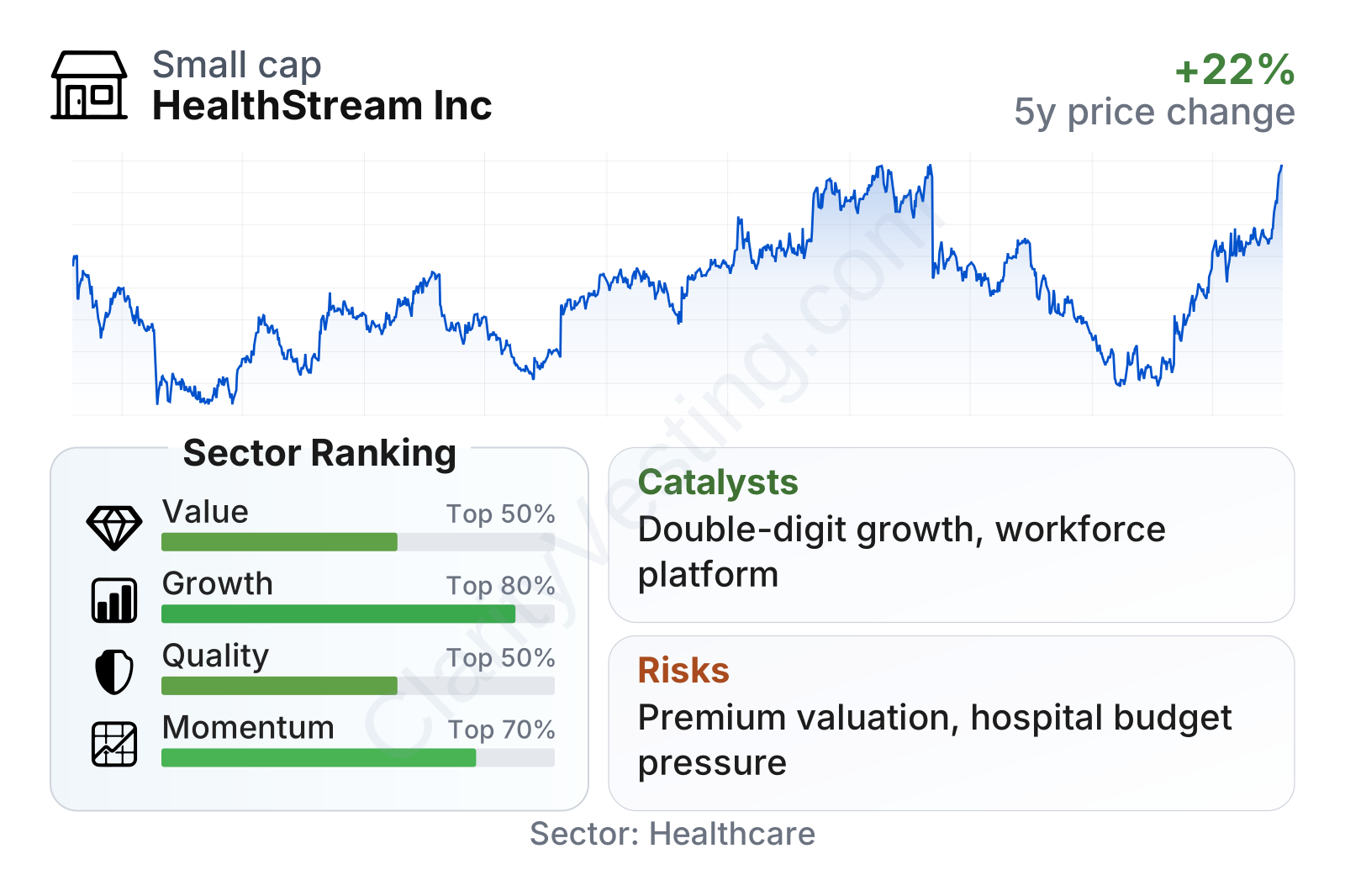
HealthStream is a small-cap healthcare software company with a market value a little above $1 billion and a notably low beta, meaning its share price has historically moved less dramatically than the broader market. On growth, the company ranks well within its healthcare peer group, helped by double-digit recent revenue growth and very strong multi-year free cash flow expansion. On quality, the balance sheet stands out: debt is very low, net debt is negative, and returns on capital are above sector medians. The main tension is valuation. Earnings-based multiples are above the sector median, so the market is already assigning a premium to the company’s stability and recent execution.
Growth
HealthStream operates in a part of healthcare that has favorable long-term demand drivers. Hospitals and health systems face constant pressure to train staff, document competencies, manage turnover, onboard clinicians faster, and deal with accreditation and compliance requirements. These needs do not disappear when the economy slows. In fact, labor shortages and rising complexity can make digital workforce tools even more necessary.
The company’s strategy is logical for this environment. Rather than relying on a single training product, it is building a broader workforce platform around learning, credentialing, staffing, scheduling, and provider management. That matters because customers often prefer fewer vendors handling connected workflows. A hospital that already uses HealthStream for education may be more willing to adopt adjacent modules, which can raise revenue per customer and improve retention.
Recent growth has accelerated. Year-over-year revenue growth was mostly in the low- to mid-single digits through much of 2022 to 2025, but it moved into double digits in the latest reported periods and recently reached around 12% to 13%, well above the sector median near 7%. That improvement suggests the company is getting more traction from its product portfolio and commercial execution rather than just benefiting from a stable installed base.
Cash generation also supports the growth case. Free cash flow has remained solid at roughly $50 million over the trailing period, after rising strongly over several years. That gives HealthStream room to fund internal development, maintain acquisitions as an option, and continue returning some capital through its dividend without leaning on debt. For a company of this size, self-funded growth is an important advantage.
A meaningful catalyst is the broader healthcare labor environment. Providers continue to face staffing constraints, retention challenges, and pressure to improve productivity. Products that help standardize onboarding, verify credentials, assess skills, and optimize workforce deployment fit directly into those operational needs. If HealthStream continues to deepen its position as a workflow provider rather than a narrow training vendor, its addressable market can keep expanding.
Risks
This article is for informational purposes only and does not constitute financial advice. Some content is AI-generated. See Disclaimer


