Stock Analysis · Host Hotels & Resorts Inc (HST)
Overview
Host Hotels & Resorts is a hotel real estate investment trust, or REIT. In simple terms, it owns a large portfolio of hotels and earns money from the cash flow those properties generate. The company focuses mainly on upscale and luxury hotels in the United States, with many assets operating under major brands such as Marriott, Ritz-Carlton, Westin, Sheraton, Hyatt, and Four Seasons. Because it is a REIT, the business is centered on property ownership, capital allocation, redevelopment, and balance sheet management rather than running a consumer brand of its own.
Its revenue comes primarily from hotel operations at consolidated properties. Based on recent company reporting, the business mix is heavily concentrated in room revenue, followed by food and beverage, then other hotel and ancillary items.
- Rooms: approximately 64% to 68% of total hotel revenue. This includes nightly room bookings and is the core earnings driver.
- Food and beverage: approximately 25% to 30%. This covers restaurants, bars, banquets, catering, and group event spending.
- Other revenue: approximately 5% to 10%. This generally includes resort fees, parking, spa, attrition and cancellation fees, retail, and other on-property services.
Geographically, the portfolio is primarily U.S.-based, with exposure to major urban markets and resort destinations. That matters because demand patterns are not identical: urban hotels depend more on business travel, conventions, and international visitors, while resorts are more tied to leisure travel and pricing power in peak seasons.
Over the last several years, the business has moved from pandemic-era recovery into normalized profitability. Revenue climbed from roughly $2.9 billion in 2021 to about $5.7 billion in 2024, while net income and operating income also recovered sharply. The visual below reflects that broader pattern, even if some 2025 line items appear distorted and should be treated cautiously.
Key Figures
| Metric | Value | Sector ⓘ |
|---|---|---|
| Date | Oct 04, 2026 | |
| Context | ||
| Sector | Real Estate | |
| Industry | REIT - Hotel & Motel | |
| Market Cap ⓘ | $15.67B | |
| Beta ⓘ | 1.10 | |
Value (Cheapness) | ||
| P/E Ratio ⓘ | 15.14 | 17.35 |
| P/B Ratio ⓘ | 2.54 | 0.86 |
| FCF Yield ⓘ | 6.46% | 7.47% |
| Dividend Yield ⓘ | 3.55% | 4.75% |
| EBIT / EV ⓘ | 7.05% | 3.81% |
| PEG ⓘ | 3.36 | |
Growth (Business expansion) | ||
| Revenue Growth ⓘ | 3.60% | 5.30% |
| RPS Growth (5Y CAGR) ⓘ | 21.31% | 5.96% |
| EPS Growth (5Y CAGR) ⓘ | 12.09% | -11.41% |
| BVPS Growth (5Y CAGR) ⓘ | 0.36% | 0.41% |
| Margin Growth (5Y Trend) ⓘ | 14.14% | 0.53% |
| FCF Growth (5Y CAGR) ⓘ | N/A | 5.40% |
| DPS Growth (5Y CAGR) ⓘ | 43.59% | 5.02% |
Quality (Business durability) | ||
| ROIC (Latest) ⓘ | 10.84% | 5.77% |
| ROE (Latest) ⓘ | 16.22% | 7.64% |
| ROA (Latest) ⓘ | 7.81% | 2.85% |
| ROIC (5Y Median) ⓘ | 8.00% | 4.20% |
| ROE (5Y Median) ⓘ | 10.82% | 6.03% |
| ROA (5Y Median) ⓘ | 5.51% | 2.45% |
| Net Debt / EBIT (Latest) ⓘ | 2.78 | 7.57 |
| Net Debt / EBIT (5Y Median) ⓘ | 4.99 | 8.41 |
| Net Debt / EBITDA (Latest) ⓘ | 1.74 | 5.12 |
| Net Debt / Assets ⓘ | 27.86% | 37.84% |
| EBITDA / Interest ⓘ | 8.93 | 4.11 |
| Operating Margin (Latest) ⓘ | 21.39% | 35.40% |
| Operating Margin (5Y Median) ⓘ | 16.81% | 36.59% |
| Debt to Equity (Latest) ⓘ | 88.37% | 89.06% |
| Profit Margin (Latest) ⓘ | 16.47% | 19.99% |
| Free Cash Flow (Latest) ⓘ | $1.01B | |
Momentum (Price trend) | ||
| 3Y Return ⓘ | +75.76% | +30.66% |
| 12M Return (excl. last month) ⓘ | +40.18% | +7.55% |
| 6M Return ⓘ | +23.49% | +0.69% |
| Price vs. 200-Day MA ⓘ | +9.51% | -2.27% |
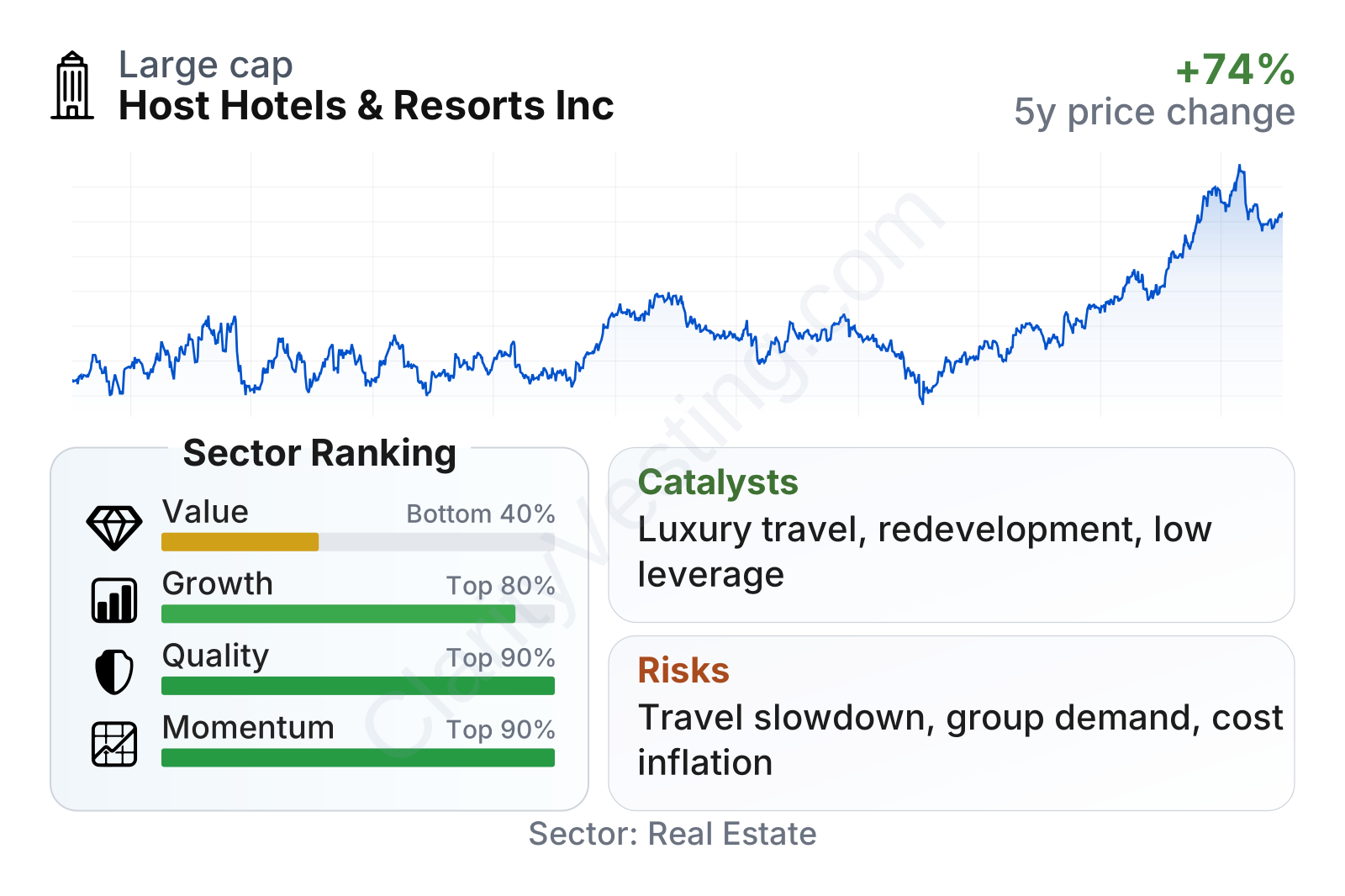
Host Hotels & Resorts is a large company in the hotel REIT space, with share-price volatility close to the broader market rather than extreme. The overall metric profile is mixed in an interesting way: growth, balance-sheet quality, and market momentum rank strongly versus the real estate sector, while classic value measures look less favorable. In other words, the market is giving the company credit for resilience, asset quality, and recovery execution, so it no longer screens as a cheap REIT on asset-based measures.
Profitability and capital efficiency stand out. Returns on assets, equity, and invested capital are all well above sector medians, and leverage metrics are clearly healthier than many peers. Free cash flow remains substantial at around $1.0 billion on a trailing basis, which supports redevelopment spending, dividends, and financial flexibility. The weaker point is that revenue growth in the latest year appears positive but not especially fast compared with the broader sector median, suggesting that the company is now in a steadier, more mature phase after the rebound.
Growth
Host Hotels & Resorts operates in a sector that can grow over time, but not in a straight line. Long-term demand is supported by business travel, group events, luxury leisure travel, and constrained new supply in many high-end lodging markets. Upscale and luxury hotels can be attractive assets because replacement costs are high, strong locations are limited, and well-known brands help sustain occupancy and daily rates. However, hotel real estate is more cyclical than apartments, industrial buildings, or grocery-anchored retail because room demand reacts quickly to the economy.
The company’s strategy is coherent for this setting. It concentrates on premium assets in large gateway cities and destination resorts, upgrades properties through redevelopment, and actively recycles capital by selling lower-growth hotels and reinvesting in higher-potential ones. That approach can lift revenue per room and cash generation even without aggressive portfolio expansion. The business also benefits from scale, which helps in negotiations, capital access, and portfolio diversification across markets and demand types.
Revenue per share has risen strongly over the last five years, which suggests that growth has not relied only on issuing more equity. That is an important distinction for REITs. The five-year compound annual growth rate of revenue per share is above 20%, far ahead of the sector median, showing that the recovery period translated into meaningful per-share progress.
Dividend restoration is another sign of normalization. REIT payouts were heavily disrupted during the pandemic, especially in lodging, but Host has rebuilt its dividend from very low levels. That does not make the payout perfectly stable, because hotel cash flow is inherently cyclical, but it does show that earnings power and cash flow have materially improved.
Recent company updates have also pointed to continued investment in redevelopment and return-enhancing projects across key hotels. For a lodging REIT, these projects can matter more than raw unit growth because they support higher room rates, more premium group business, and stronger non-room spending. A favorable backdrop would be steady convention demand, healthy luxury leisure travel, and limited new competing supply in top markets.
Risks
This article is for informational purposes only and does not constitute financial advice. Some content is AI-generated. See Disclaimer