Stock Analysis · Henry Schein Inc (HSIC)
Overview
Henry Schein is a healthcare distribution and services company focused mainly on dental and medical professionals. It supplies clinics, private practices, and healthcare facilities with consumable products, equipment, software, and business services. In simple terms, it sits in the middle of healthcare delivery: it helps dentists and physicians run their practices by providing the products they use every day and some of the technology and support tools behind the scenes.
The business is broad, but most revenue still comes from distribution. Based on the company’s recent annual reporting structure, the main sources of revenue are approximately:
- Global Distribution and Value-Added Services – about 93% to 95%: this is the core activity. It includes dental supplies, medical products, animal health products where applicable in the reporting perimeter, laboratory items, vaccines, pharmaceuticals, and practice support services tied to distribution.
- Global Specialty Products – about 5% to 7%: this segment includes higher-value dental products and equipment-related offerings, such as implants, endodontics, orthodontics, biomaterials, and other specialty dental categories.
Within that mix, dental is the largest end market for Henry Schein, followed by medical distribution and practice-related technology and services. The company’s role is less about developing breakthrough drugs or devices and more about being a critical operating partner for thousands of healthcare offices that need reliable supply, logistics, and workflow support.
The company’s revenue model has naturally high sales volume but relatively thin margins, which is typical for distributors. That means scale, purchasing power, customer relationships, and execution matter more than flashy product launches. The financial flow also shows a business where the cost of goods absorbs the large majority of revenue, while overhead and interest costs have become more important pressure points in recent years.
Over the last several years, revenue has been fairly steady to modestly growing, but a larger share of that revenue has been consumed by operating costs and interest expense. Gross profit has held up reasonably well, yet net income has trended lower than earlier peak levels, which helps explain why operational discipline matters so much for this company.
Key Figures
| Metric | Value | Sector ⓘ |
|---|---|---|
| Date | Oct 03, 2026 | |
| Context | ||
| Sector | Healthcare | |
| Industry | Medical Distribution | |
| Market Cap ⓘ | $9.36B | |
| Beta ⓘ | 0.81 | |
Value (Cheapness) | ||
| P/E Ratio ⓘ | 24.77 | 24.06 |
| P/B Ratio ⓘ | 6.11 | 3.08 |
| FCF Yield ⓘ | 5.76% | 3.07% |
| Dividend Yield ⓘ | N/A | 2.05% |
| EBIT / EV ⓘ | 5.36% | 0.63% |
| PEG ⓘ | 1.74 | |
Growth (Business expansion) | ||
| Revenue Growth ⓘ | 6.70% | 7.50% |
| RPS Growth (5Y CAGR) ⓘ | 5.49% | 8.70% |
| EPS Growth (5Y CAGR) ⓘ | -15.92% | -18.20% |
| BVPS Growth (5Y CAGR) ⓘ | -8.24% | 3.95% |
| Margin Growth (5Y Trend) ⓘ | -1.65% | -0.58% |
| FCF Growth (5Y CAGR) ⓘ | -2.36% | 0.88% |
| DPS Growth (5Y CAGR) ⓘ | 100.18% | 6.80% |
Quality (Business durability) | ||
| ROIC (Latest) ⓘ | 8.40% | 3.29% |
| ROA (Latest) ⓘ | 3.59% | 3.02% |
| ROIC (5Y Median) ⓘ | 9.31% | 4.75% |
| ROA (5Y Median) ⓘ | 4.34% | 1.93% |
| Net Debt / EBIT (Latest) ⓘ | 5.09 | 1.33 |
| Net Debt / EBIT (5Y Median) ⓘ | 4.09 | 1.83 |
| Net Debt / EBITDA (Latest) ⓘ | 3.55 | 0.99 |
| Net Debt / Assets ⓘ | 32.12% | 5.33% |
| EBITDA / Interest ⓘ | 6.48 | 9.63 |
| Operating Margin (Latest) ⓘ | 5.28% | 9.25% |
| Operating Margin (5Y Median) ⓘ | 5.27% | 7.80% |
| Debt to Equity (Latest) ⓘ | 120.78% | 28.99% |
| Profit Margin (Latest) ⓘ | 2.96% | 3.60% |
| Free Cash Flow (Latest) ⓘ | $539.00M | |
Momentum (Price trend) | ||
| 3Y Return ⓘ | +15.87% | +37.48% |
| 12M Return (excl. last month) ⓘ | +27.22% | +20.85% |
| 6M Return ⓘ | +16.28% | +9.73% |
| Price vs. 200-Day MA ⓘ | +5.86% | +4.69% |
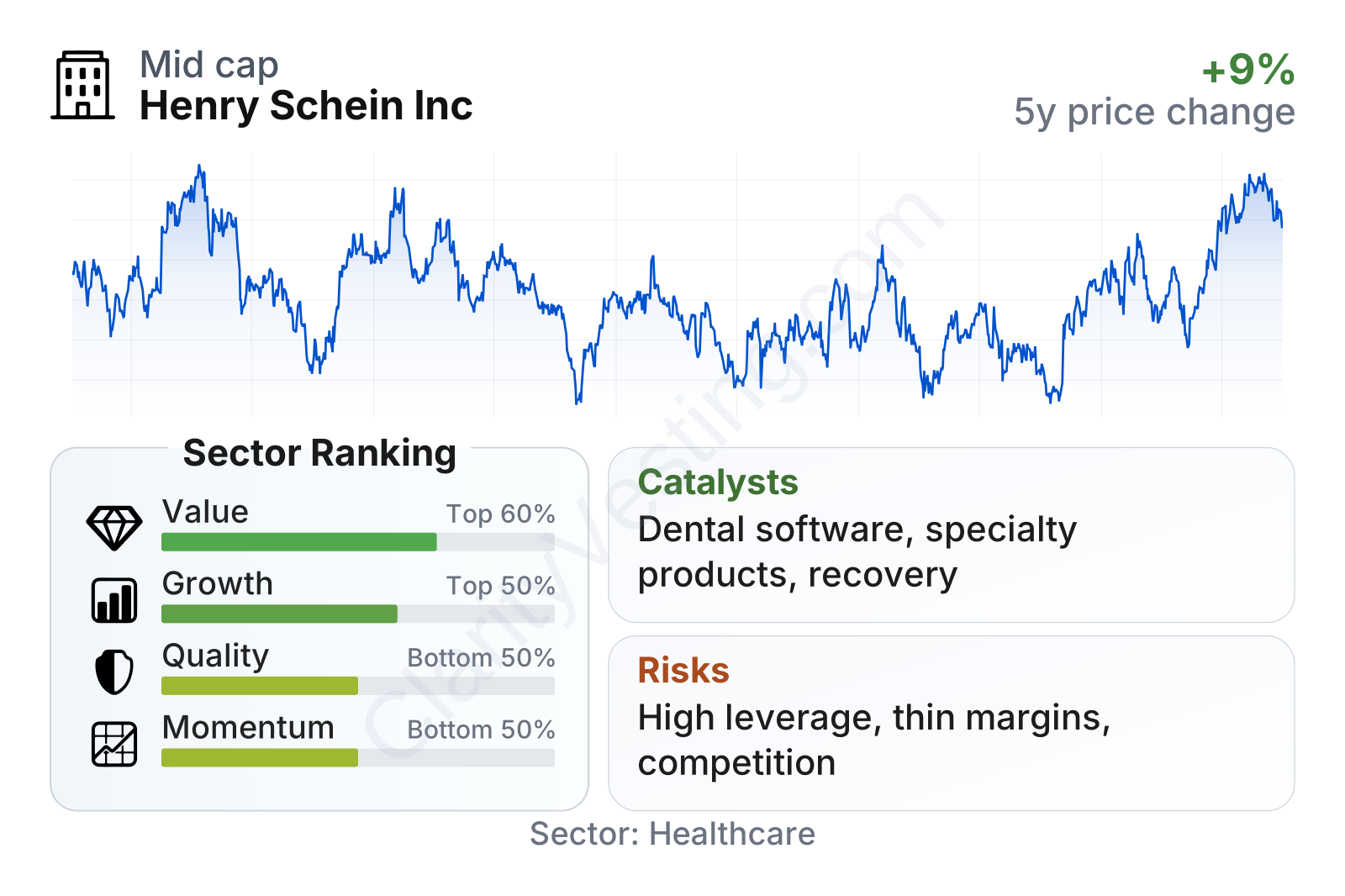
Henry Schein is a large healthcare distributor with a market value around $10 billion and a stock volatility below the broader market, as shown by its beta under 1. The overall profile is mixed. On valuation, it sits near the sector’s average earnings multiple, while cash-generation-based measures look stronger than many peers. Growth ranks around the middle of the healthcare group, and recent share-price momentum has improved over the last 6 to 12 months even though the longer three-year record has been less impressive. The weakest area is balance-sheet quality: leverage is materially above the sector median, and margins are lower than many healthcare companies, even if returns on capital remain respectable for a distributor.
Growth
Henry Schein operates in healthcare distribution and practice solutions, a sector supported by durable long-term demand. Dental and medical care do not depend only on economic cycles; over time they benefit from aging populations, ongoing treatment needs, and the steady digitization of clinics. That does not guarantee fast growth, but it does create a stable backdrop for companies with strong customer networks and efficient logistics.
The company’s strategy for future growth is logical. It combines a large distribution base with value-added services, software, equipment, and specialty dental products. That matters because pure distribution tends to produce limited margins, while software, specialty products, and integrated services can deepen customer relationships and improve profitability over time. Henry Schein has also historically used acquisitions and partnerships to expand its reach and add capabilities.
Recent revenue growth has turned more constructive again after a choppy period. Growth moved through a mix of weak and negative quarters in 2023 and parts of 2025, but the latest readings are back in the mid-single-digit range. That suggests the company is still capable of expanding, though not at a pace that would place it among the faster-growing healthcare names.
Cash generation is another important part of the growth picture. Free cash flow remains positive and meaningful in dollar terms, but it has not followed a clean upward trend over the last several years. That limits strategic flexibility somewhat, especially when debt is elevated. Even so, continued positive free cash flow supports acquisitions, technology investment, and balance-sheet management if execution remains disciplined.
One of the clearer catalysts is the company’s position in digital practice management and dental specialty categories. Dental offices increasingly need software, workflow tools, imaging, and more integrated purchasing relationships. If Henry Schein can keep bundling products and services effectively, that can strengthen customer retention and lift revenue per customer. Another useful tailwind is normalization in procedure volumes and equipment demand after periods of disruption in the dental market.
Recent company communications have also continued to emphasize operational initiatives, automation, and a focus on specialty dental and practice technology. None of these is a single transformative event on its own, but together they support a realistic path to gradual expansion rather than dramatic acceleration.
Risks
This article is for informational purposes only and does not constitute financial advice. Some content is AI-generated. See Disclaimer