Stock Analysis · HSBC Holdings PLC (HSBC)
Overview
HSBC Holdings PLC is one of the world’s largest banking groups. It provides everyday banking, lending, payments, wealth management, and capital markets services to individuals, businesses, institutions, and governments. Its defining feature is its international network, especially across Asia, the Middle East, and major trade corridors linking those regions with Europe and North America. In practice, HSBC is a bank built around cross-border money flows: helping companies finance trade, move cash, raise capital, manage foreign exchange, and helping affluent customers save, invest, and borrow.
The business is now organized around four main operating segments. Based on recent annual reporting, revenue is led by the corporate and institutional franchise, followed by personal banking and wealth activities, then commercial banking, with a smaller contribution from the central corporate area. Approximate shares can vary with interest rates and market activity, but the mix is broadly as follows:
- Corporate and Institutional Banking: about 40% to 45% of revenue. This includes transaction banking, global payments, securities services, financing, advisory, and markets activities for large companies, financial institutions, and government-related clients.
- International Wealth and Premier Banking: about 30% to 35% of revenue. This covers deposits, mortgages, cards, personal lending, insurance, investment products, and wealth management for retail and affluent customers.
- Business Banking: about 20% to 25% of revenue. This segment serves small and mid-sized businesses with loans, cash management, trade finance, and day-to-day banking.
- Corporate Center: usually a low single-digit positive or negative contribution depending on treasury, funding, and legacy items.
Geographically, HSBC is heavily exposed to Asia, with Hong Kong remaining the largest earnings center. That matters because the bank’s results are shaped not only by general banking demand, but also by regional trade activity, interest rates, wealth creation in Asia, and confidence in China and Hong Kong.
Over the last several years, total revenue expanded sharply, helped by higher rates and stronger net interest income, while operating profit and net income also moved materially higher from 2021 levels. Even so, 2025 showed some moderation versus 2024, which is a reminder that banking profits can move with the rate cycle and credit conditions.
The long-run picture is that revenue and profit are well above 2021 levels, but the path has not been smooth. Interest-related income became a much bigger driver during the recent rate upswing, while expenses have also risen again after a period of tighter cost control.
Key Figures
| Metric | Value | Sector ⓘ |
|---|---|---|
| Date | Oct 03, 2026 | |
| Context | ||
| Sector | Financial Services | |
| Industry | Banks - Diversified | |
| Market Cap ⓘ | $339.77B | |
| Beta ⓘ | 0.57 | |
Value (Cheapness) | ||
| P/E Ratio ⓘ | 14.19 | 12.60 |
| P/B Ratio ⓘ | 1.69 | 1.23 |
| FCF Yield ⓘ | 1.52% | 10.16% |
| Dividend Yield ⓘ | 0.74% | 2.96% |
| EBIT / EV ⓘ | 3.42% | 7.77% |
| PEG ⓘ | 0.89 | |
Growth (Business expansion) | ||
| Revenue Growth ⓘ | 25.40% | 9.50% |
| RPS Growth (5Y CAGR) ⓘ | 20.35% | 12.10% |
| EPS Growth (5Y CAGR) ⓘ | -3.42% | -9.45% |
| BVPS Growth (5Y CAGR) ⓘ | 2.72% | 5.01% |
| Margin Growth (5Y Trend) ⓘ | -3.26% | -4.07% |
| FCF Growth (5Y CAGR) ⓘ | -29.35% | 4.96% |
| DPS Growth (5Y CAGR) ⓘ | 20.37% | 8.79% |
Quality (Business durability) | ||
| ROIC (Latest) ⓘ | 7.60% | 9.60% |
| ROE (Latest) ⓘ | 13.40% | 13.84% |
| ROA (Latest) ⓘ | 0.76% | 1.53% |
| ROIC (5Y Median) ⓘ | 5.28% | 7.86% |
| ROE (5Y Median) ⓘ | 12.10% | 12.20% |
| ROA (5Y Median) ⓘ | 0.71% | 1.29% |
| Net Debt / EBIT (Latest) ⓘ | -2.82 | 0.91 |
| Net Debt / EBIT (5Y Median) ⓘ | -2.12 | 0.74 |
| Net Debt / EBITDA (Latest) ⓘ | -2.39 | 0.97 |
| Operating Margin (Latest) ⓘ | 24.99% | 22.12% |
| Operating Margin (5Y Median) ⓘ | 22.55% | 24.39% |
| Debt to Equity (Latest) ⓘ | 67.57% | 60.37% |
| Profit Margin (Latest) ⓘ | 37.80% | 26.62% |
| Free Cash Flow (Latest) ⓘ | $5.17B | |
Momentum (Price trend) | ||
| 3Y Return ⓘ | +193.80% | +89.23% |
| 12M Return (excl. last month) ⓘ | +67.77% | +17.35% |
| 6M Return ⓘ | +13.29% | +10.00% |
| Price vs. 200-Day MA ⓘ | +5.61% | +3.73% |
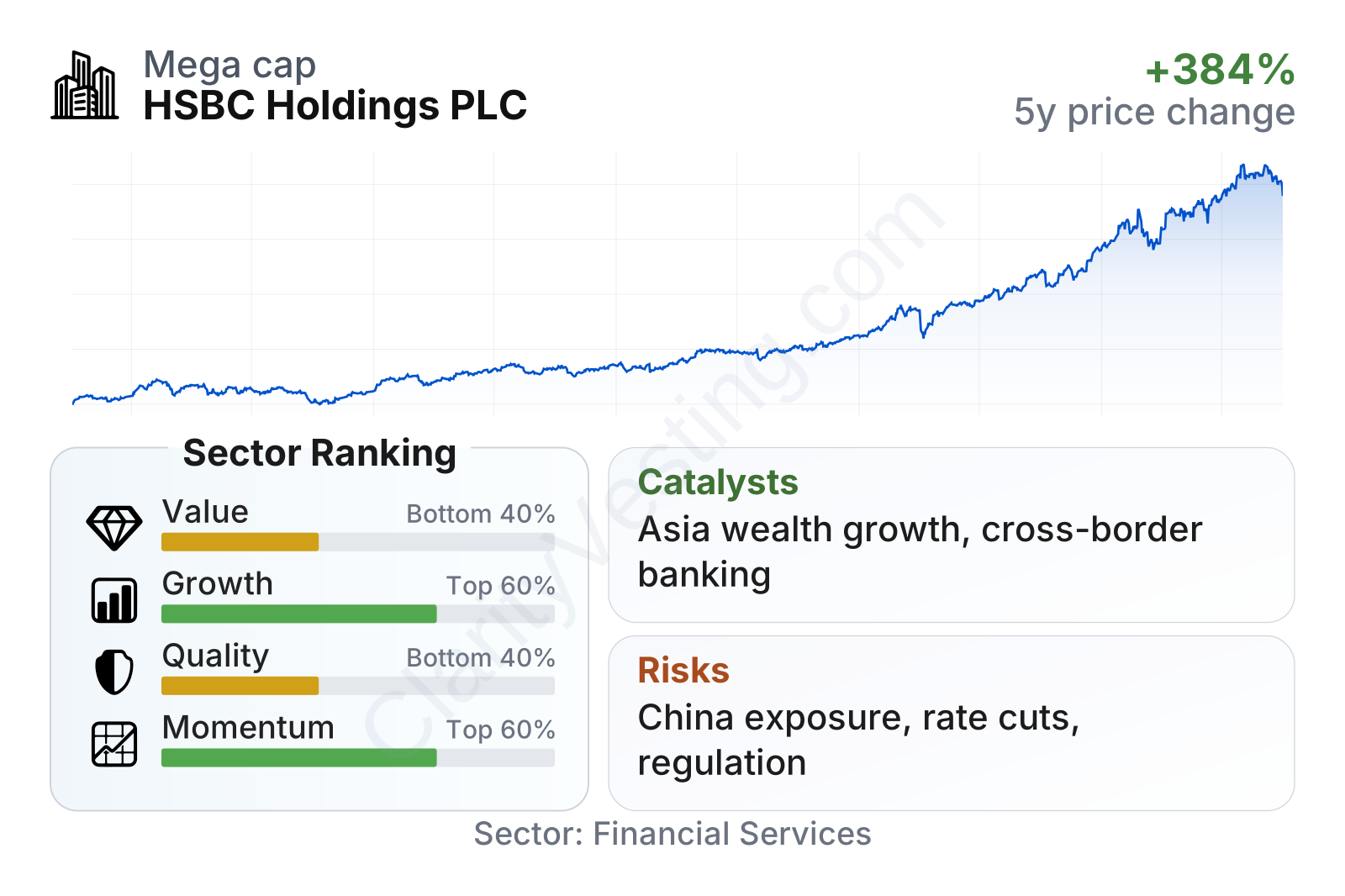
HSBC is a very large global bank with relatively low share-price volatility, as reflected by a beta well below 1. Recent market performance has been strong: the stock has substantially outperformed much of the broader banking universe over the last one, three, and even shorter time frames. On growth, the picture is better than many peers, with revenue trends and dividends improving meaningfully over five years. On quality and valuation, the picture is less generous. Profitability is respectable, but not exceptional for the sector, and the stock is no longer screened as cheap on several common measures versus the diversified banking median.
Growth
Banking is not a high-growth sector in the same way as software or semiconductors, but parts of HSBC’s footprint are tied to attractive long-term themes. The most important are the expansion of Asian wealth, rising cross-border financial flows, trade and treasury needs for multinational companies, and demand for internationally connected banking among affluent customers and businesses. Those areas can grow faster than mature domestic retail banking markets.
HSBC’s strategy is broadly coherent with those themes. In recent years, the group has continued simplifying its structure, reducing exposure to lower-return activities, and concentrating more capital on Asia, transaction banking, wealth, and corporate banking where its international network has real relevance. This matters because scale alone is not enough in banking; returns depend on whether a bank has a defendable niche. HSBC’s niche is not local branch density or U.S. consumer banking. It is the ability to serve clients across currencies, jurisdictions, and trade corridors.
Another support for growth is the bank’s balance sheet strength and deposit base, which allow it to keep investing in wealth, payments, and institutional capabilities. Book value per share has also trended upward again after a dip earlier in the period, which suggests underlying capital has been rebuilt while the company continued returning capital to shareholders.
Earnings per share have been volatile, but the broader direction since 2021 has improved, with 2024 and 2025 standing at clearly stronger levels than the early post-pandemic period. For a bank, that matters because earnings power tends to drive both capital generation and flexibility for dividends and buybacks.
The increase in book value per share over the last few years is important context. For banks, book value is a practical anchor because it reflects the capital base supporting lending and other balance-sheet activities. A rising trend usually signals that profits are being retained at a healthy enough pace to offset distributions and business restructuring costs.
A meaningful catalyst is continued expansion in wealth management and affluent banking in Asia and the Middle East. These activities often carry better fee potential and stronger client retention than plain lending. Another catalyst is the possibility that cross-border treasury, trade finance, and payments volumes continue growing as supply chains and capital flows become more regionally diversified. HSBC is well positioned where those flows are concentrated.
Recent company updates have also emphasized shareholder distributions, cost discipline, and ongoing business reshaping. None of these alone creates explosive growth, but together they support the case that HSBC is trying to become a more focused and higher-return bank than it was several years ago.
Risks
This article is for informational purposes only and does not constitute financial advice. Some content is AI-generated. See Disclaimer