Stock Analysis · Harrow Health Inc (HROW)
Overview
Harrow Health is a specialized ophthalmic pharmaceutical company focused on eye care. In simple terms, it develops, acquires, manufactures, and commercializes prescription products used by ophthalmologists and other eye-care professionals. Its business is centered on treating eye diseases and supporting eye surgery, which gives it a narrower focus than large diversified drugmakers.
Based on recent company filings and investor materials, Harrow’s revenue mainly comes from branded ophthalmic pharmaceuticals, with a portfolio that includes products used for retinal disease, dry eye, inflammation, infection, and surgical care. The company has also expanded through licensing and acquisitions, aiming to build a broader eye-care platform rather than relying on a single product.
The revenue mix is heavily concentrated in ophthalmic prescription product sales. Exact percentages by product can shift quarter to quarter, but the broad structure appears to be:
- Branded ophthalmic prescription products: the large majority of revenue, generated from commercial eye medicines sold through prescribers and pharmacies.
- Surgical and perioperative ophthalmic products: a smaller but meaningful contribution tied to products used around eye procedures.
- Other revenue streams: a limited share from compounding-related activities, royalties, milestone-type arrangements, or legacy operations where applicable.
What stands out is not a highly diversified healthcare conglomerate, but a relatively small company trying to become a scaled specialist in one medical niche. That concentration can be powerful if execution is strong, because ophthalmology has high clinical specialization and prescriber relationships matter.
The business has expanded rapidly over the last several years, with revenue rising from roughly $72 million in 2021 to about $272 million in 2025. Gross profit has also grown strongly, which suggests the core products carry attractive economics. At the same time, selling and administrative expenses have remained very high, and interest expense has absorbed a large share of operating progress, which helps explain why bottom-line profitability has lagged behind revenue growth.
Key Figures
| Metric | Value | Sector ⓘ |
|---|---|---|
| Date | Oct 17, 2026 | |
| Context | ||
| Sector | Healthcare | |
| Industry | Drug Manufacturers - Specialty & Generic | |
| Market Cap ⓘ | $1.02B | |
| Beta ⓘ | 0.18 | |
Value (Cheapness) | ||
| P/E Ratio ⓘ | N/A | 24.79 |
| P/B Ratio ⓘ | 69.03 | 3.08 |
| FCF Yield ⓘ | 0.56% | 3.15% |
| Dividend Yield ⓘ | N/A | 1.94% |
| EBIT / EV ⓘ | -0.71% | 0.57% |
| PEG ⓘ | N/A | |
Growth (Business expansion) | ||
| Revenue Growth ⓘ | 10.90% | 7.45% |
| RPS Growth (5Y CAGR) ⓘ | 28.60% | 8.61% |
| EPS Growth (5Y CAGR) ⓘ | N/A | -17.81% |
| BVPS Growth (5Y CAGR) ⓘ | 34.80% | 3.72% |
| Margin Growth (5Y Trend) ⓘ | 3.61% | -0.62% |
| FCF Growth (5Y CAGR) ⓘ | N/A | 1.04% |
| DPS Growth (5Y CAGR) ⓘ | 56.39% | 6.77% |
Quality (Business durability) | ||
| ROIC (Latest) ⓘ | -3.42% | 3.24% |
| ROA (Latest) ⓘ | -9.55% | 3.01% |
| ROIC (5Y Median) ⓘ | 2.61% | 4.60% |
| ROA (5Y Median) ⓘ | -10.41% | 1.89% |
| Net Debt / EBIT (Latest) ⓘ | N/A | 1.34 |
| Net Debt / EBIT (5Y Median) ⓘ | 15.33 | 1.84 |
| Net Debt / EBITDA (Latest) ⓘ | 19.38 | 1.00 |
| Net Debt / Assets ⓘ | 52.03% | 5.45% |
| EBITDA / Interest ⓘ | 0.49 | 9.64 |
| Operating Margin (Latest) ⓘ | -3.79% | 9.27% |
| Operating Margin (5Y Median) ⓘ | 4.55% | 7.38% |
| Debt to Equity (Latest) ⓘ | 1978.58% | 28.58% |
| Profit Margin (Latest) ⓘ | -13.51% | 3.59% |
| Free Cash Flow (Latest) ⓘ | $5.69M | |
Momentum (Price trend) | ||
| 3Y Return ⓘ | +84.41% | +42.80% |
| 12M Return (excl. last month) ⓘ | -20.97% | +18.50% |
| 6M Return ⓘ | -25.88% | +7.57% |
| Price vs. 200-Day MA ⓘ | -27.26% | +5.12% |
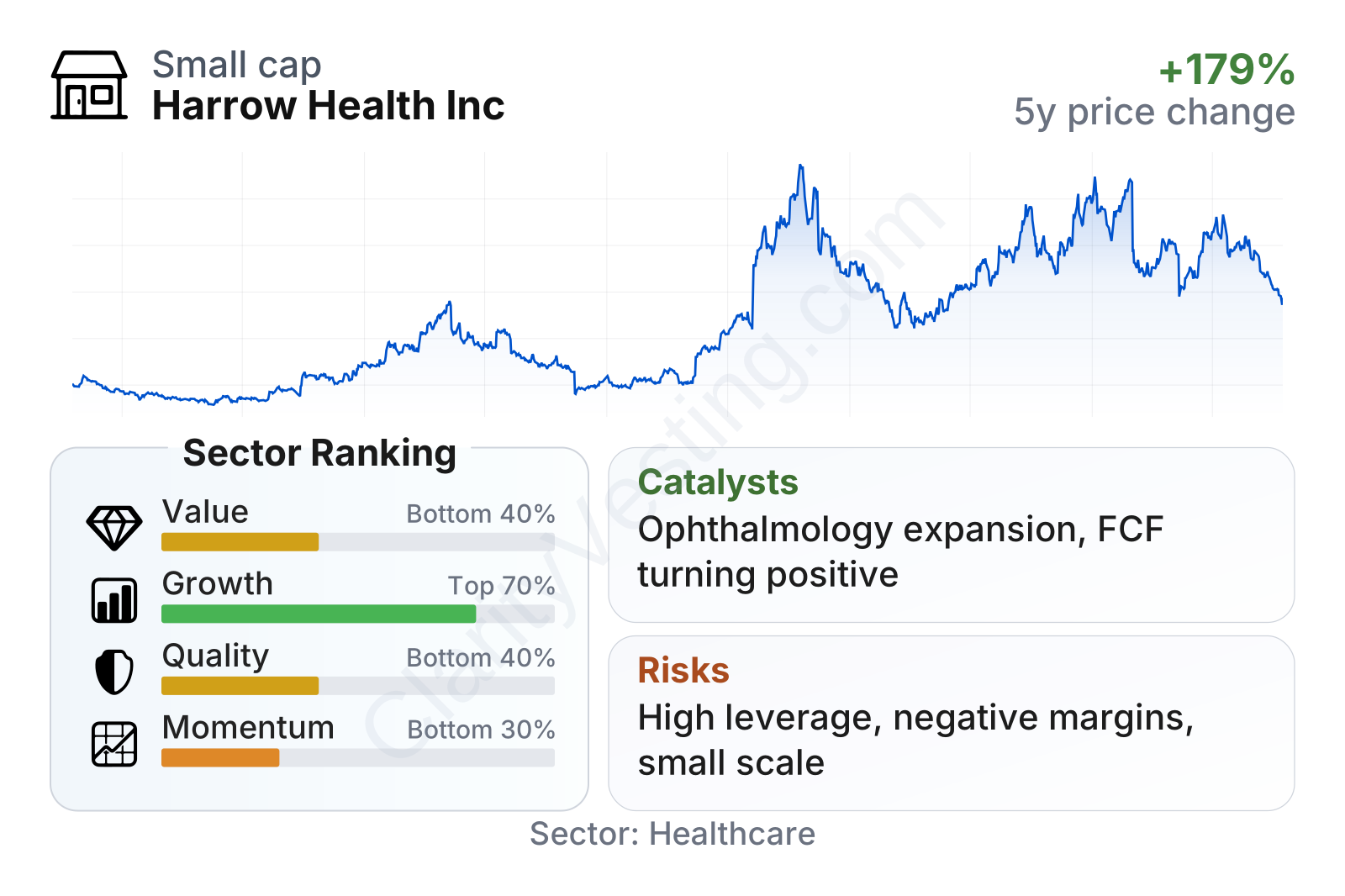
Harrow sits in the small-cap range, and its share price history shows unusually large swings: a strong multiyear rise followed by sharp pullbacks. In the latest factor breakdown, growth looks better than much of the healthcare sector, while value, quality, and momentum are weaker. The most striking points are a very high price-to-book ratio, thin free cash flow yield, negative returns on capital, and weaker recent price performance. In other words, the market has been willing to pay for expansion potential, but the current financial quality profile remains demanding.
Growth
Harrow operates in a healthcare segment with favorable long-term demand drivers. Eye disease is supported by aging populations, rising diagnosis rates, and recurring treatment needs. Ophthalmology can also be attractive commercially because successful products often target specialists, which can make sales efforts more focused than in broad primary-care markets.
The company’s strategy is fairly easy to understand: build a focused eye-care portfolio, add commercial products through deals, and use that platform to increase prescribing across more indications. That approach can make sense in specialty pharma because a targeted sales force may support several related products at once. If the portfolio deepens, each new launch can potentially strengthen the value of the commercial infrastructure already in place.
Revenue growth has been strong over most of the past few years, including several periods of very high year-over-year expansion. More recently, growth has become less linear, with one negative quarter in early 2026 followed by a return to positive growth around the low double-digit range by mid-2026. That shift matters: Harrow is no longer in the earliest burst phase where growth alone dominates the narrative, so consistency is becoming more important.
Cash generation has also improved from deeply negative levels to positive territory more recently. That is an important operational milestone because it suggests the business may be moving closer to self-funding growth. For a company that has relied on external capital and has meaningful financing costs, improving free cash flow is one of the clearest signals to watch.
One of the stronger potential catalysts is the continued scaling of recently acquired or licensed ophthalmic brands. If management can keep expanding prescription volumes while limiting the rate of expense growth, Harrow could show a clearer transition from revenue expansion to earnings leverage. Recent company communications have also highlighted commercial progress across key eye-care products, which points to a significant opportunity if adoption remains durable.
Risks
This article is for informational purposes only and does not constitute financial advice. Some content is AI-generated. See Disclaimer


