Stock Analysis · Harmony Biosciences Holdings (HRMY)
Overview
Harmony Biosciences Holdings is a commercial-stage biotechnology company focused on rare neurological diseases and other underserved central nervous system conditions. Its business has been built around identifying, developing, and commercializing therapies for patients with limited treatment options, especially in sleep-wake disorders. The company’s best-known product is Wakix, a treatment used in narcolepsy, and that product has been the economic engine of the company for several years.
Revenue is still highly concentrated. Based on the company’s recent annual reporting and operating history, the sales mix is approximately as follows:
- Wakix (pitolisant): about 95% to 100% of current revenue. This is the company’s flagship product in the U.S. and the primary source of commercial sales. Wakix is approved for excessive daytime sleepiness and cataplexy in adult patients with narcolepsy.
- Other revenue: about 0% to 5%. This can include collaboration-related items, royalty-type streams, or other smaller business activities depending on the period, but these remain limited compared with Wakix.
That concentration creates a very simple business model to understand: Harmony generates cash today from one leading rare-disease product, then reinvests part of that cash into lifecycle expansion, acquisitions, and pipeline development intended to broaden the company beyond a single asset.
The financial profile has improved materially over the last several years. Revenue has risen strongly, gross profit remains high, and operating income has expanded even while research and development spending increased. That pattern suggests a company using the cash flow from an established medicine to fund its next stage of growth rather than relying primarily on outside financing.
The operating picture shows a favorable mix of strong gross profitability and rising investment. Research spending has climbed sharply over time, but revenue and operating income have also grown, which indicates that expansion efforts have so far been funded from a profitable commercial base.
Key Figures
| Metric | Value | Sector ⓘ |
|---|---|---|
| Date | Oct 24, 2026 | |
| Context | ||
| Sector | Healthcare | |
| Industry | Biotechnology | |
| Market Cap ⓘ | $2.23B | |
| Beta ⓘ | 1.01 | |
Value (Cheapness) | ||
| P/E Ratio ⓘ | 12.36 | 25.42 |
| P/B Ratio ⓘ | 2.12 | 3.08 |
| FCF Yield ⓘ | 15.91% | 3.12% |
| Dividend Yield ⓘ | N/A | 1.85% |
| EBIT / EV ⓘ | 13.61% | 0.56% |
| PEG ⓘ | N/A | |
Growth (Business expansion) | ||
| Revenue Growth ⓘ | 30.30% | 7.50% |
| RPS Growth (5Y CAGR) ⓘ | 30.22% | 8.60% |
| EPS Growth (5Y CAGR) ⓘ | -7.92% | -17.73% |
| BVPS Growth (5Y CAGR) ⓘ | 47.38% | 3.72% |
| Margin Growth (5Y Trend) ⓘ | 6.28% | -0.57% |
| FCF Growth (5Y CAGR) ⓘ | 37.17% | 0.96% |
| DPS Growth (5Y CAGR) ⓘ | -56.12% | 6.69% |
Quality (Business durability) | ||
| ROIC (Latest) ⓘ | 17.69% | 3.17% |
| ROA (Latest) ⓘ | 14.04% | 2.98% |
| ROIC (5Y Median) ⓘ | 21.18% | 4.56% |
| ROA (5Y Median) ⓘ | 16.07% | 1.87% |
| Net Debt / EBIT (Latest) ⓘ | -1.58 | 1.34 |
| Net Debt / EBIT (5Y Median) ⓘ | -0.63 | 1.86 |
| Net Debt / EBITDA (Latest) ⓘ | -1.43 | 1.00 |
| Net Debt / Assets ⓘ | -28.83% | 5.06% |
| EBITDA / Interest ⓘ | 20.50 | 9.55 |
| Operating Margin (Latest) ⓘ | 26.15% | 9.25% |
| Operating Margin (5Y Median) ⓘ | 28.20% | 7.33% |
| Debt to Equity (Latest) ⓘ | 15.41% | 26.68% |
| Profit Margin (Latest) ⓘ | 18.88% | 3.34% |
| Free Cash Flow (Latest) ⓘ | $354.90M | |
Momentum (Price trend) | ||
| 3Y Return ⓘ | +82.43% | +51.61% |
| 12M Return (excl. last month) ⓘ | +28.10% | +19.90% |
| 6M Return ⓘ | +12.70% | +10.10% |
| Price vs. 200-Day MA ⓘ | +3.90% | +6.44% |
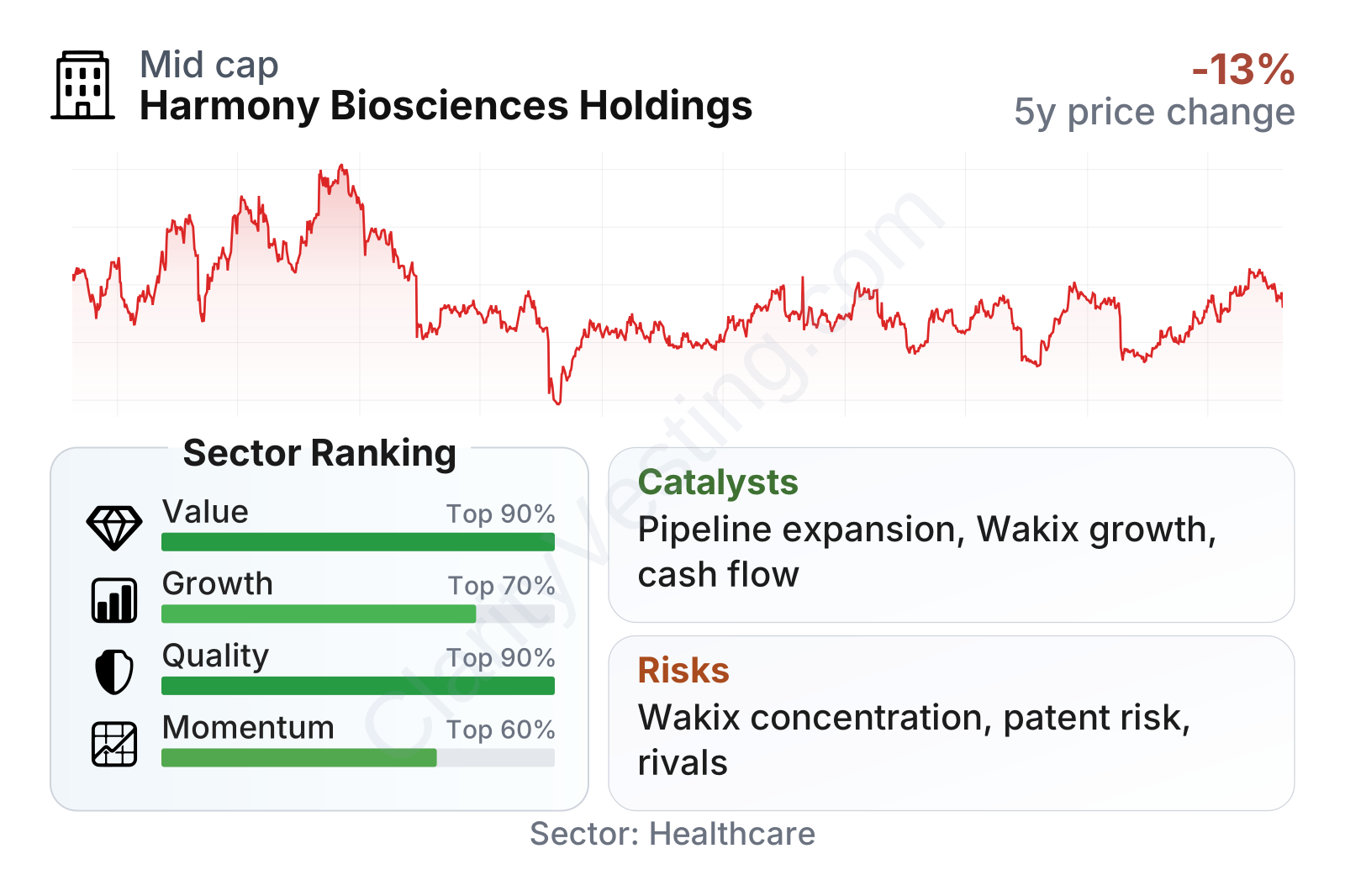
Harmony stands out in its sector for profitability, cash generation, and balance-sheet quality. Value metrics are notably stronger than many biotechnology peers, with earnings and cash flow multiples below sector norms while free cash flow yield is substantially higher. Quality is also a clear strength: returns on capital and assets are well above typical healthcare biotech levels, and leverage has moved down to a conservative range. Growth is solid rather than extreme, supported by strong revenue and free cash flow expansion, while share-price performance has been more mixed over longer periods despite a stronger recent rebound.
The stock history also reflects that contrast. The shares have been volatile and remain well below earlier highs reached during periods of higher enthusiasm, but the more recent recovery shows that the market has responded to improving fundamentals and renewed confidence in future pipeline value.
Growth
Harmony operates in an attractive part of healthcare: rare neurological diseases. This area tends to benefit from high unmet need, specialist prescribing, and potentially durable pricing power when a therapy addresses a clearly defined patient population. Narcolepsy itself is a niche market, but it remains important because diagnosis rates can improve over time and treated patient counts can expand as awareness rises. More broadly, the company’s strategy of building in rare neurology makes sense because it can leverage a focused commercial infrastructure across multiple related indications.
The company’s growth case has two layers. The first is continued Wakix execution, supported by patient additions, physician adoption, and market penetration in narcolepsy. The second is diversification through business development and pipeline expansion. Harmony has been working to reduce dependence on a single product by adding new programs in sleep, epilepsy, and other rare neurological conditions. That matters because long-term durability will likely depend more on the future portfolio than on Wakix alone.
Revenue growth has slowed from the very high rates seen earlier after launch, which is normal for a product maturing into a larger base. Even so, the business has continued to post growth comfortably above the sector median, and the recent reacceleration suggests demand has remained resilient rather than flattening out.
Cash generation is one of the strongest parts of the Harmony profile. Free cash flow has trended sharply upward and now sits at a level that gives the company meaningful flexibility. That cash can support internal development, licensing deals, acquisitions, debt reduction, and legal defense if needed. In biotechnology, where many companies remain dependent on capital markets, this self-funded model is a meaningful advantage.
A major catalyst for future growth is the broadening of the pipeline through recently acquired or in-licensed assets. Recent company communications have emphasized advancing additional rare-neurology programs and preparing for potential future regulatory milestones. If even one or two of these assets become commercially meaningful, Harmony could shift from a single-product business toward a more diversified specialty-biopharma model. That would likely matter more for long-term value than incremental quarterly changes in Wakix prescriptions.
Risks
This article is for informational purposes only and does not constitute financial advice. Some content is AI-generated. See Disclaimer


