Stock Analysis · Hormel Foods Corporation (HRL)
Overview
Hormel Foods is a packaged foods company that makes and sells meat products, snack foods, refrigerated meals, shelf-stable foods, nut butters, bacon, deli items, and foodservice products. Its portfolio includes widely recognized brands such as SPAM, Jennie-O, Applegate, Hormel Black Label, Columbus, Planters, Skippy, and Wholly. The business serves retail grocery channels, convenience stores, foodservice operators, and international markets.
For long-term analysis, Hormel stands out as a defensive consumer staples company rather than a high-growth business. People keep buying food in weak economies, which generally makes demand steadier than in more cyclical industries. At the same time, packaged foods is a competitive category where growth often depends on brand strength, pricing, product mix, distribution, and cost control more than on fast industry expansion.
Based on the company’s recent reporting structure, Hormel’s revenue comes mainly from four operating segments.
- Retail: approximately 46% of revenue. This includes branded products sold through grocery and mass retail channels, such as bacon, pepperoni, nut butter, deli meats, shelf-stable meals, and snacks.
- Foodservice: approximately 32% of revenue. This segment supplies restaurants, schools, healthcare, hospitality, and other away-from-home eating channels.
- International: approximately 14% of revenue. This includes exports and overseas sales of branded and commodity products.
- Jennie-O Turkey Store: approximately 8% of revenue. This covers turkey products sold in retail and foodservice channels.
That mix matters because it shows Hormel is not dependent on one single product category. However, it is still exposed to protein costs, consumer trade-down behavior, and category-specific pressure in turkey and value-added meats.
The business has remained a large-scale food company with annual revenue around $12 billion in recent years, but profitability has weakened. Revenue has been relatively stable, while the larger issue has been margin compression: operating profit and net income have fallen much faster than sales. In other words, the recent challenge has been earning less on each dollar of revenue, not a collapse in demand.
Key Figures
| Metric | Value | Sector ⓘ |
|---|---|---|
| Date | Oct 10, 2026 | |
| Context | ||
| Sector | Consumer Defensive | |
| Industry | Packaged Foods | |
| Market Cap ⓘ | $11.05B | |
| Beta ⓘ | 0.29 | |
Value (Cheapness) | ||
| P/E Ratio ⓘ | 32.39 | 17.64 |
| P/B Ratio ⓘ | 1.40 | 1.27 |
| FCF Yield ⓘ | 7.07% | 12.68% |
| Dividend Yield ⓘ | 5.77% | 2.85% |
| EBIT / EV ⓘ | 4.64% | 6.32% |
| PEG ⓘ | 1.40 | |
Growth (Business expansion) | ||
| Revenue Growth ⓘ | -2.40% | 3.85% |
| RPS Growth (5Y CAGR) ⓘ | 1.41% | 6.20% |
| EPS Growth (5Y CAGR) ⓘ | -12.49% | -14.31% |
| BVPS Growth (5Y CAGR) ⓘ | 3.01% | 3.33% |
| Margin Growth (5Y Trend) ⓘ | -4.15% | -0.17% |
| FCF Growth (5Y CAGR) ⓘ | -8.78% | 4.37% |
| DPS Growth (5Y CAGR) ⓘ | 4.75% | 6.68% |
Quality (Business durability) | ||
| ROIC (Latest) ⓘ | 4.08% | 12.58% |
| ROA (Latest) ⓘ | 2.57% | 6.32% |
| ROIC (5Y Median) ⓘ | 7.92% | 10.38% |
| ROA (5Y Median) ⓘ | 5.99% | 5.44% |
| Net Debt / EBIT (Latest) ⓘ | 3.36 | 1.92 |
| Net Debt / EBIT (5Y Median) ⓘ | 2.32 | 2.32 |
| Net Debt / EBITDA (Latest) ⓘ | 2.31 | 1.36 |
| Net Debt / Assets ⓘ | 15.16% | 21.29% |
| EBITDA / Interest ⓘ | 11.07 | 9.52 |
| Operating Margin (Latest) ⓘ | 4.95% | 8.88% |
| Operating Margin (5Y Median) ⓘ | 9.36% | 9.53% |
| Debt to Equity (Latest) ⓘ | 36.40% | 71.95% |
| Profit Margin (Latest) ⓘ | 2.82% | 5.37% |
| Free Cash Flow (Latest) ⓘ | $780.87M | |
Momentum (Price trend) | ||
| 3Y Return ⓘ | -38.98% | +18.12% |
| 12M Return (excl. last month) ⓘ | -11.67% | +2.64% |
| 6M Return ⓘ | -6.66% | +1.32% |
| Price vs. 200-Day MA ⓘ | -12.75% | +0.17% |
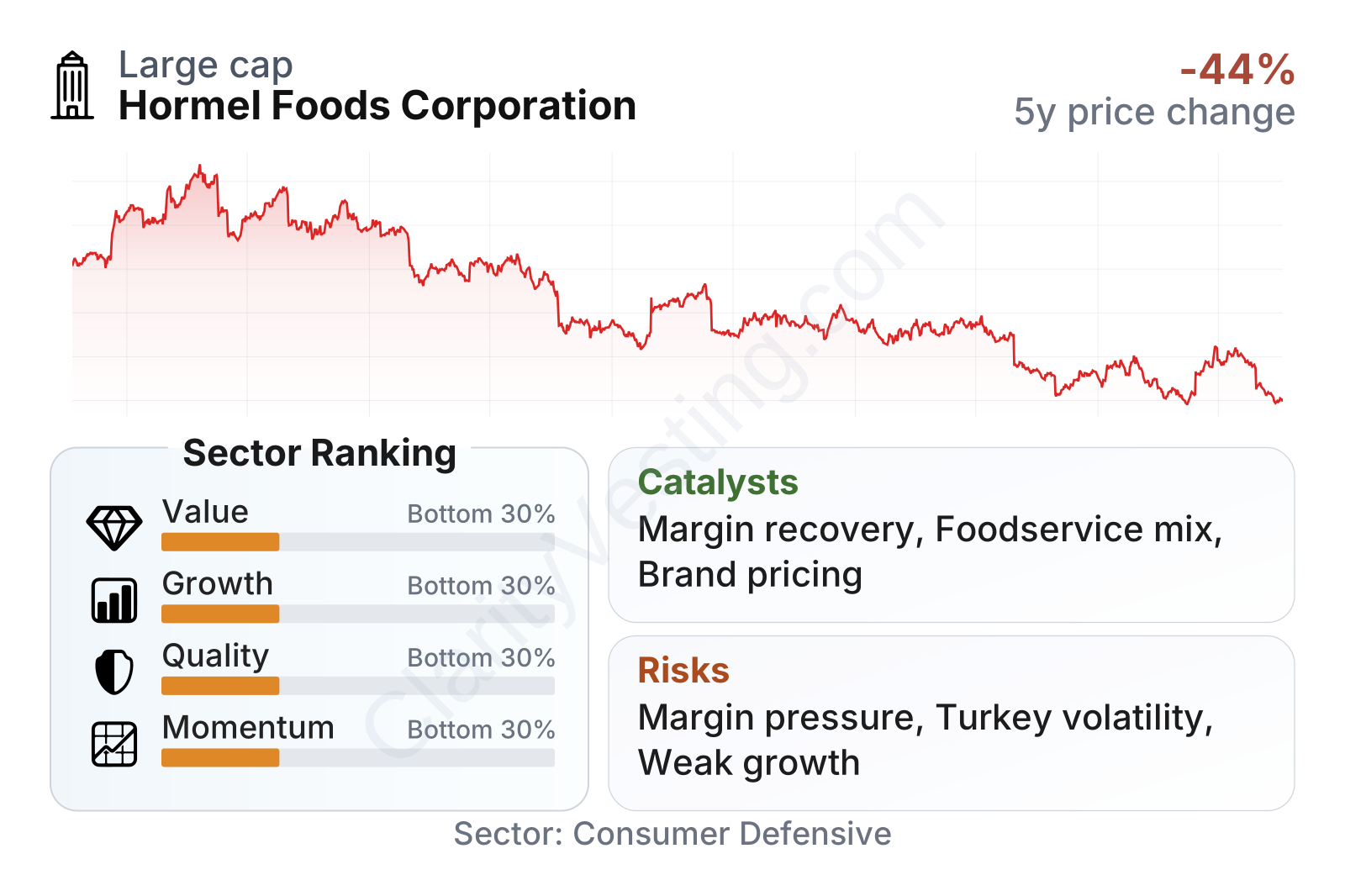
Hormel is a large consumer staples company with notably low share-price volatility, as shown by its beta near 0.3. That fits the nature of the business. The weaker part of the picture is relative performance: value, growth, quality, and momentum all rank in the lower end of the sector. The dividend yield is above the sector median, but that is happening alongside slower growth, thinner profitability, and a richer earnings multiple than many peers. This combination suggests the market is still giving Hormel credit for resilience and brand quality even though recent operating performance has been under pressure.
Growth
Hormel operates in a mature sector, not a rapidly expanding one. Packaged foods can still grow over time, but usually through pricing, premium products, distribution gains, acquisitions, innovation, and better mix rather than through explosive industry demand. That means the company’s future growth case depends more on execution than on a strong tailwind from the sector itself.
The strategy broadly makes sense for this kind of business. Hormel has focused on branded products, convenience-oriented offerings, foodservice expansion, and portfolio reshaping. Those are reasonable priorities because branded and value-added foods typically carry better margins than commodity-style products. The company has also emphasized areas such as snacking, away-from-home eating, and products with easier meal preparation, which match long-term consumer habits.
Recent sales trends show a company that has struggled to sustain momentum. After strong post-pandemic comparisons, year-over-year revenue moved through a long stretch of flat to negative readings, then briefly improved, and most recently softened again. This does not look like a structurally broken business, but it does show that Hormel has not yet established a clear, durable reacceleration in top-line growth.
Cash generation is still one of the more important supports for the long-term case, even though it has become less consistent. Free cash flow has remained positive, which helps fund dividends, debt service, brand investment, and internal improvement projects. Still, the recent decline from earlier peaks suggests that stronger execution is needed before the company can be viewed as returning to a healthier growth-and-cash profile.
A practical catalyst is the company’s ability to recover margins through productivity programs, supply chain efficiency, and improved product mix. If branded retail and foodservice items make up a larger share of sales, earnings can improve even without major revenue acceleration. Another potential support is stabilization in turkey operations and input costs, since volatility there has weighed on results in the past. In addition, Hormel’s brands remain well distributed across U.S. retail and foodservice channels, giving it a platform to launch line extensions and premium offerings without needing to build new distribution from scratch.
Recent company communications have also pointed to continued efforts around transformation, cost discipline, and portfolio focus. For Hormel, those initiatives matter more than headline expansion because modest sales growth paired with a margin recovery could have a meaningful effect on profit.
Risks
This article is for informational purposes only and does not constitute financial advice. Some content is AI-generated. See Disclaimer