Stock Analysis · Herc Holdings Inc (HRI)
Overview
Herc Holdings is one of the largest equipment rental companies in North America. It rents out machinery, tools, trucks, and related equipment used by construction firms, industrial customers, infrastructure projects, utilities, government agencies, and event operators. Instead of selling equipment outright, the company mainly earns money by owning a large fleet and charging customers to use it for short periods or project-based needs. This business model can work well when customers prefer flexibility and lower upfront spending rather than buying expensive equipment themselves.
Its revenue mix is centered on equipment rentals, with additional income from sales and services tied to the fleet.
- Equipment rentals: the clear majority of revenue, typically around 80% to 85%. This includes general construction equipment and higher-value specialty categories such as aerial, earthmoving, material handling, pumps, power, climate control, and similar products.
- Sales of rental equipment: usually around 10% to 15%. Herc regularly refreshes its fleet and sells used machinery once it reaches the right point in its life cycle.
- Other revenue: usually around 3% to 8%. This includes delivery, repair, fuel, re-rental, parts, and related service activity.
The company’s recent financial flow shows a business that expanded revenue strongly from 2021 through 2025, but with a noticeable squeeze from higher operating costs and especially higher interest expense. Operating income grew over that period, yet net income became much more volatile because debt costs rose sharply.
Key Figures
| Metric | Value | Sector ⓘ |
|---|---|---|
| Date | Nov 03, 2026 | |
| Context | ||
| Sector | Industrials | |
| Industry | Rental & Leasing Services | |
| Market Cap ⓘ | $5.63B | |
| Beta ⓘ | 1.99 | |
Value (Cheapness) | ||
| P/E Ratio ⓘ | 44.36 | 22.04 |
| P/B Ratio ⓘ | 2.84 | 1.99 |
| FCF Yield ⓘ | 0.50% | 6.30% |
| Dividend Yield ⓘ | 1.69% | 1.87% |
| EBIT / EV ⓘ | 4.31% | 4.91% |
| PEG ⓘ | 0.05 | |
Growth (Business expansion) | ||
| Revenue Growth ⓘ | 4.60% | 9.60% |
| RPS Growth (5Y CAGR) ⓘ | 19.57% | 7.67% |
| EPS Growth (5Y CAGR) ⓘ | -17.24% | -10.50% |
| BVPS Growth (5Y CAGR) ⓘ | 17.87% | 6.15% |
| Margin Growth (5Y Trend) ⓘ | -8.71% | 0.71% |
| FCF Growth (5Y CAGR) ⓘ | N/A | 11.01% |
| DPS Growth (5Y CAGR) ⓘ | 54.45% | 9.31% |
Quality (Business durability) | ||
| ROIC (Latest) ⓘ | 6.96% | 10.76% |
| ROA (Latest) ⓘ | 0.88% | 5.50% |
| ROIC (5Y Median) ⓘ | 11.16% | 9.33% |
| ROA (5Y Median) ⓘ | 5.33% | 4.94% |
| Net Debt / EBIT (Latest) ⓘ | 14.67 | 2.07 |
| Net Debt / EBIT (5Y Median) ⓘ | 6.65 | 2.28 |
| Net Debt / EBITDA (Latest) ⓘ | 4.94 | 1.40 |
| Net Debt / Assets ⓘ | 68.04% | 19.23% |
| EBITDA / Interest ⓘ | 3.76 | 9.73 |
| Operating Margin (Latest) ⓘ | 13.26% | 10.51% |
| Operating Margin (5Y Median) ⓘ | 20.20% | 10.30% |
| Debt to Equity (Latest) ⓘ | 485.38% | 66.13% |
| Profit Margin (Latest) ⓘ | 2.50% | 6.61% |
| Free Cash Flow (Latest) ⓘ | $28.00M | |
Momentum (Price trend) | ||
| 3Y Return ⓘ | +43.49% | +71.04% |
| 12M Return (excl. last month) ⓘ | +10.05% | +11.43% |
| 6M Return ⓘ | +27.58% | +0.36% |
| Price vs. 200-Day MA ⓘ | +21.70% | +0.42% |
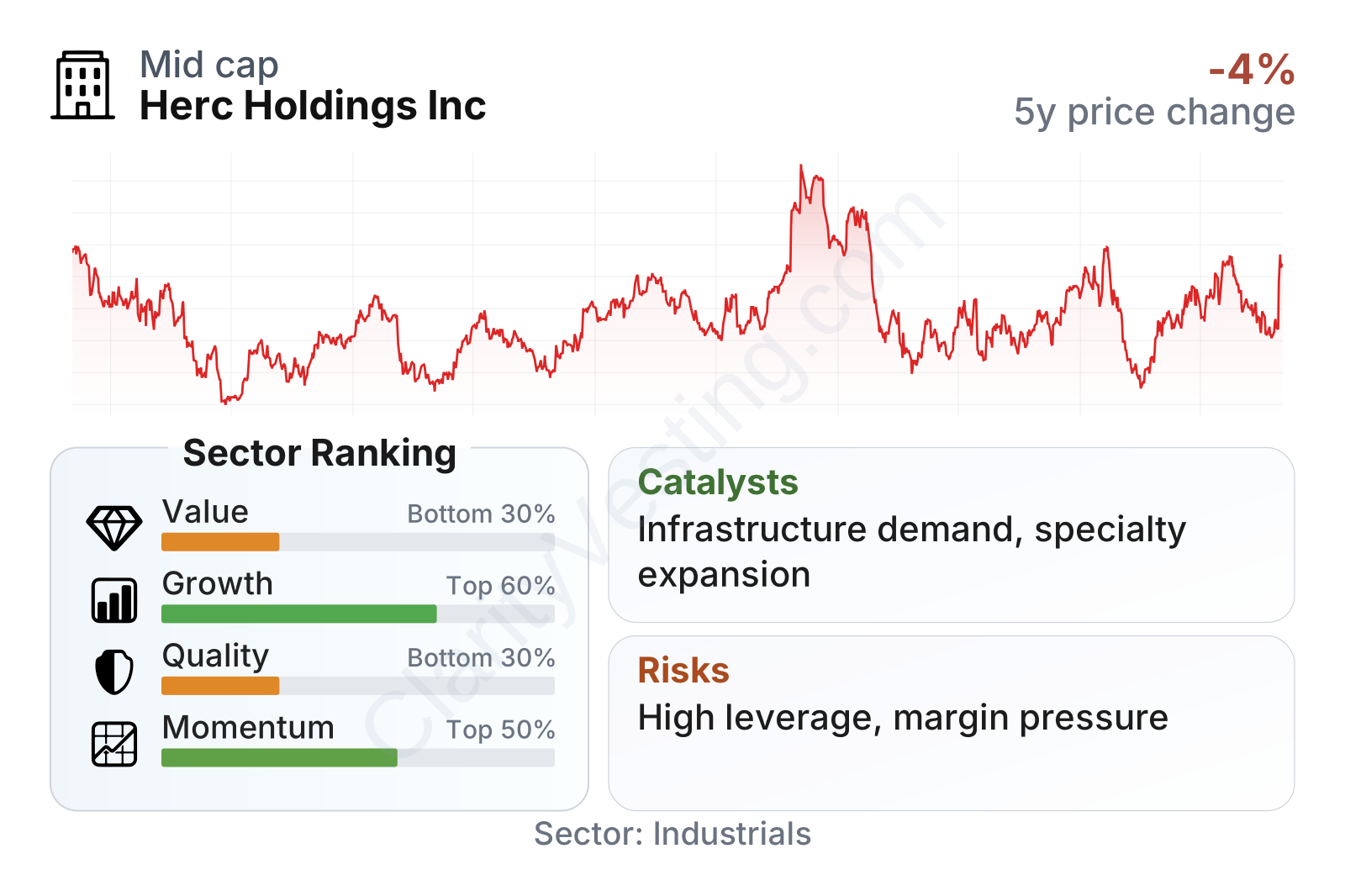
Herc is a mid-sized public company within the industrial rental space, and its share price has been volatile, which fits a business tied to economic cycles and heavy equipment demand. The latest factor snapshot is mixed: growth indicators remain decent, momentum has improved, but value and balance-sheet quality rank in the weaker part of the sector. In practical terms, the market is still giving the company credit for expansion potential, while also applying caution because leverage is elevated and profitability has not fully recovered to earlier levels.
Growth
Equipment rental is generally a favorable long-term market. Many contractors and industrial operators prefer renting because it reduces upfront capital spending, shifts maintenance burdens to rental specialists, and gives access to newer equipment only when needed. That trend supports large rental platforms such as Herc, especially as projects become more specialized and customers want one supplier that can serve multiple job sites and equipment categories.
Herc’s strategy also fits that environment. The company has been expanding through fleet investment, branch growth, specialty offerings, and acquisitions. Specialty rental matters because it often carries stronger customer stickiness and can support better pricing than basic general rentals. Over the last five years, revenue per share and book value per share have both grown much faster than the sector median, which suggests that expansion has not been purely cosmetic.
Revenue growth has clearly remained positive, but it has also cooled from the very strong post-pandemic surge. Earlier periods showed growth rates above 20% and at times above 30%, while the latest year-over-year reading is much lower, around the mid-single digits. That points to a business still expanding, but now doing so in a more normal environment rather than in a rapid rebound phase.
Cash generation deserves close attention. Free cash flow was negative for several periods as Herc spent heavily on its fleet and expansion, then turned positive again more recently. That improvement is encouraging because rental businesses need large ongoing equipment investment. Sustained positive free cash flow would make the growth profile more durable, especially with borrowing costs still much higher than they were a few years ago.
A major catalyst for future growth is the continued demand tied to infrastructure, manufacturing reshoring, energy, utility, and large non-residential construction projects across North America. Another important catalyst is execution on acquisitions and branch expansion, because scale matters in rental: a larger network can improve utilization, delivery density, and cross-selling of specialty products. If Herc can raise fleet utilization while controlling financing costs, growth could translate more effectively into shareholder returns than it has recently.
Risks
This article is for informational purposes only and does not constitute financial advice. Some content is AI-generated. See Disclaimer