Stock Analysis · Healthcare Realty Trust Incorporated (HR)
Overview
Healthcare Realty Trust Incorporated is a real estate investment trust, or REIT, focused on medical outpatient buildings. In simple terms, it owns, leases, and manages buildings used by doctors, health systems, and other healthcare providers, usually located on or near hospital campuses. The company’s portfolio is built around properties that support everyday healthcare visits rather than senior housing, nursing homes, or hospitals themselves.
This focus matters because outpatient care has been gaining importance across the U.S. healthcare system. More procedures and routine services are being delivered outside the hospital, which supports demand for well-located medical office space. Healthcare Realty’s role is to provide the physical locations where that care happens and to collect rental income from tenants using those spaces.
Based on recent company reporting, revenue is still overwhelmingly rental in nature, with a smaller contribution from other property-related items. The main sources of revenue can be summarized as follows:
- Rental income from medical outpatient buildings: approximately 90% to 95% of total revenue. This includes base rent paid by physician groups, hospitals, and health-system affiliates leasing space in the company’s properties.
- Tenant recoveries and reimbursements: approximately 4% to 8% of total revenue. These are amounts tenants repay for operating costs such as maintenance, utilities, and common area expenses, depending on lease structures.
- Other property income: typically a low-single share of revenue when present, including items such as parking, management-related income, lease termination fees, and other ancillary building revenue.
Healthcare Realty is a specialized landlord rather than a healthcare operator. That means its performance depends more on occupancy, rental rates, property expenses, capital allocation, and balance sheet management than on the day-to-day economics of medical practices.
The business mix also shows how much of the economics flow through operating costs and interest expense. Revenue expanded sharply after the large medical office portfolio combination completed in 2022, but profitability has been pressured since then by higher expenses, asset sales, and financing costs. That helps explain why the company remains sizable in scale while still working through an efficiency and balance-sheet reset.
Key Figures
| Metric | Value | Sector ⓘ |
|---|---|---|
| Date | Nov 14, 2026 | |
| Context | ||
| Sector | Real Estate | |
| Industry | REIT - Healthcare Facilities | |
| Market Cap ⓘ | $6.68B | |
| Beta ⓘ | 0.79 | |
Value (Cheapness) | ||
| P/E Ratio ⓘ | N/A | 18.10 |
| P/B Ratio ⓘ | 1.62 | 1.62 |
| FCF Yield ⓘ | 2.52% | 5.78% |
| Dividend Yield ⓘ | 4.96% | 4.71% |
| EBIT / EV ⓘ | 1.51% | 4.93% |
| PEG ⓘ | 8.82 | |
Growth (Business expansion) | ||
| Revenue Growth ⓘ | -3.60% | 5.70% |
| RPS Growth (5Y CAGR) ⓘ | -2.58% | 5.87% |
| EPS Growth (5Y CAGR) ⓘ | N/A | -3.35% |
| BVPS Growth (5Y CAGR) ⓘ | -3.96% | 0.24% |
| Margin Growth (5Y Trend) ⓘ | N/A | -0.69% |
| FCF Growth (5Y CAGR) ⓘ | -0.96% | 5.81% |
| DPS Growth (5Y CAGR) ⓘ | -2.61% | 5.00% |
Quality (Business durability) | ||
| ROIC (Latest) ⓘ | 1.54% | 5.18% |
| ROE (Latest) ⓘ | -1.06% | 7.66% |
| ROA (Latest) ⓘ | -0.49% | 3.09% |
| ROIC (5Y Median) ⓘ | -0.37% | 4.21% |
| ROE (5Y Median) ⓘ | -3.91% | 6.04% |
| ROA (5Y Median) ⓘ | -2.10% | 2.43% |
| Net Debt / EBIT (Latest) ⓘ | 26.83 | 7.49 |
| Net Debt / EBIT (5Y Median) ⓘ | N/A | 8.41 |
| Net Debt / EBITDA (Latest) ⓘ | 6.26 | 5.31 |
| Net Debt / Assets ⓘ | 49.89% | 38.16% |
| EBITDA / Interest ⓘ | 4.15 | 4.20 |
| Operating Margin (Latest) ⓘ | 14.69% | 34.29% |
| Operating Margin (5Y Median) ⓘ | -1.00% | 37.26% |
| Debt to Equity (Latest) ⓘ | 109.97% | 90.28% |
| Profit Margin (Latest) ⓘ | -3.95% | 18.55% |
| Free Cash Flow (Latest) ⓘ | $168.56M | |
Momentum (Price trend) | ||
| 3Y Return ⓘ | +68.14% | +33.76% |
| 12M Return (excl. last month) ⓘ | -2.79% | +1.92% |
| 6M Return ⓘ | -2.73% | -1.15% |
| Price vs. 200-Day MA ⓘ | +4.57% | 0.00% |
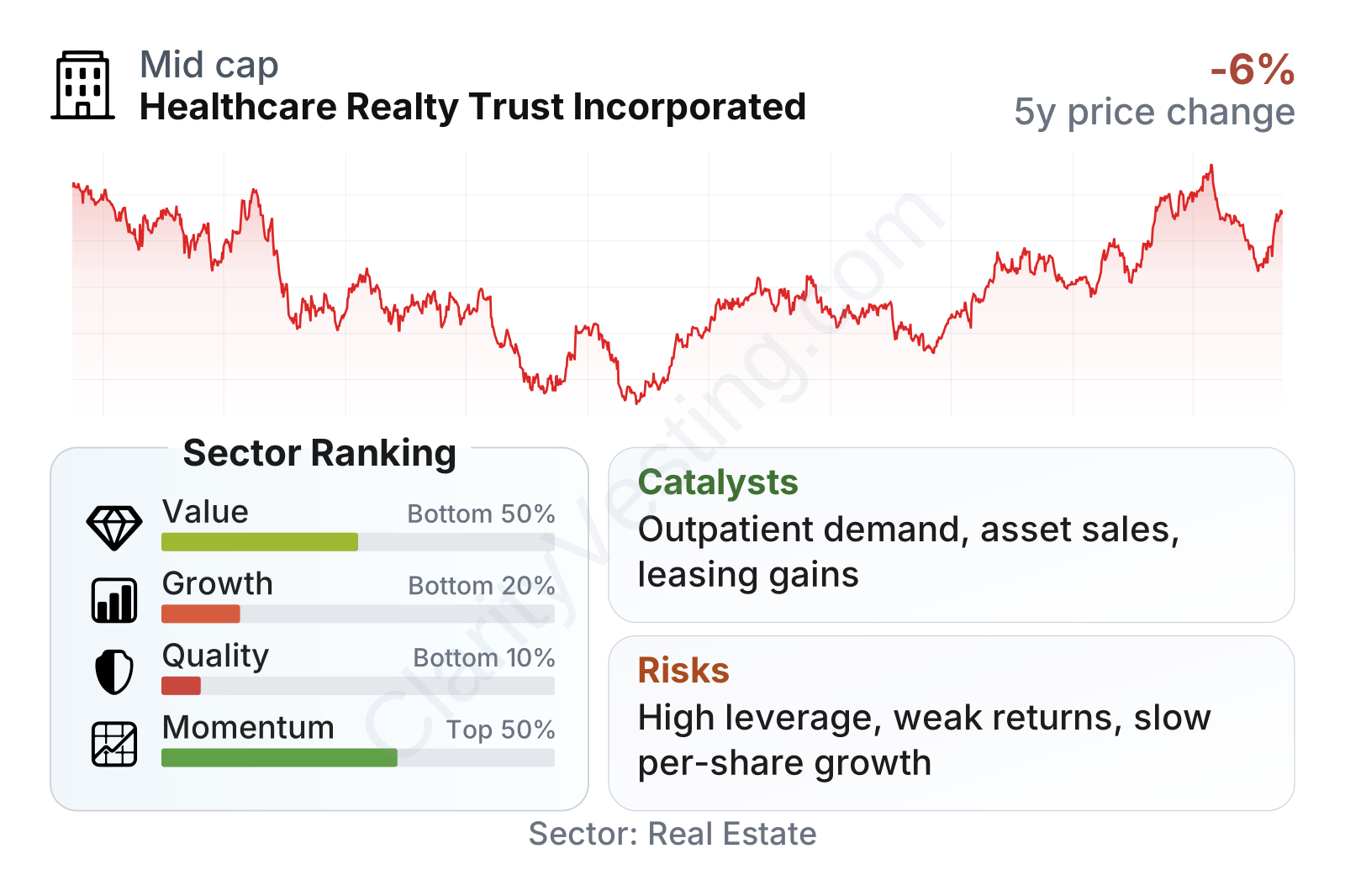
Healthcare Realty is a mid-sized REIT with a stock that has recovered from the lows seen during the pressure of rising rates, but its underlying fundamentals still look weaker than much of the real estate sector. In the latest factor view, value, growth, and quality all rank near the lower end of the sector, while share-price momentum has been somewhat better. That combination suggests the market has recently become more constructive on the stock even though operating performance and balance-sheet metrics remain under strain.
The company’s valuation multiples are not especially low compared with the broader real estate group, and its cash flow yield and dividend yield sit below sector medians. At the same time, profitability measures such as return on assets, return on equity, and return on invested capital remain depressed. In short, recent stock performance has improved faster than the company’s fundamental profile.
Growth
Healthcare Realty operates in a part of healthcare real estate that has an understandable long-term demand base. Aging demographics, steady growth in healthcare utilization, and the migration of procedures toward outpatient settings all support the need for medical office buildings. This is not a fast-changing technology market, but it can be a durable one when assets are well located and tied to strong hospital systems.
The company’s strategy is also logically aligned with those trends. It concentrates on medical outpatient facilities, often clustered around health-system campuses, where tenant demand can be more resilient than in general office real estate. Large health systems want convenient access points for patients, and physicians often prefer space connected to referral networks and hospital infrastructure. That can create durable occupancy for the right buildings.
Still, the company’s recent growth record has been soft. Revenue per share has drifted lower over the last five years, which means portfolio scale has not translated into better growth on a per-share basis. For long-term analysis, that is an important distinction: owning many properties is less meaningful if each share represents a shrinking slice of revenue over time.
The dividend path tells a similar story. The payout has remained meaningful, but it has not shown a clean upward trajectory over the period, reflecting the company’s need to balance shareholder distributions with debt management and portfolio repositioning.
A key potential catalyst is execution on simplification and capital recycling. After the major merger that reshaped the company, management has been selling non-core properties, directing capital toward balance-sheet repair, and focusing on stronger assets in better markets. If that process leads to better occupancy, improved same-store growth, and lower leverage, the business could look structurally stronger than it has over the last few years.
Recent company communications have also emphasized leasing, expense control, and selective dispositions. For a healthcare property owner, that can be significant because small improvements in occupancy and rent spreads across a large portfolio can gradually rebuild cash flow. The opportunity is real, but it depends on disciplined execution rather than a single transformative event.
Risks
This article is for informational purposes only and does not constitute financial advice. Some content is AI-generated. See Disclaimer