Stock Analysis · Tekla Healthcare Investors (HQH)
Overview
Tekla Healthcare Investors is not an operating healthcare company that sells drugs or medical devices. It is a closed-end fund managed by Tekla Capital Management that invests primarily in healthcare securities. In simple terms, shareholders are buying a professionally managed portfolio of healthcare stocks and related investments rather than a single healthcare business line.
The fund’s objective is long-term capital appreciation, with current income as a secondary objective. Its portfolio is focused on publicly traded healthcare companies across areas such as biotechnology, pharmaceuticals, healthcare equipment, healthcare services, and life sciences. Because HQH is structured as an investment fund, its results depend mainly on how well its portfolio holdings perform and on gains or losses realized when positions are sold.
Its economic engine is therefore different from a traditional company. Revenue and earnings are driven mostly by investment activity rather than product sales.
- Net realized and unrealized gains on investments: typically the largest driver over time, coming from changes in the market value of healthcare holdings and profits or losses when securities are sold.
- Dividend and interest income from portfolio holdings: a smaller but recurring source of income generated by stocks and other securities held in the portfolio.
- Option-related income and other investment-related activity: can contribute at times, but it is generally not the core earnings source compared with portfolio appreciation.
Because HQH is a fund, precise revenue-source percentages can swing sharply from year to year and are less useful than they would be for an industrial company. Recent annual results show that investment gains and losses dominate reported income, while operating expenses remain comparatively small versus portfolio-level swings. That makes HQH financially closer to a healthcare investment vehicle than to a conventional asset manager with stable fee revenue.
The recent profit flow also shows how sensitive results are to market conditions. The fund moved from a large loss in 2022 to positive results in 2023 and stronger profitability in 2025, while overhead remained relatively limited. For readers, the key takeaway is simple: performance depends mainly on healthcare market returns and portfolio selection.
Key Figures
| Metric | Value | Sector ⓘ |
|---|---|---|
| Date | Oct 17, 2026 | |
| Context | ||
| Sector | Financial Services | |
| Industry | Asset Management | |
| Market Cap ⓘ | $1.13B | |
| Beta ⓘ | 0.75 | |
Value (Cheapness) | ||
| P/E Ratio ⓘ | 4.28 | 12.26 |
| P/B Ratio ⓘ | 0.97 | 1.23 |
| FCF Yield ⓘ | -1.08% | 10.40% |
| Dividend Yield ⓘ | 11.76% | 3.02% |
| EBIT / EV ⓘ | N/A | 8.14% |
| PEG ⓘ | N/A | |
Growth (Business expansion) | ||
| Revenue Growth ⓘ | -42.10% | 9.35% |
| RPS Growth (5Y CAGR) ⓘ | -14.35% | 12.19% |
| EPS Growth (5Y CAGR) ⓘ | -27.52% | -9.53% |
| BVPS Growth (5Y CAGR) ⓘ | -5.40% | 4.99% |
| Margin Growth (5Y Trend) ⓘ | -1.84% | -3.86% |
| FCF Growth (5Y CAGR) ⓘ | N/A | 4.81% |
| DPS Growth (5Y CAGR) ⓘ | 43.96% | 8.79% |
Quality (Business durability) | ||
| ROIC (Latest) ⓘ | N/A | 9.49% |
| ROE (Latest) ⓘ | 42.22% | 13.90% |
| ROA (Latest) ⓘ | 42.13% | 1.55% |
| ROIC (5Y Median) ⓘ | N/A | 7.86% |
| ROE (5Y Median) ⓘ | 9.16% | 12.17% |
| ROA (5Y Median) ⓘ | 9.14% | 1.30% |
| Net Debt / EBIT (Latest) ⓘ | N/A | 0.96 |
| Net Debt / EBIT (5Y Median) ⓘ | N/A | 0.73 |
| Net Debt / EBITDA (Latest) ⓘ | N/A | 0.92 |
| Operating Margin (Latest) ⓘ | N/A | 22.30% |
| Operating Margin (5Y Median) ⓘ | 98.77% | 24.63% |
| Debt to Equity (Latest) ⓘ | N/A | 58.56% |
| Profit Margin (Latest) ⓘ | 4561.32% | 26.57% |
| Free Cash Flow (Latest) ⓘ | -$12.14M | |
Momentum (Price trend) | ||
| 3Y Return ⓘ | +80.51% | +88.33% |
| 12M Return (excl. last month) ⓘ | +46.64% | +19.38% |
| 6M Return ⓘ | +3.34% | +4.75% |
| Price vs. 200-Day MA ⓘ | -0.63% | +3.50% |
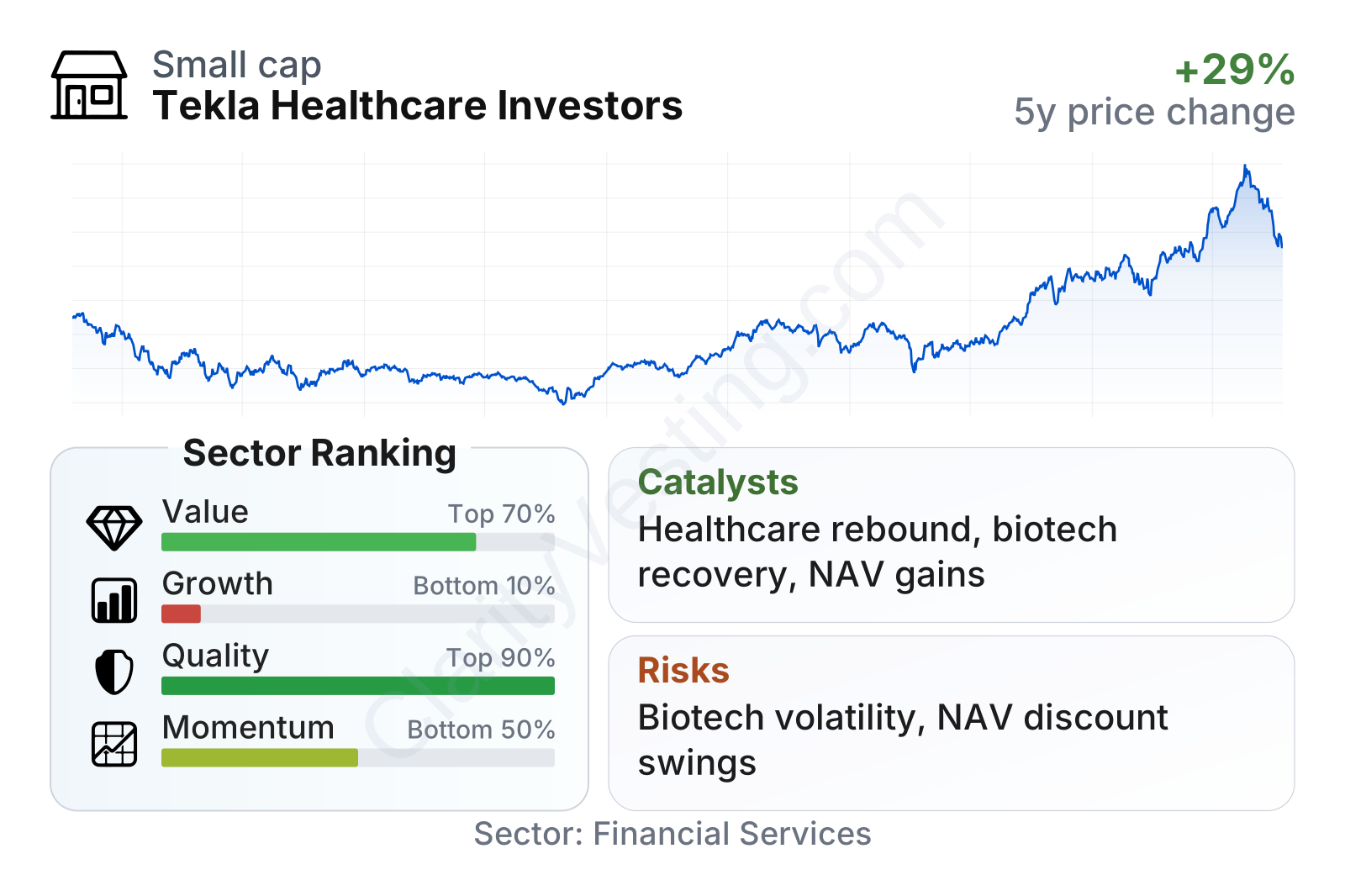
HQH is a mid-sized closed-end fund with a market value a little above $1 billion and a beta below 1, which suggests somewhat lower share-price sensitivity than the broader equity market. The latest metrics present a mixed picture. On valuation, the shares screen cheaper than the sector on both earnings and book value measures, while the trailing distribution yield is far above the sector median. On quality, profitability ratios rank very well versus the broader financial sector, although those numbers should be read carefully because investment funds can post unusually high or volatile returns when portfolio values move sharply.
The weakest area is growth. Multi-year revenue, earnings, and book value trends have been uneven, which is normal for a fund exposed to market cycles but still important for long-term analysis. Momentum has been better: the share price has risen strongly over the past year, six months, and three years, indicating that market sentiment toward the fund and the healthcare space has improved.
Growth
HQH operates in healthcare, which remains one of the most important long-term investment sectors. The broad backdrop is supported by aging populations, rising medical spending, continued demand for innovative drugs, and steady development in biotechnology and specialized care. Those trends do not guarantee smooth results, but they do provide a durable reason why healthcare remains a large and relevant area for capital over many years.
HQH’s strategy also makes practical sense for long-term growth because it offers diversified exposure across healthcare subsectors instead of depending on one product or one company. That matters especially in biotechnology, where individual stocks can be very volatile. A portfolio structure can reduce company-specific blowups while still allowing participation when drug pipelines, approvals, or takeover activity lift the sector.
The recent earnings pattern shows a meaningful recovery from the deep drawdown seen in 2022. Profit per share turned positive again and has remained positive in the most recent annual periods shown, which suggests portfolio performance stabilized after a very weak year for growth-oriented healthcare assets.
Book value per share, which is especially important for a fund like HQH, has also recovered from the 2023 dip and moved back above $20 in the latest periods shown. That is a useful sign because book value is closely tied to the net asset base behind the shares. Even so, the five-year trend remains modestly negative, so the recovery is real but not yet a long uninterrupted compounding pattern.
A notable recent tailwind is the stronger market appetite for healthcare and biotech risk assets after the pressure seen in 2022 and parts of 2023. If capital continues rotating back into innovative healthcare names, HQH can benefit through both net asset value improvement and a narrower discount or better valuation in the market. The fund’s managed distribution policy also keeps it visible among income-focused market participants, which can support demand when portfolio conditions are favorable.
Risks
This article is for informational purposes only and does not constitute financial advice. Some content is AI-generated. See Disclaimer


