Stock Analysis · Horizon Quantum Holdings Ltd (HQ)
Overview
Horizon Quantum Holdings Ltd is a very small technology company focused on quantum computing software and related infrastructure tools. In simple terms, it is trying to build software that helps businesses and researchers develop, test, and eventually use quantum computing systems. That places the company in an emerging part of the software market where commercial adoption is still early and real-world revenue remains limited.
The business appears to be centered much more on product development than on large-scale commercialization today. Financials show a company still in the buildout phase, with operating expenses far above revenue and a heavy emphasis on research and development. That profile is common among early-stage quantum firms, but it also means the current investment case depends more on future execution than on present operating strength.
Based on available public information and recent financial reporting, revenue is currently very small and not diversified enough to map into stable, well-established segments with confidence. The broad economic picture is clearer than the exact mix: spending is concentrated on developing the platform rather than monetizing it at scale.
- Software and quantum-related platform revenue: nearly all reported revenue appears to come from the company’s core software and related offerings, but the absolute level remains minimal.
- Other revenue streams: no meaningful secondary revenue source is clearly established in recent public filings.
The financial flow over recent years also shows a familiar early-stage pattern: expenses, especially research and development and general corporate costs, have risen much faster than sales. Revenue briefly improved in 2024 and then remained extremely small in 2025, while losses widened sharply as the company increased spending.
Key Figures
| Metric | Value | Sector ⓘ |
|---|---|---|
| Date | Oct 24, 2026 | |
| Context | ||
| Sector | Technology | |
| Industry | Software - Infrastructure | |
| Market Cap ⓘ | $841.42M | |
| Beta ⓘ | 0.33 | |
Value (Cheapness) | ||
| P/E Ratio ⓘ | N/A | 29.68 |
| FCF Yield ⓘ | -2.23% | 4.28% |
| Dividend Yield ⓘ | N/A | 1.30% |
| EBIT / EV ⓘ | N/A | 2.70% |
| PEG ⓘ | N/A | |
Growth (Business expansion) | ||
| Revenue Growth ⓘ | -100.00% | 15.80% |
| RPS Growth (5Y CAGR) ⓘ | 23.36% | 8.56% |
| EPS Growth (5Y CAGR) ⓘ | -8.54% | -11.54% |
| Margin Growth (5Y Trend) ⓘ | N/A | 0.46% |
| FCF Growth (5Y CAGR) ⓘ | -31.94% | 9.76% |
| DPS Growth (5Y CAGR) ⓘ | N/A | 7.79% |
Quality (Business durability) | ||
| ROIC (Latest) ⓘ | N/A | 9.38% |
| ROIC (5Y Median) ⓘ | N/A | 8.32% |
| Net Debt / EBIT (Latest) ⓘ | N/A | 0.52 |
| Net Debt / EBIT (5Y Median) ⓘ | N/A | 0.46 |
| Net Debt / EBITDA (Latest) ⓘ | N/A | 0.28 |
| Net Debt / Assets ⓘ | -90.75% | 3.44% |
| EBITDA / Interest ⓘ | N/A | 13.20 |
| Operating Margin (Latest) ⓘ | N/A | 9.70% |
| Operating Margin (5Y Median) ⓘ | -10346.70% | 8.51% |
| Debt to Equity (Latest) ⓘ | 0.83% | 33.40% |
| Profit Margin (Latest) ⓘ | N/A | 7.14% |
| Free Cash Flow (Latest) ⓘ | -$18.72M | |
Momentum (Price trend) | ||
| 3Y Return ⓘ | +49.33% | +55.43% |
| 12M Return (excl. last month) ⓘ | +40.63% | +10.33% |
| 6M Return ⓘ | +43.16% | +7.97% |
| Price vs. 200-Day MA ⓘ | +11.01% | +5.41% |
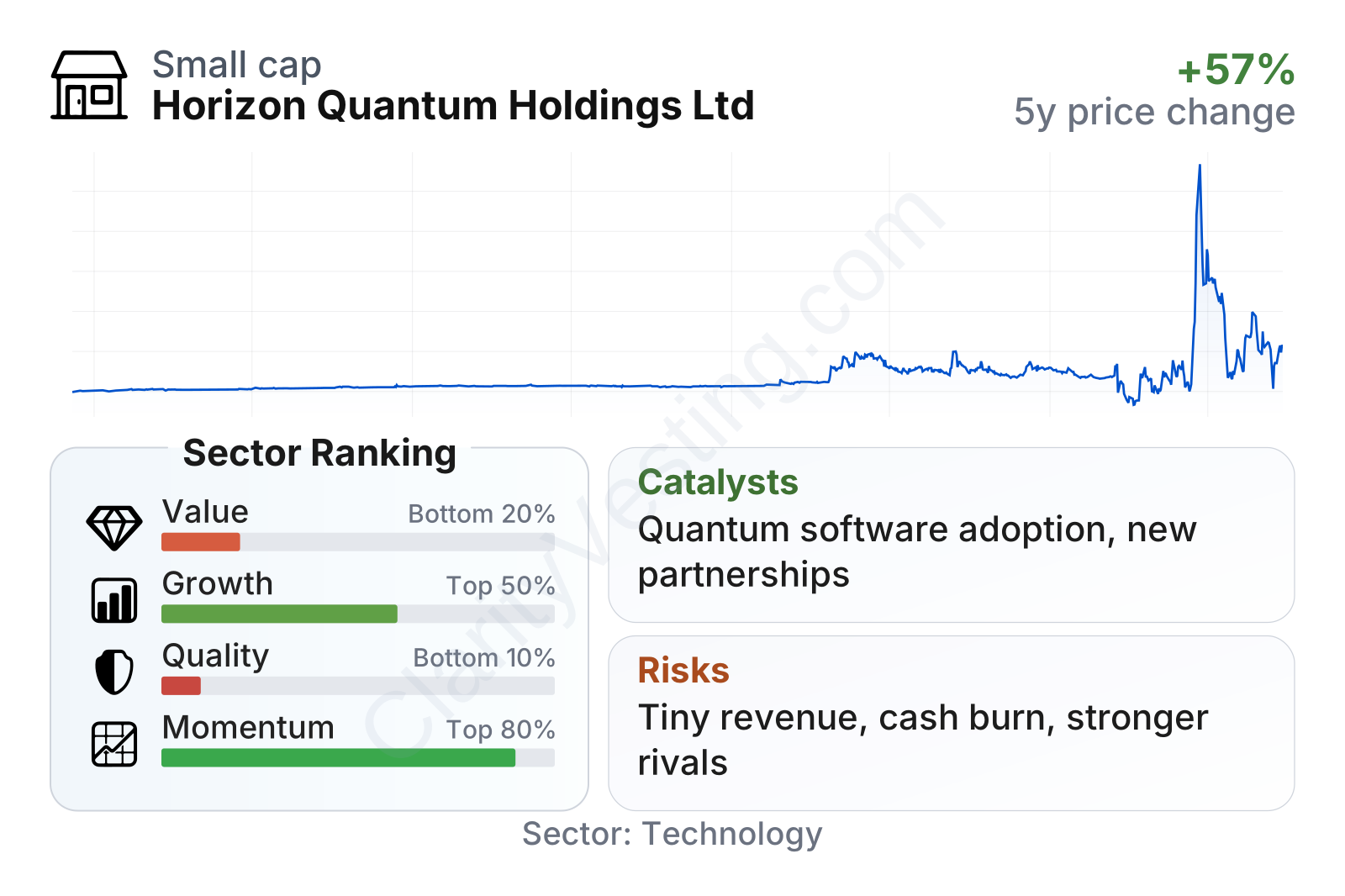
Horizon Quantum is a small-cap company with unusually low share-price volatility for a business at such an early stage, as reflected by a beta well below 1. Its factor profile is mixed. Growth ranks around the middle of the technology sector, helped by strong multi-year revenue-per-share expansion, but quality ranks near the bottom because profitability is weak, free cash flow is negative, and margins remain far below sector norms. Value measures also look weak, which is typical for a company with minimal earnings and cash generation. Momentum is somewhat better, with the stock performing ahead of many sector peers over the last 6 to 12 months.
The stock-price history also shows that market enthusiasm has strengthened more recently than in prior years. After trading in a fairly narrow range for a long period, the shares moved higher in 2025 and then became more volatile in 2026, which suggests that sentiment is increasingly tied to expectations around future quantum computing progress rather than current business scale.
Growth
Quantum computing remains a growing long-term field. Large technology companies, governments, defense organizations, and research institutions continue to invest in the space because of its potential to solve certain problems much faster than classical computers. That gives Horizon Quantum exposure to a sector with genuine strategic importance, even if widespread commercial adoption is still years away.
The company’s strategy makes sense at a high level: build software and development tools first, establish a position in the ecosystem, and aim to benefit as quantum hardware improves. Software-focused players can have an advantage if they become part of the workflow used by researchers, developers, or enterprise customers before the market matures. In theory, that creates a path to growth without needing to own the underlying hardware.
At the same time, the near-term business base remains very small. That is visible in the income profile, where annual revenue has remained modest while research and administrative costs have expanded sharply. The central growth question is therefore not whether quantum computing is important, but whether Horizon Quantum can turn technical relevance into recurring commercial demand.
Cash generation remains a weak point. Free cash flow has stayed negative and deteriorated into 2025, indicating that the company is still consuming capital rather than producing it. For a long-term growth narrative, that matters because it increases dependence on outside funding unless revenue starts scaling much more meaningfully.
A potential catalyst is any sign that the company can convert its technology into partnerships, enterprise contracts, government-related projects, or broader software adoption. In this kind of industry, even a small number of credible commercial relationships can change how the market views the business. Recent share-price strength suggests that expectations for such developments have improved, although the financial statements have not yet shown clear operating proof.
Risks
This article is for informational purposes only and does not constitute financial advice. Some content is AI-generated. See Disclaimer


