Stock Analysis · Hope Bancorp Inc (HOPE)
Overview
Hope Bancorp is a regional bank holding company whose main operating subsidiary is Bank of Hope. The group focuses on commercial banking, with a strong presence in California, New York, New Jersey, Texas, Washington, Illinois, Virginia, Alabama, and Georgia. It is especially known for serving small and mid-sized businesses, commercial real estate borrowers, and Korean-American communities, while also offering consumer banking products such as checking, savings, mortgages, and credit cards.
Like most banks, Hope Bancorp does not make money by selling physical products. Its revenue mainly comes from the spread between the interest it earns on loans and securities and the interest it pays on deposits and other funding, plus a smaller stream of fees.
Based on the company’s recent annual disclosures, the main revenue sources are approximately:
- Interest and dividend income from loans and investment securities: about 85% to 90%. This is the core of the business and includes commercial real estate loans, commercial and industrial loans, residential mortgage loans, SBA lending, and income from the securities portfolio.
- Service charges, fees, and other noninterest income: about 10% to 15%. This includes deposit service charges, loan servicing, wealth-related activities, gains on loan sales, and other banking fees.
The loan book is centered on business-oriented lending rather than mass-market consumer credit. That makes Hope Bancorp more tied to the health of small business activity, commercial property conditions, and regional economic trends than a large national retail bank would be.
The business mix over the last several years shows a familiar banking pattern: revenue expanded sharply when rates rose, but earnings did not follow at the same pace because funding costs also climbed and profitability compressed. That helps explain why reported revenue stayed relatively solid while net income weakened.
Key Figures
| Metric | Value | Sector ⓘ |
|---|---|---|
| Date | Oct 24, 2026 | |
| Context | ||
| Sector | Financial Services | |
| Industry | Banks - Regional | |
| Market Cap ⓘ | $1.74B | |
| Beta ⓘ | 0.85 | |
Value (Cheapness) | ||
| P/E Ratio ⓘ | 13.26 | 12.46 |
| P/B Ratio ⓘ | 0.79 | 1.25 |
| FCF Yield ⓘ | 10.54% | 9.82% |
| Dividend Yield ⓘ | 4.11% | 2.94% |
| EBIT / EV ⓘ | N/A | 8.11% |
| PEG ⓘ | 1.24 | |
Growth (Business expansion) | ||
| Revenue Growth ⓘ | 71.00% | 9.10% |
| RPS Growth (5Y CAGR) ⓘ | 13.79% | 12.31% |
| EPS Growth (5Y CAGR) ⓘ | -29.05% | -6.97% |
| BVPS Growth (5Y CAGR) ⓘ | 1.06% | 5.02% |
| Margin Growth (5Y Trend) ⓘ | -41.53% | -4.00% |
| FCF Growth (5Y CAGR) ⓘ | -16.86% | 4.71% |
| DPS Growth (5Y CAGR) ⓘ | -0.38% | 8.92% |
Quality (Business durability) | ||
| ROIC (Latest) ⓘ | N/A | 9.18% |
| ROE (Latest) ⓘ | 5.62% | 13.93% |
| ROA (Latest) ⓘ | 0.68% | 1.57% |
| ROIC (5Y Median) ⓘ | 4.11% | 7.80% |
| ROE (5Y Median) ⓘ | 6.46% | 12.15% |
| ROA (5Y Median) ⓘ | 0.70% | 1.28% |
| Net Debt / EBIT (Latest) ⓘ | N/A | 1.02 |
| Net Debt / EBIT (5Y Median) ⓘ | 0.14 | 0.72 |
| Net Debt / EBITDA (Latest) ⓘ | -0.26 | 0.88 |
| Operating Margin (Latest) ⓘ | N/A | 22.30% |
| Operating Margin (5Y Median) ⓘ | 18.06% | 24.50% |
| Debt to Equity (Latest) ⓘ | 25.42% | 59.34% |
| Profit Margin (Latest) ⓘ | 23.93% | 26.42% |
| Free Cash Flow (Latest) ⓘ | $183.92M | |
Momentum (Price trend) | ||
| 3Y Return ⓘ | +95.03% | +95.73% |
| 12M Return (excl. last month) ⓘ | +33.69% | +17.30% |
| 6M Return ⓘ | +15.07% | +6.07% |
| Price vs. 200-Day MA ⓘ | +11.52% | +5.36% |
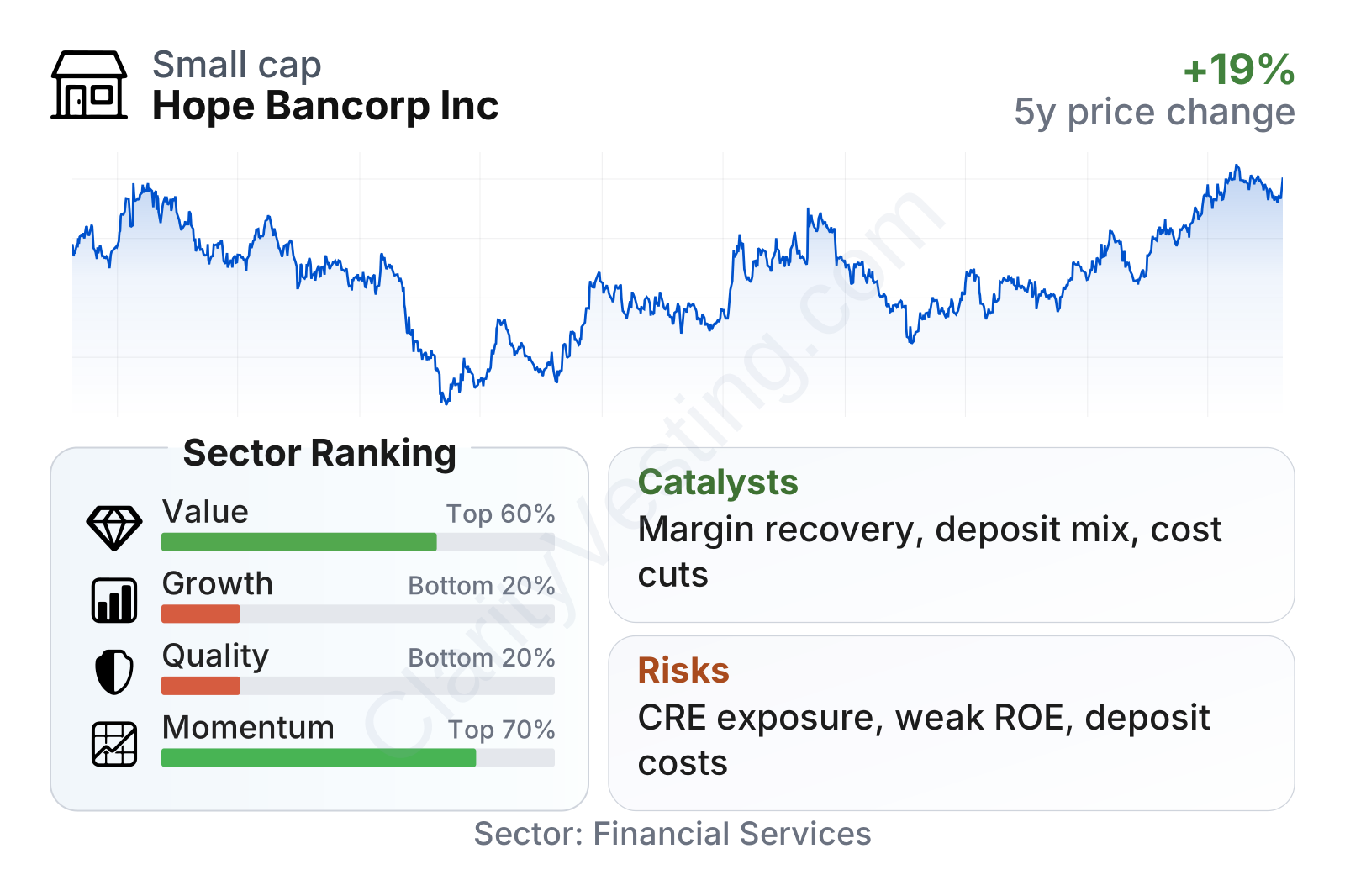
Hope Bancorp is a small-cap regional bank with a below-market beta, which suggests the shares have historically moved somewhat less than the broader equity market. On valuation, the company looks inexpensive on book value, with a price-to-book ratio well below the sector median, while the earnings multiple is close to the middle of the peer group. The dividend yield is above the sector median, which supports total return potential, but the weak ranking on quality and growth shows why the discount exists. Recent price momentum has been better than much of the regional bank group, yet profitability still trails peers by a wide margin.
Growth
Regional banking is not a high-growth industry in the way software or semiconductors can be, but it remains an essential sector with long-term demand tied to business formation, real estate activity, and household savings. For Hope Bancorp, the opportunity is less about rapid industry expansion and more about improving returns within its niche: relationship banking for small and midsized businesses, commercial real estate clients, and communities where local ties matter.
The strategy has a logical foundation. The bank has built a recognizable franchise in Korean-American banking and business lending, and that specialization can support customer loyalty, cross-selling, and deposit gathering. It also has a multistate footprint that gives it access to large metro markets rather than relying on a single local economy. In theory, that combination can help it grow loans and low-cost deposits over time.
A major potential catalyst is the interest-rate cycle. If deposit costs stabilize or fall faster than asset yields, net interest margin could recover. That matters because the bank’s recent earnings weakness has been driven more by pressure on spreads and funding costs than by a collapse in revenue. Expense control is another lever: management has already been emphasizing efficiency, and even moderate improvement can have an outsized effect when profitability has been compressed.
The earnings trend still shows the challenge clearly. After a stronger 2021-2022 period, earnings per share dropped sharply in 2023 and 2024, with only limited stabilization afterward. That means the growth debate is currently less about expansion and more about recovery. For a bank, a rebound in earnings can happen faster than balance-sheet growth if margins improve, credit costs stay contained, and operating expenses remain disciplined.
Book value per share has been much steadier than earnings, staying broadly flat to slightly higher over the last several years. That is an important sign because it suggests the franchise has preserved capital even through a difficult profitability period. A stable book value does not guarantee future growth, but it does indicate that the recent pressure has not translated into severe balance-sheet erosion.
Recent company communications have also highlighted continued attention to core deposits, loan repricing, and selective production rather than chasing volume at weak spreads. In the current banking environment, that is a sensible posture. It may not produce fast top-line expansion, but it is more consistent with rebuilding returns.
Risks
This article is for informational purposes only and does not constitute financial advice. Some content is AI-generated. See Disclaimer


