Stock Analysis · Home BancShares Inc (HOMB)
Overview
Home BancShares is a regional bank holding company best known for operating Centennial Bank. It gathers deposits from households and businesses, makes loans, earns interest on those loans and securities, and provides standard banking services such as treasury management, cards, and certain fee-based services. Its footprint is concentrated in the South and Southeast, with a meaningful presence in Arkansas, Florida, Texas, Alabama, and nearby markets, and it also has a loan production presence in specialized areas including commercial real estate and marine lending.
Like most banks, its revenue is driven primarily by net interest income, which is the spread between what it earns on loans and securities and what it pays on deposits and other funding. Non-interest income is smaller but still useful because it adds diversification beyond pure lending spreads.
Based on recent annual reporting, the main revenue sources are approximately:
- Net interest income: about 83% to 88% of total revenue. This includes income from commercial real estate loans, residential mortgage lending, construction and land development, agricultural loans, consumer lending, and investment securities, minus funding costs on deposits and borrowings.
- Service charges and fees: about 5% to 8%. This generally includes deposit account fees, interchange and card-related income, treasury and cash-management fees, and other customer transaction fees.
- Other non-interest income: about 4% to 8%. This can include gains on loan sales, mortgage-related revenue, income from bank-owned life insurance, and occasional securities or other balance-sheet related gains.
What stands out is that Home BancShares remains a fairly traditional bank. It is not dependent on a large investment banking arm or capital markets business. That makes the company easier to understand: long-term performance is tied mainly to loan growth, deposit costs, credit quality, expense control, and disciplined acquisitions.
The business mix over recent years shows revenue rising from the low-$700 million range in 2021 to above $1.3 billion in 2025, while net income also moved higher overall. The biggest swing inside that revenue has been funding cost pressure: interest expense climbed sharply as rates rose, then eased somewhat, showing how sensitive bank earnings can be to the rate cycle even when the core franchise remains profitable.
Key Figures
| Metric | Value | Sector ⓘ |
|---|---|---|
| Date | Oct 19, 2026 | |
| Context | ||
| Sector | Financial Services | |
| Industry | Banks - Regional | |
| Market Cap ⓘ | $5.84B | |
| Beta ⓘ | 0.72 | |
Value (Cheapness) | ||
| P/E Ratio ⓘ | 11.97 | 12.26 |
| P/B Ratio ⓘ | 1.27 | 1.23 |
| FCF Yield ⓘ | 7.36% | 10.40% |
| Dividend Yield ⓘ | 2.98% | 3.02% |
| EBIT / EV ⓘ | 11.06% | 8.14% |
| PEG ⓘ | 3.01 | |
Growth (Business expansion) | ||
| Revenue Growth ⓘ | 5.80% | 9.25% |
| RPS Growth (5Y CAGR) ⓘ | 11.12% | 12.19% |
| EPS Growth (5Y CAGR) ⓘ | -0.28% | -9.36% |
| BVPS Growth (5Y CAGR) ⓘ | 6.69% | 4.99% |
| Margin Growth (5Y Trend) ⓘ | -11.67% | -3.86% |
| FCF Growth (5Y CAGR) ⓘ | -0.14% | 4.81% |
| DPS Growth (5Y CAGR) ⓘ | 9.52% | 8.79% |
Quality (Business durability) | ||
| ROIC (Latest) ⓘ | 9.35% | 9.49% |
| ROE (Latest) ⓘ | 10.99% | 13.87% |
| ROA (Latest) ⓘ | 2.06% | 1.54% |
| ROIC (5Y Median) ⓘ | 7.74% | 7.86% |
| ROE (5Y Median) ⓘ | 10.74% | 12.17% |
| ROA (5Y Median) ⓘ | 1.78% | 1.30% |
| Net Debt / EBIT (Latest) ⓘ | 1.00 | 0.99 |
| Net Debt / EBIT (5Y Median) ⓘ | 0.56 | 0.73 |
| Net Debt / EBITDA (Latest) ⓘ | -0.26 | 0.91 |
| Operating Margin (Latest) ⓘ | 43.58% | 22.30% |
| Operating Margin (5Y Median) ⓘ | 38.59% | 24.63% |
| Debt to Equity (Latest) ⓘ | 15.26% | 58.04% |
| Profit Margin (Latest) ⓘ | 43.51% | 26.57% |
| Free Cash Flow (Latest) ⓘ | $429.87M | |
Momentum (Price trend) | ||
| 3Y Return ⓘ | +46.73% | +88.26% |
| 12M Return (excl. last month) ⓘ | +5.80% | +19.24% |
| 6M Return ⓘ | +10.90% | +4.70% |
| Price vs. 200-Day MA ⓘ | +3.65% | +3.66% |
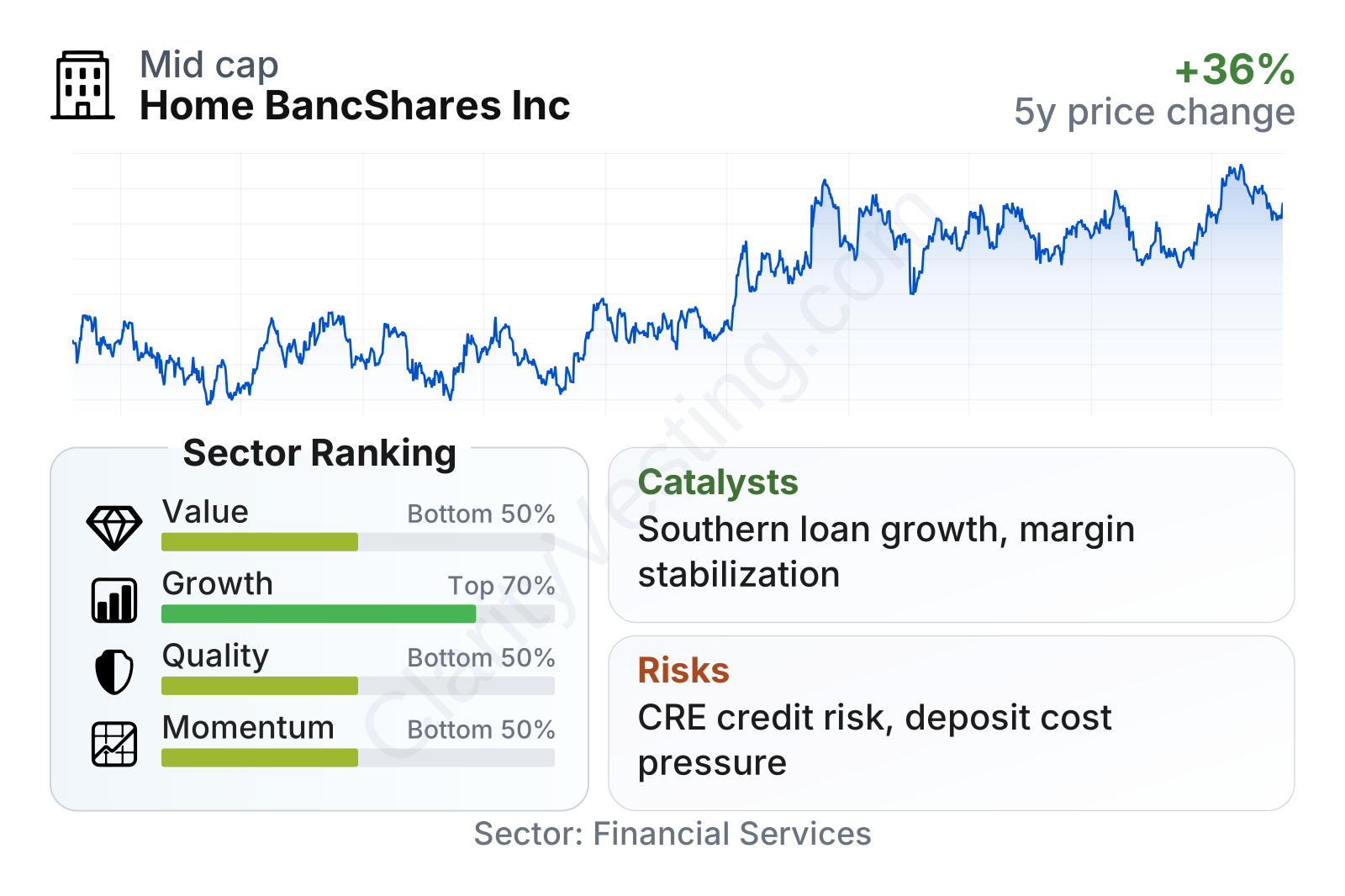
Home BancShares is a mid-sized regional bank with a market value around the mid-single-digit billions of dollars and a below-market beta, which points to lower share-price volatility than many stocks. On valuation, the shares trade near the sector median on earnings and slightly above it on book value. On growth, the picture is mixed: revenue has continued to rise, book value per share has compounded at a healthy pace, and dividend growth has been solid, but margin trends and free cash flow growth have been softer than ideal. On quality, profitability is unusual in one important way: return on assets is stronger than the sector median, while return on equity is below the median, suggesting the bank runs with relatively conservative leverage. Momentum has improved recently, but over longer periods the share-price performance has lagged the stronger part of the regional bank group.
Growth
Regional banking is not a high-growth industry in the same sense as software or semiconductors, but it remains a structurally important sector because local businesses and households still need deposits, credit, and payments services. Growth tends to come from population migration into attractive markets, gaining commercial relationships, expanding specialty lending, and buying smaller banks at sensible prices. Home BancShares operates in several states that have benefited from business relocation and population inflows, especially in parts of the South, which supports long-term demand for loans and banking services.
The company’s strategy has generally been straightforward: keep a strong deposit base, maintain disciplined underwriting, expand in faster-growing markets, and remain open to acquisitions when pricing is attractive. That approach has history behind it. Home BancShares has grown over time through a mix of organic expansion and selected bank deals, and its current footprint gives it exposure to real estate development, small and mid-sized business lending, and consumer banking in markets that have often grown faster than the national average.
Earnings progression has been steady rather than explosive. Annual earnings per share rose from about $1.83 in 2021 to about $2.35 in 2025, which shows the bank has been able to convert balance-sheet growth and better asset yields into higher profits despite a difficult funding environment for the industry.
Another encouraging sign for long-term business compounding is book value per share. It has moved from roughly $16.8 in 2021 to about $21.7 in 2025. For banks, book value matters because it reflects the capital base supporting future lending and earnings. A rising book value per share over several years usually points to retained profitability and balance-sheet discipline.
One notable catalyst is the possibility of improved net interest margin if deposit costs stabilize while loan yields remain favorable. Another is continued loan growth in faster-growing Southern markets. Management has also remained active in capital allocation through dividends, and the dividend per share has grown at a pace above the sector median over the last five years. Recent company updates have also pointed to ongoing balance-sheet management, loan production, and credit monitoring rather than any sign of operational disruption, which matters in a sector where stability is often more valuable than rapid change.
Risks
This article is for informational purposes only and does not constitute financial advice. Some content is AI-generated. See Disclaimer


