Stock Analysis · HÖEgh Autoliners AS (HOEGF)
Overview
HÖegh Autoliners AS is a specialized ocean shipping company focused on moving cars and other rolling cargo around the world. Its fleet mainly consists of Pure Car and Truck Carriers, usually called PCTC vessels, which are designed to transport finished vehicles efficiently over long distances. In addition to passenger cars, the company also carries trucks, buses, agricultural machinery, construction equipment, and other high-and-heavy cargo that can be rolled on and off ships.
The business is tied to global trade flows, especially exports from major auto-producing regions to consumer markets. That makes HÖegh Autoliners more specialized than a broad container shipping company. Its position is built around long-standing relationships with automobile manufacturers, global route coverage, and vessel capacity tailored to vehicle logistics.
Public filings and company materials show that revenue is primarily generated from ocean transportation services, with additional exposure to related logistics and shipping services. A simple way to think about the revenue mix is the following:
- Deep-sea transportation of cars and light vehicles: approximately 60% to 75% of revenue. This is the core activity and includes contracts with global car manufacturers and exporters.
- High-and-heavy cargo transportation: approximately 20% to 35% of revenue. This includes trucks, buses, mining equipment, farm machinery, and other wheeled or rollable industrial cargo.
- Other shipping-related services: approximately 5% to 10% of revenue. This can include ancillary freight services, repositioning-related income, and other contractual logistics elements.
The broad pattern visible over the last several years is that revenue expanded sharply from 2021 to 2023, then remained at a high level through 2024 and 2025 while profitability stayed unusually strong for a shipping company. Costs did rise again in 2025, but the company still converted a large share of sales into operating income and net profit, which points to favorable market conditions and disciplined contract pricing.
Key Figures
| Metric | Value | Sector ⓘ |
|---|---|---|
| Date | Oct 24, 2026 | |
| Context | ||
| Sector | Industrials | |
| Industry | Marine Shipping | |
| Market Cap ⓘ | $3.68B | |
| Beta ⓘ | 0.22 | |
Value (Cheapness) | ||
| P/E Ratio ⓘ | 8.27 | 22.29 |
| P/B Ratio ⓘ | 2.93 | 1.98 |
| FCF Yield ⓘ | 7.81% | 6.26% |
| Dividend Yield ⓘ | 6.36% | 1.92% |
| EBIT / EV ⓘ | 7.11% | 4.83% |
| PEG ⓘ | N/A | |
Growth (Business expansion) | ||
| Revenue Growth ⓘ | 2.30% | 9.30% |
| RPS Growth (5Y CAGR) ⓘ | 2.53% | 7.76% |
| EPS Growth (5Y CAGR) ⓘ | -12.46% | -13.17% |
| BVPS Growth (5Y CAGR) ⓘ | 3.23% | 6.13% |
| Margin Growth (5Y Trend) ⓘ | 27.34% | 0.74% |
| FCF Growth (5Y CAGR) ⓘ | 16.07% | 10.79% |
| DPS Growth (5Y CAGR) ⓘ | 71.77% | 9.41% |
Quality (Business durability) | ||
| ROIC (Latest) ⓘ | 15.28% | 10.75% |
| ROA (Latest) ⓘ | 13.11% | 5.41% |
| ROIC (5Y Median) ⓘ | 28.17% | 9.37% |
| ROA (5Y Median) ⓘ | 23.82% | 4.95% |
| Net Debt / EBIT (Latest) ⓘ | 2.29 | 2.04 |
| Net Debt / EBIT (5Y Median) ⓘ | 1.10 | 2.27 |
| Net Debt / EBITDA (Latest) ⓘ | 1.66 | 1.39 |
| Net Debt / Assets ⓘ | 31.58% | 19.27% |
| EBITDA / Interest ⓘ | 12.16 | 9.58 |
| Operating Margin (Latest) ⓘ | 29.46% | 10.49% |
| Operating Margin (5Y Median) ⓘ | 34.36% | 10.30% |
| Debt to Equity (Latest) ⓘ | 76.43% | 64.82% |
| Profit Margin (Latest) ⓘ | 28.95% | 6.67% |
| Free Cash Flow (Latest) ⓘ | $287.11M | |
Momentum (Price trend) | ||
| 3Y Return ⓘ | +479.74% | +67.77% |
| 12M Return (excl. last month) ⓘ | +86.30% | +12.05% |
| 6M Return ⓘ | +40.61% | 0.00% |
| Price vs. 200-Day MA ⓘ | +29.96% | +0.67% |
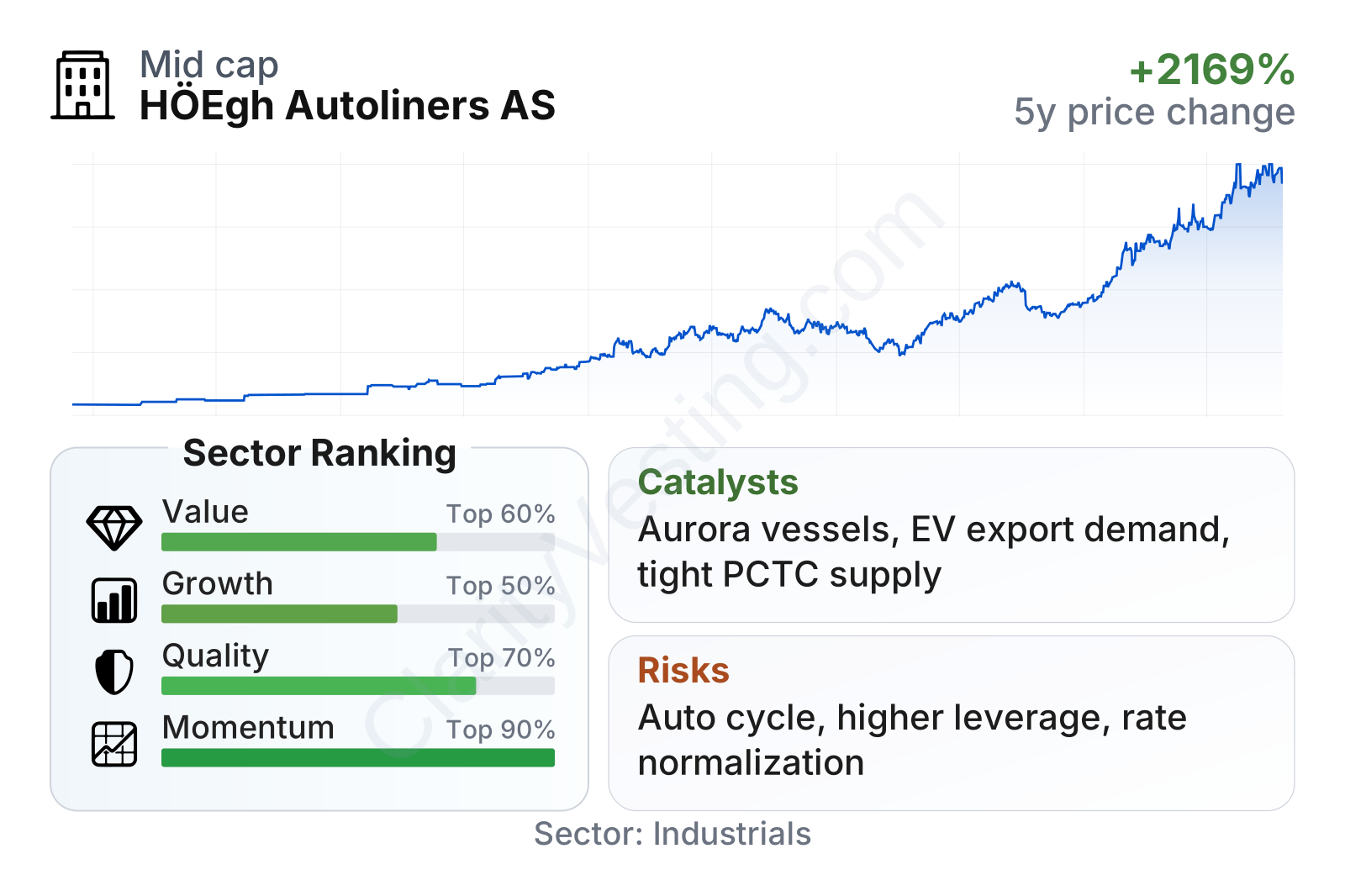
HÖegh Autoliners stands out as a mid-sized listed shipping company with an unusually strong combination of profitability, cash generation, and stock momentum. Quality measures are solid versus the broader industrial sector: returns on assets and invested capital are above sector medians, while operating margins and profit margins remain far stronger than what is typical in marine transport. Growth is more mixed. Recent revenue growth has been modest compared with the sector median, but free cash flow and margin expansion over a multi-year period have been notably strong. On valuation, earnings and cash-flow multiples remain lower than many industrial peers even after a large share-price rise, although the price-to-book ratio is less conservative than the earnings multiple suggests.
Growth
The sector itself is structurally important because vehicle manufacturers need dependable global export capacity, and modern car trade is becoming more complex as production footprints shift between Asia, Europe, and the Americas. Demand for car carriers has also been supported by growth in electric vehicle exports from Asia and by tighter vessel supply after years of limited new ordering across the industry. In plain terms, this is not a fast-changing technology market, but it is a market where vessel availability, customer relationships, and route networks matter a lot.
HÖegh Autoliners’ strategy appears coherent for long-term expansion. The company has emphasized contract coverage, premium cargo mix, and a more environmentally advanced fleet. Its ammonia-ready Aurora-class newbuild program is especially important. These vessels are designed to increase capacity and improve fuel efficiency while preparing for stricter emissions rules over time. That matters because shipping customers increasingly care about both reliability and carbon intensity, and regulators are steadily making older tonnage less attractive.
Revenue growth has been uneven after the exceptional upswing of 2022 and 2023. Growth turned negative at several points in 2024, then recovered into low positive territory in parts of 2025 and early 2026 before softening again. That pattern suggests the company is now operating from a high base rather than in a straight-line expansion phase. Even so, the level of business remains elevated compared with pre-boom conditions.
Cash generation is one of the more attractive parts of the picture. Free cash flow climbed sharply into 2024, then fell back, but it has stayed positive at a healthy level. For a capital-intensive shipowner, remaining solidly cash generative after a peak cycle is a meaningful sign. It gives the company room to support dividends, fund fleet renewal, and manage debt without relying heavily on new equity.
A notable catalyst in recent company updates has been continued fleet renewal and chartering activity tied to expected long-term demand for vehicle transportation. Another favorable backdrop is the still-tight global car-carrier market, where vessel supply has not expanded as quickly as demand over the last several years. If global vehicle exports remain firm and contract pricing stays supportive, HÖegh Autoliners could continue to earn returns above historical shipping norms.
Risks
This article is for informational purposes only and does not constitute financial advice. Some content is AI-generated. See Disclaimer


