Stock Analysis · Hinge Health Inc (HNGE)
Overview
Hinge Health is a digital healthcare company focused on musculoskeletal care, meaning treatment and prevention for back, joint, muscle, and related pain conditions. Its platform combines exercise therapy, health coaching, clinical support, and software tools that patients use at home. The company mainly sells to employers and health plans that want to lower medical costs and reduce the impact of chronic pain on productivity and quality of life.
The business model is centered on contracted healthcare programs rather than consumer subscriptions. Based on the company’s public filings, revenue is primarily generated from fees tied to access, participation, and care delivery across its musculoskeletal programs. The exact mix can vary by customer contract, but the broad sources can be summarized as follows:
- Enterprise musculoskeletal care programs: the large majority of revenue. These programs cover prevention, acute care, and chronic pain support for members of employer and health plan customers.
- Care delivery and clinical services: a meaningful but smaller portion of revenue, tied to coaching, physical therapy support, and other member services delivered through the platform.
- Technology-enabled add-on services and newer offerings: a smaller share, including adjacent care modules, analytics, and program expansions sold into existing customer accounts.
What stands out is the operating model: software helps scale care delivery, while clinicians and coaches support engagement and outcomes. That gives Hinge Health a mix of recurring enterprise revenue and healthcare-service economics. Revenue expanded strongly from about $293 million in 2023 to about $390 million in 2024 and then to roughly $588 million in 2025, showing that demand has been rising quickly. At the same time, earlier losses were heavily affected by aggressive spending, especially in product development and operating expansion.
The financial flow also shows a sharp improvement from 2023 to 2024, with revenue growing faster than direct service costs and operating losses narrowing substantially. In 2025, revenue continued to climb, but expenses surged much faster than sales, which points to a year shaped by exceptional cost growth rather than a simple deterioration in demand.
Key Figures
| Metric | Value | Sector ⓘ |
|---|---|---|
| Date | Oct 04, 2026 | |
| Context | ||
| Sector | Healthcare | |
| Industry | Health Information Services | |
| Market Cap ⓘ | $7.88B | |
| Beta ⓘ | N/A | |
Value (Cheapness) | ||
| P/E Ratio ⓘ | 11.88 | 24.06 |
| P/B Ratio ⓘ | 23.36 | 3.08 |
| FCF Yield ⓘ | 3.65% | 3.08% |
| Dividend Yield ⓘ | N/A | 2.05% |
| EBIT / EV ⓘ | 1.40% | 0.63% |
| PEG ⓘ | N/A | |
Growth (Business expansion) | ||
| Revenue Growth ⓘ | 53.00% | 7.50% |
| RPS Growth (5Y CAGR) ⓘ | 38.45% | 8.70% |
| EPS Growth (5Y CAGR) ⓘ | N/A | -18.20% |
| BVPS Growth (5Y CAGR) ⓘ | -8.02% | 3.95% |
| Margin Growth (5Y Trend) ⓘ | N/A | -0.58% |
| FCF Growth (5Y CAGR) ⓘ | N/A | 0.88% |
| DPS Growth (5Y CAGR) ⓘ | N/A | 6.80% |
Quality (Business durability) | ||
| ROIC (Latest) ⓘ | 46.82% | 3.29% |
| ROA (Latest) ⓘ | 13.66% | 3.02% |
| ROIC (5Y Median) ⓘ | N/A | 4.75% |
| ROA (5Y Median) ⓘ | N/A | 1.93% |
| Net Debt / EBIT (Latest) ⓘ | -2.84 | 1.33 |
| Net Debt / EBIT (5Y Median) ⓘ | N/A | 1.83 |
| Net Debt / EBITDA (Latest) ⓘ | -2.72 | 0.99 |
| Net Debt / Assets ⓘ | -33.88% | 5.33% |
| EBITDA / Interest ⓘ | N/A | 9.63 |
| Operating Margin (Latest) ⓘ | 13.73% | 9.25% |
| Operating Margin (5Y Median) ⓘ | -44.59% | 7.80% |
| Debt to Equity (Latest) ⓘ | 1.71% | 28.99% |
| Profit Margin (Latest) ⓘ | 15.15% | 3.60% |
| Free Cash Flow (Latest) ⓘ | $287.33M | |
Momentum (Price trend) | ||
| 3Y Return ⓘ | N/A | +36.74% |
| 12M Return (excl. last month) ⓘ | +64.96% | +20.89% |
| 6M Return ⓘ | +150.56% | +9.73% |
| Price vs. 200-Day MA ⓘ | +59.70% | +4.69% |
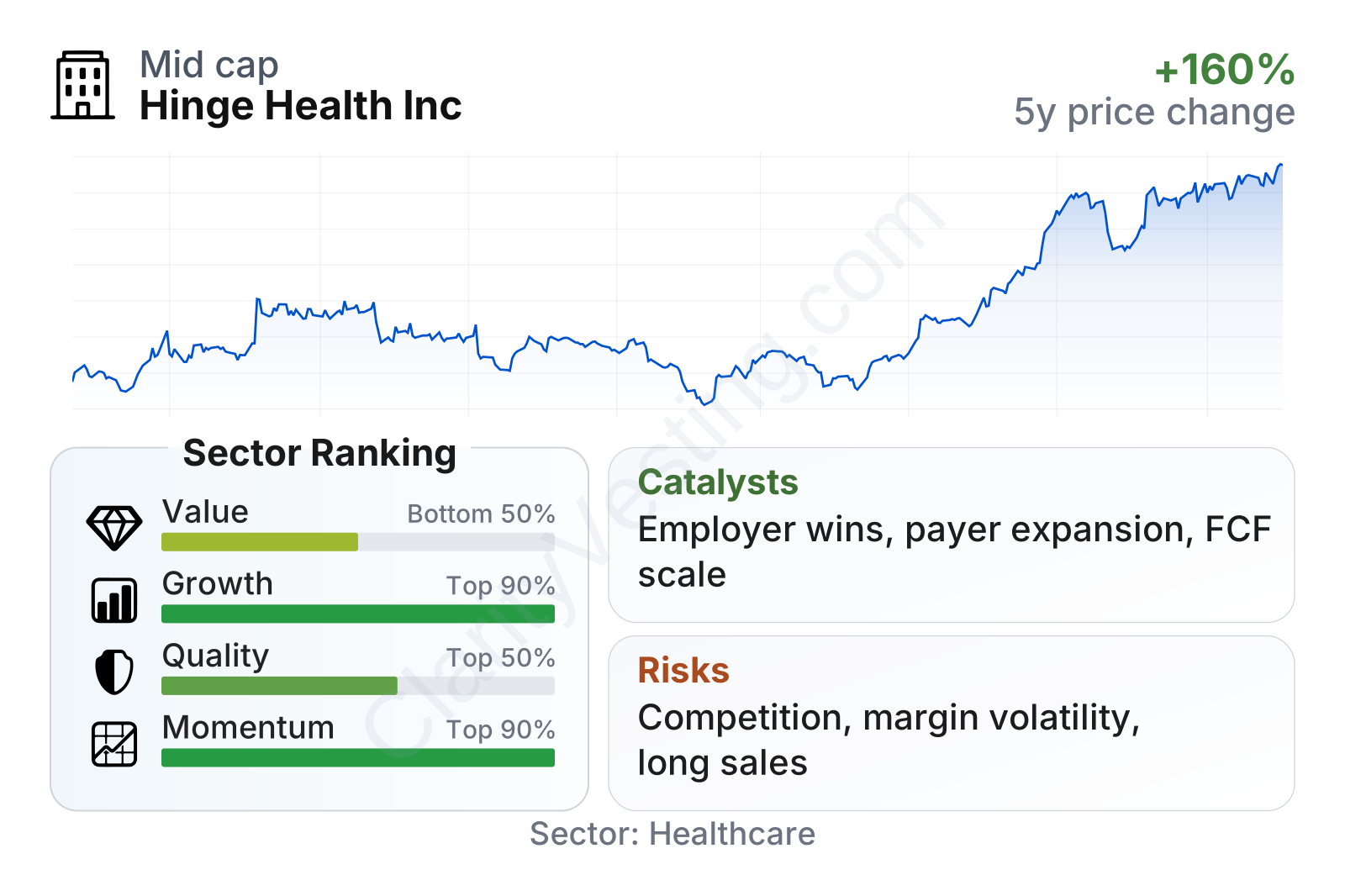
Hinge Health currently sits in a somewhat unusual position. Growth and market momentum rank near the top of the healthcare sector, while profitability and capital efficiency are also better than many peers. Revenue growth is far above the sector median, returns on capital are strong, and the balance sheet carries very little debt. The weaker point in the table is traditional value screening: the stock does not look broadly cheap across all metrics, especially because the price-to-book ratio is very high, which is common in businesses built more on software, brand, and customer relationships than on physical assets.
The company is also now large enough to matter, with a multibillion-dollar market value, but it remains small relative to the biggest healthcare platforms. That can create room for expansion if execution remains solid, while also implying that the stock can move sharply when the market reassesses growth expectations.
Growth
Hinge Health operates in a part of healthcare that has strong structural support. Musculoskeletal conditions are among the most common and costly health issues for working-age adults, and employers have a clear financial reason to manage them earlier and more effectively. Digital delivery also fits a broad healthcare trend: shifting care away from high-cost in-person settings when outcomes can still be maintained or improved.
The company’s strategy is logical for long-term expansion. It is not trying to build a general telehealth marketplace; it is focused on a specific, expensive category where payers and employers can measure results. That is important because enterprise healthcare buyers usually want proof of lower costs, fewer surgeries, lower imaging use, or better employee function before they expand a vendor relationship. A specialized platform can be easier to justify than a broad but harder-to-measure wellness offering.
Recent growth has been exceptionally strong. Year-over-year revenue growth has been running around the high-40% to low-50% range in the latest reported periods, far ahead of the healthcare sector median. That pace suggests Hinge Health is still in a land-grab phase within its category, gaining customers or increasing penetration inside existing accounts.
Cash generation is another encouraging point. Free cash flow moved higher into 2026, reaching a level that is notable for a company still commonly viewed through a growth lens. This matters because it suggests the business can fund expansion internally more easily than many digital health peers, which often depend on outside capital for much longer.
A major catalyst is the combination of strong adoption and measurable economics for customers. If Hinge Health continues proving that its programs reduce downstream medical costs, it can deepen relationships with employers and insurers, expand internationally over time, and cross-sell newer services into an existing client base. Public company status also tends to improve visibility with large enterprise buyers, which can support larger contracts if execution remains steady.
Risks
This article is for informational purposes only and does not constitute financial advice. Some content is AI-generated. See Disclaimer