Stock Analysis · Horace Mann Educators Corporation (HMN)
Overview
Horace Mann Educators Corporation is a specialized insurance and financial services company focused mainly on serving educators and other school employees in the United States. That niche matters because the company is not trying to compete broadly across every customer category in insurance. Instead, it builds products, pricing, and distribution around a defined professional group that tends to value long-term relationships, bundled coverage, and workplace access.
Its business is spread across property and casualty insurance, life insurance, supplemental and worksite products, and retirement-related financial solutions. The company distributes many of these offerings through a dedicated agent network and school-focused relationships, which is one of the clearest ways it differentiates itself from larger national insurers.
The latest annual revenue mix by segment is not perfectly comparable to a traditional manufacturer because insurance companies report premiums, policy charges, contract deposits, and investment income across different lines. Still, the largest sources can be summarized approximately as follows:
- Property & Casualty insurance: approximately 55% to 65% of core insurance revenue, driven by auto and homeowners policies sold primarily to educators.
- Supplemental and worksite benefits: approximately 15% to 25%, including products such as cancer, accident, hospital, and disability coverage, an area expanded by the Madison National acquisition.
- Life & Retirement: approximately 15% to 25%, including life insurance, annuities, and retirement products and services aimed at school employees.
- Net investment income and other items: a smaller but meaningful contributor that supports insurer earnings across the group.
Over the last several years, the business has also shown a recovery in earnings structure after a difficult 2022 period for insurers. Revenue has climbed from roughly $1.25 billion in 2021 to about $1.62 billion in 2025, while operating income and net income have improved materially from the post-inflation slump.
The revenue and profit flow shows a clear rebound after 2022. Total revenue has been rising steadily, while operating income and net income recovered strongly through 2024 and 2025, suggesting that pricing actions, claims normalization, and a broader product mix have started to restore profitability.
Key Figures
| Metric | Value | Sector ⓘ |
|---|---|---|
| Date | Oct 24, 2026 | |
| Context | ||
| Sector | Financial Services | |
| Industry | Insurance - Property & Casualty | |
| Market Cap ⓘ | $1.88B | |
| Beta ⓘ | 0.10 | |
Value (Cheapness) | ||
| P/E Ratio ⓘ | 10.83 | 12.46 |
| P/B Ratio ⓘ | 1.30 | 1.25 |
| FCF Yield ⓘ | 30.16% | 9.82% |
| Dividend Yield ⓘ | 3.06% | 2.94% |
| EBIT / EV ⓘ | 10.08% | 8.11% |
| PEG ⓘ | 1.16 | |
Growth (Business expansion) | ||
| Revenue Growth ⓘ | 7.70% | 9.10% |
| RPS Growth (5Y CAGR) ⓘ | 7.15% | 12.31% |
| EPS Growth (5Y CAGR) ⓘ | 24.12% | -6.97% |
| BVPS Growth (5Y CAGR) ⓘ | -4.49% | 5.02% |
| Margin Growth (5Y Trend) ⓘ | -3.29% | -4.00% |
| FCF Growth (5Y CAGR) ⓘ | 27.83% | 4.71% |
| DPS Growth (5Y CAGR) ⓘ | 3.03% | 8.92% |
Quality (Business durability) | ||
| ROIC (Latest) ⓘ | 9.78% | 9.18% |
| ROE (Latest) ⓘ | 12.04% | 13.93% |
| ROA (Latest) ⓘ | 1.14% | 1.57% |
| ROIC (5Y Median) ⓘ | 7.34% | 7.80% |
| ROE (5Y Median) ⓘ | 7.94% | 12.15% |
| ROA (5Y Median) ⓘ | 0.72% | 1.28% |
| Net Debt / EBIT (Latest) ⓘ | 2.15 | 1.02 |
| Net Debt / EBIT (5Y Median) ⓘ | 3.15 | 0.72 |
| Net Debt / EBITDA (Latest) ⓘ | 1.95 | 0.88 |
| Operating Margin (Latest) ⓘ | 14.89% | 22.30% |
| Operating Margin (5Y Median) ⓘ | 10.53% | 24.50% |
| Debt to Equity (Latest) ⓘ | 39.54% | 59.34% |
| Profit Margin (Latest) ⓘ | 10.15% | 26.42% |
| Free Cash Flow (Latest) ⓘ | $566.10M | |
Momentum (Price trend) | ||
| 3Y Return ⓘ | +69.53% | +95.73% |
| 12M Return (excl. last month) ⓘ | +5.96% | +17.30% |
| 6M Return ⓘ | +6.05% | +6.07% |
| Price vs. 200-Day MA ⓘ | +2.37% | +5.36% |
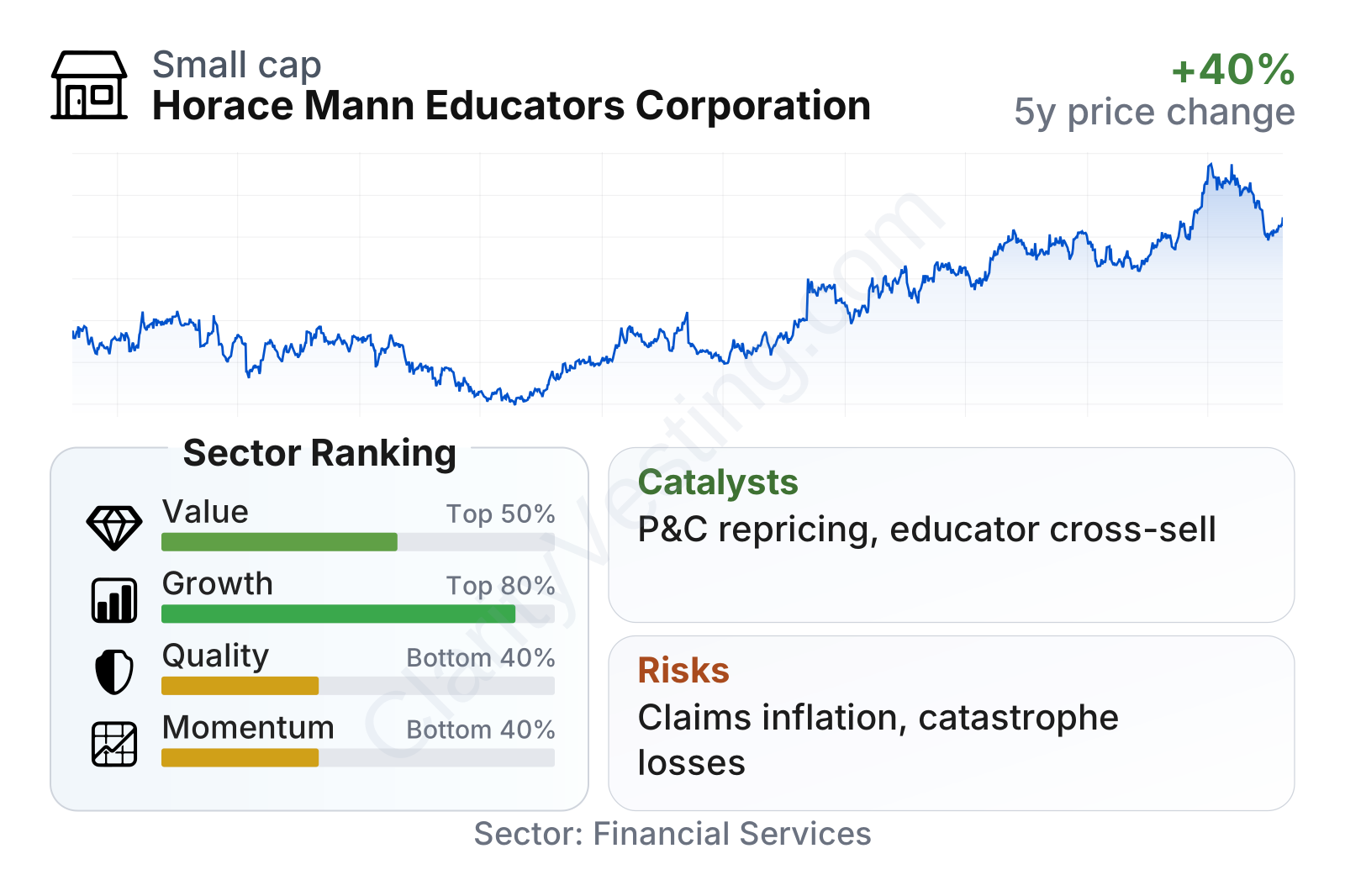
Horace Mann is a small-cap insurer with unusually low share-price volatility, reflected in a beta close to zero. On valuation, it sits around the middle of the financial sector: earnings and cash-flow metrics look relatively favorable, while price-to-book is close to the sector norm rather than deeply discounted. Growth indicators are mixed. Earnings growth over five years has been strong, but revenue growth has been more modest than the sector median and book value growth has lagged. Quality is the softer area: returns on equity and assets have improved, yet profitability still trails many peers, and leverage is higher than typical on an EBIT basis. Share-price momentum has also been weaker than the sector in recent periods.
Growth
Horace Mann operates in a mature sector rather than a high-growth one, but some of its end markets still offer room for expansion. Insurance demand is persistent, and educator-focused financial protection products can remain relevant for decades because they are tied to auto ownership, home ownership, family protection, disability coverage, and retirement planning. That creates a durable base, even if the industry itself does not expand at technology-sector rates.
The company’s strategy appears sensible for long-term development because it combines a niche customer base with cross-selling. An educator who first buys auto insurance can later be introduced to homeowners, life, supplemental health, and retirement products. That can lower customer acquisition costs over time and raise lifetime value if retention remains solid. The Madison National acquisition also broadened Horace Mann’s presence in worksite and supplemental benefits, giving it more products that fit naturally with school-district and employer relationships.
Earnings per share show how sharply the business has recovered from the 2022 trough. After dropping to nearly $1 per share in 2022, EPS rebuilt through 2024 and 2025 to a much stronger level. That pattern suggests the recent earnings profile is being driven less by one-off stress and more by operational repair, especially in underwriting and pricing.
Book value per share is also important for an insurer because it reflects the capital base supporting future underwriting. Horace Mann’s book value fell sharply in 2022, then recovered steadily through 2025. It has not fully returned to the 2021 level, but the direction has become more constructive. For long-term analysis, that recovery matters because insurers that can rebuild book value after a stress period often regain flexibility in pricing, capital allocation, and dividend support.
A meaningful catalyst is the ongoing normalization of property and casualty results. The auto insurance industry has spent the last few years repricing after severe claims inflation in vehicles, parts, labor, and litigation costs. If rate increases continue to earn through the book while loss trends stabilize, Horace Mann could continue converting premium growth into better underwriting margins. Higher investment income is another support, since insurers benefit when new money can be invested at improved yields.
Recent company updates have also highlighted continued progress in educator-focused distribution, product bundling, and worksite benefits integration. None of these are explosive catalysts on their own, but together they support a practical path to measured growth and earnings durability.
Risks
This article is for informational purposes only and does not constitute financial advice. Some content is AI-generated. See Disclaimer


