Stock Analysis · Helvetia Holding AG (HLVTY)
Overview
Helvetia Holding AG is a Swiss insurance group that sells property and casualty insurance, life insurance, and specialty coverage to individuals and businesses. Its core markets are Switzerland, Germany, Spain, and Italy, and it also operates in selected international specialty lines through its Global & Specialty segment. In simple terms, Helvetia collects premiums from policyholders, invests part of that money, pays claims when covered events happen, and aims to keep the difference after expenses and claims.
The company’s revenue mix is shaped mainly by insurance premiums and, to a lesser extent, investment and fee-related income. Based on Helvetia’s recent reporting structure and annual disclosures, the broad business mix can be summarized as follows:
- Non-life insurance: approximately 55% to 65% of business volume. This includes motor, property, liability, accident, transport, and other commercial and retail insurance products.
- Life insurance: approximately 20% to 30% of business volume. This covers individual life, occupational pensions, savings-oriented policies, and protection products.
- Specialty lines and other services: approximately 10% to 20% of business volume. This includes marine, aviation, art, engineering, and other specialty risks, plus some service and fee-related activities.
- Investment income: an important earnings contributor rather than a standalone operating segment. For insurers, returns on bond portfolios and other invested assets can materially affect profit, especially when interest rates are higher.
Geographically, Switzerland remains the largest earnings base, while Germany, Spain, and Italy provide diversification across European insurance markets. That mix matters because it reduces dependence on a single economy, but it also exposes the group to different regulatory regimes and underwriting conditions.
The recent income profile shows a recovery after weaker years: revenue moved back above 10 billion in 2024 and 2025, operating income improved, and net income rose meaningfully. Expenses still absorb the vast majority of revenue, which is normal in insurance, so profitability depends heavily on underwriting discipline, pricing, claims experience, and investment returns.
The business has shown a clearer earnings rebound than a straight-line expansion. Revenue dipped sharply in 2022, then recovered, while operating income and net income improved notably in 2024 and 2025. That pattern suggests Helvetia’s near-term progress has come more from restoring margins and pricing than from uninterrupted top-line growth.
Key Figures
| Metric | Value | Sector ⓘ |
|---|---|---|
| Date | Oct 10, 2026 | |
| Context | ||
| Sector | Financial Services | |
| Industry | Insurance - Diversified | |
| Market Cap ⓘ | $22.85B | |
| Beta ⓘ | 0.33 | |
Value (Cheapness) | ||
| P/E Ratio ⓘ | 36.06 | 12.38 |
| P/B Ratio ⓘ | 0.04 | 1.23 |
| FCF Yield ⓘ | N/A | 10.23% |
| Dividend Yield ⓘ | 4.27% | 3.01% |
| EBIT / EV ⓘ | 3.14% | 8.08% |
| PEG ⓘ | N/A | |
Growth (Business expansion) | ||
| Revenue Growth ⓘ | 73.00% | 9.50% |
| RPS Growth (5Y CAGR) ⓘ | -17.07% | 12.21% |
| EPS Growth (5Y CAGR) ⓘ | -30.43% | -9.62% |
| BVPS Growth (5Y CAGR) ⓘ | 10.13% | 4.98% |
| Margin Growth (5Y Trend) ⓘ | 1.25% | -4.07% |
| FCF Growth (5Y CAGR) ⓘ | 6.10% | 4.76% |
| DPS Growth (5Y CAGR) ⓘ | -9.06% | 8.79% |
Quality (Business durability) | ||
| ROIC (Latest) ⓘ | N/A | 9.35% |
| ROE (Latest) ⓘ | N/A | 13.91% |
| ROA (Latest) ⓘ | N/A | 1.53% |
| ROIC (5Y Median) ⓘ | N/A | 7.86% |
| ROE (5Y Median) ⓘ | 9.32% | 12.22% |
| ROA (5Y Median) ⓘ | 0.70% | 1.29% |
| Net Debt / EBIT (Latest) ⓘ | N/A | 0.99 |
| Net Debt / EBIT (5Y Median) ⓘ | N/A | 0.73 |
| Net Debt / EBITDA (Latest) ⓘ | N/A | 0.93 |
| Operating Margin (Latest) ⓘ | N/A | 22.19% |
| Operating Margin (5Y Median) ⓘ | 6.99% | 24.30% |
| Debt to Equity (Latest) ⓘ | N/A | 60.24% |
| Profit Margin (Latest) ⓘ | 2.25% | 26.49% |
| Free Cash Flow (Latest) ⓘ | N/A | |
Momentum (Price trend) | ||
| 3Y Return ⓘ | +73.83% | +88.52% |
| 12M Return (excl. last month) ⓘ | +58.38% | +19.65% |
| 6M Return ⓘ | -16.75% | +6.00% |
| Price vs. 200-Day MA ⓘ | -9.28% | +3.61% |
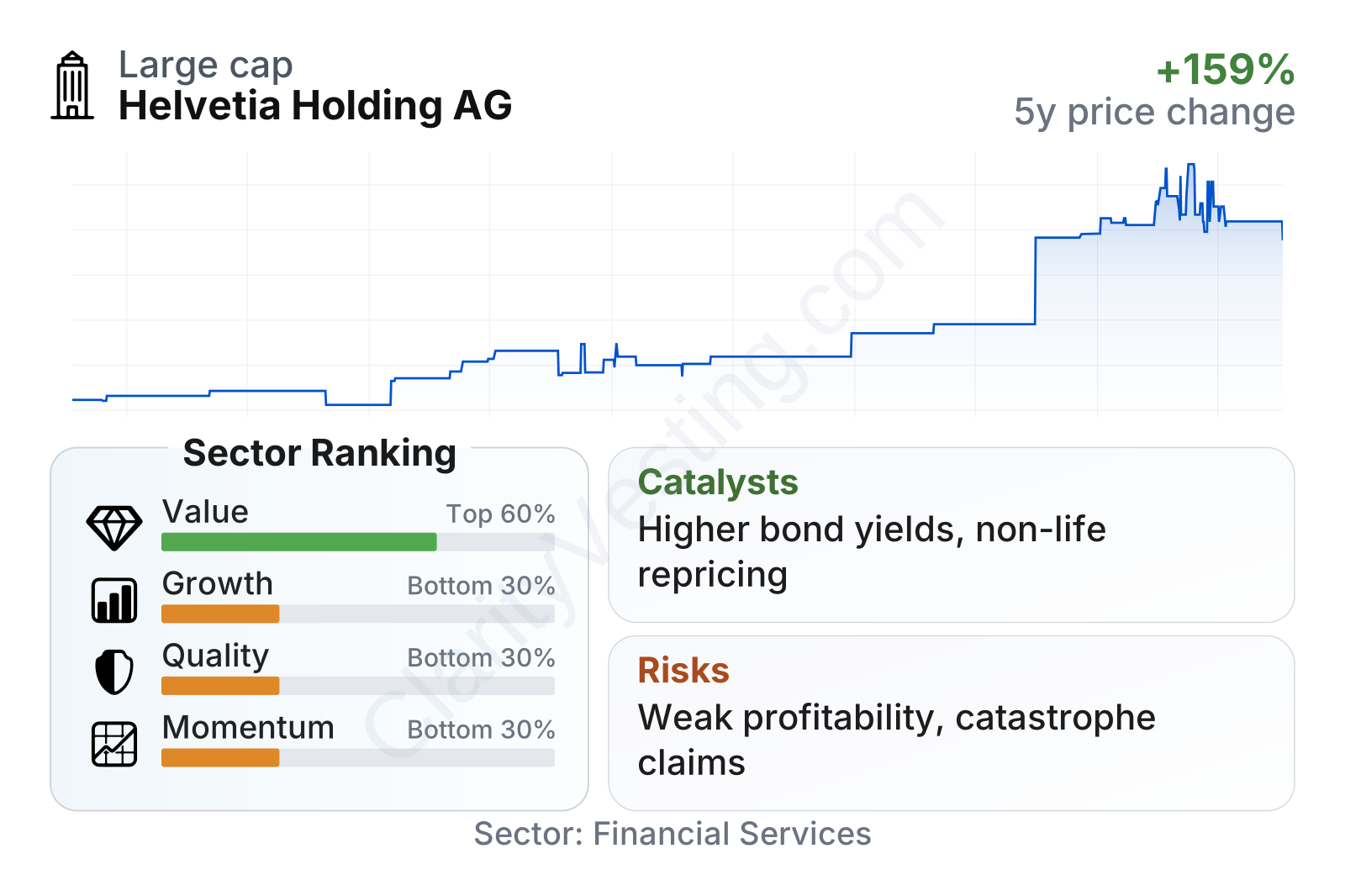
Helvetia sits in the large-cap range for its market and has had relatively low share-price volatility, as indicated by a beta well below 1. The stock’s recent price performance was strong over the past year, but the shorter-term trend weakened, with the shares falling below their 200-day average and trailing the sector over the last six months.
On valuation, the picture is mixed. The dividend yield is above the sector median, which supports the income profile, but the earnings multiple is also well above the sector median, implying the market is paying up for recent improvements. At the same time, the price-to-book reading appears unusually low for an insurer, which likely reflects share-class or data-translation quirks more than a straightforward deep-value signal, so it should be treated with caution rather than taken at face value.
Quality and growth metrics are less convincing than the recent share-price rise. Profitability ratios trail sector medians, including profit margin and medium-term returns on equity and assets. Five-year revenue-per-share and earnings-per-share trends are negative, even though book value per share and free cash flow have grown over that period. In other words, Helvetia looks stronger on balance-sheet rebuilding and cash generation than on long-run earnings compounding.
Growth
Insurance is not usually a high-growth industry, but it is a durable one. Demand tends to rise over time because households need protection for cars, homes, health, savings, and retirement, while businesses need coverage for property, liability, supply chains, and specialized risks. In Europe, pricing has also benefited from inflation, higher repair and replacement costs, and elevated catastrophe awareness. That creates a supportive background for insurers that can reprice policies appropriately.
Helvetia’s strategy makes sense in that context. The group combines a stable home market in Switzerland with positions in several European countries and a specialty business that can offer better pricing when niche risks are underwritten well. Scale is not as large as the global insurance giants, but Helvetia is big enough to spread risk across products and regions. Its recent profit rebound indicates that pricing, portfolio management, and cost control have been moving in the right direction.
Another useful sign is the rise in book value per share over the last two reported years after earlier declines. For an insurer, book value is an important marker because it reflects capital strength and the ability to support future underwriting.
The longer-term book value trend is still uneven, but the latest jump points to stronger retained earnings and improved capital accumulation. Combined with better operating income in 2024 and 2025, that gives Helvetia a more solid platform than it had during the weaker 2022–2023 period.
A practical catalyst is the current interest-rate environment relative to the ultra-low-rate years that weighed on European insurers. Insurers invest large portfolios, much of them in fixed income securities, so reinvesting at higher yields can support future investment income. For Helvetia, that matters because investment returns can make a meaningful difference to overall profit, especially when underwriting margins are not exceptionally high.
Another potential opportunity comes from continued premium rate increases in non-life insurance. If claims inflation remains manageable and pricing holds firm, margin expansion can continue even without rapid volume growth. Helvetia’s specialty operations may also benefit if commercial customers keep demanding tailored coverage in marine, engineering, and other complex risk areas.
Risks
This article is for informational purposes only and does not constitute financial advice. Some content is AI-generated. See Disclaimer


