Stock Analysis · Hillman Solutions Corp (HLMN)
Overview
Hillman Solutions Corp is a hardware and home improvement supplier that focuses on small but essential products sold mainly through retail channels. Its business is built around the kinds of items customers often need immediately for repair, maintenance, and DIY projects: fasteners, keys, identification tags, letters and numbers, threaded rod, builder hardware, and related hardware accessories. The company also provides merchandising, inventory management, and in-store service support to retailers, which is important because many of its products are low-ticket items that need reliable restocking and organized displays to generate steady sales.
Hillman’s revenue comes from a broad set of hardware categories rather than one single flagship product. Based on recent company reporting, the main sources of revenue are approximately:
- Hardware and Protective Solutions: about 50% to 55% — fasteners, anchors, specialty hardware, metal items, and protective or job-site related products sold largely into home improvement, mass retail, and industrial-oriented channels.
- Robotics and Digital Solutions: about 20% to 25% — key duplication kiosks, engraving, identification, and other automated retail solutions, plus related consumables and services.
- Canada: about 15% to 20% — a regional segment serving Canadian retail customers with similar hardware and merchandising offerings.
- Home Improvement Solutions: about 10% to 15% — items such as letters, numbers, signs, wall hanging products, threaded rod, and related home repair accessories.
The overall business model is practical and recurring. Many of the products are replenishment-driven rather than discretionary, and retailers often rely on Hillman not just as a vendor but as a category manager for thousands of small stock-keeping units. That creates switching friction and helps explain why the company has maintained a large retail footprint even though it operates in a fairly mature part of the industrial market.
From the longer financial picture, revenue has been relatively stable in the $1.4 billion to $1.6 billion range, while operating income improved meaningfully from 2021 through 2025. Gross profit also expanded over that period, showing better mix and execution, even though margins remain below many industrial peers.
The main takeaway from the business flow is that Hillman has become more profitable at the operating level over the past several years, but interest expense still absorbs a noticeable share of earnings. That means business improvement is visible, yet balance-sheet costs remain an important part of the investment debate.
Key Figures
| Metric | Value | Sector ⓘ |
|---|---|---|
| Date | Oct 03, 2026 | |
| Context | ||
| Sector | Industrials | |
| Industry | Tools & Accessories | |
| Market Cap ⓘ | $1.38B | |
| Beta ⓘ | 1.39 | |
Value (Cheapness) | ||
| P/E Ratio ⓘ | 35.55 | 22.45 |
| P/B Ratio ⓘ | 1.12 | 1.98 |
| FCF Yield ⓘ | 4.42% | 6.31% |
| Dividend Yield ⓘ | N/A | 1.96% |
| EBIT / EV ⓘ | 5.14% | 4.81% |
| PEG ⓘ | N/A | |
Growth (Business expansion) | ||
| Revenue Growth ⓘ | 9.80% | 9.10% |
| RPS Growth (5Y CAGR) ⓘ | -7.41% | 7.75% |
| EPS Growth (5Y CAGR) ⓘ | -13.87% | -13.59% |
| BVPS Growth (5Y CAGR) ⓘ | -7.84% | 6.22% |
| Margin Growth (5Y Trend) ⓘ | 5.96% | 0.72% |
| FCF Growth (5Y CAGR) ⓘ | N/A | 10.98% |
| DPS Growth (5Y CAGR) ⓘ | N/A | 9.48% |
Quality (Business durability) | ||
| ROIC (Latest) ⓘ | 4.09% | 10.92% |
| ROA (Latest) ⓘ | 1.73% | 5.41% |
| ROIC (5Y Median) ⓘ | 2.41% | 9.21% |
| ROA (5Y Median) ⓘ | -0.40% | 4.94% |
| Net Debt / EBIT (Latest) ⓘ | 6.91 | 2.07 |
| Net Debt / EBIT (5Y Median) ⓘ | 13.09 | 2.28 |
| Net Debt / EBITDA (Latest) ⓘ | 2.98 | 1.43 |
| Net Debt / Assets ⓘ | 32.20% | 19.27% |
| EBITDA / Interest ⓘ | 4.75 | 9.53 |
| Operating Margin (Latest) ⓘ | 6.91% | 10.50% |
| Operating Margin (5Y Median) ⓘ | 4.13% | 10.27% |
| Debt to Equity (Latest) ⓘ | 65.38% | 65.48% |
| Profit Margin (Latest) ⓘ | 2.57% | 6.62% |
| Free Cash Flow (Latest) ⓘ | $61.08M | |
Momentum (Price trend) | ||
| 3Y Return ⓘ | -15.27% | +58.56% |
| 12M Return (excl. last month) ⓘ | -22.06% | +15.63% |
| 6M Return ⓘ | -15.99% | +4.19% |
| Price vs. 200-Day MA ⓘ | -16.18% | +0.93% |
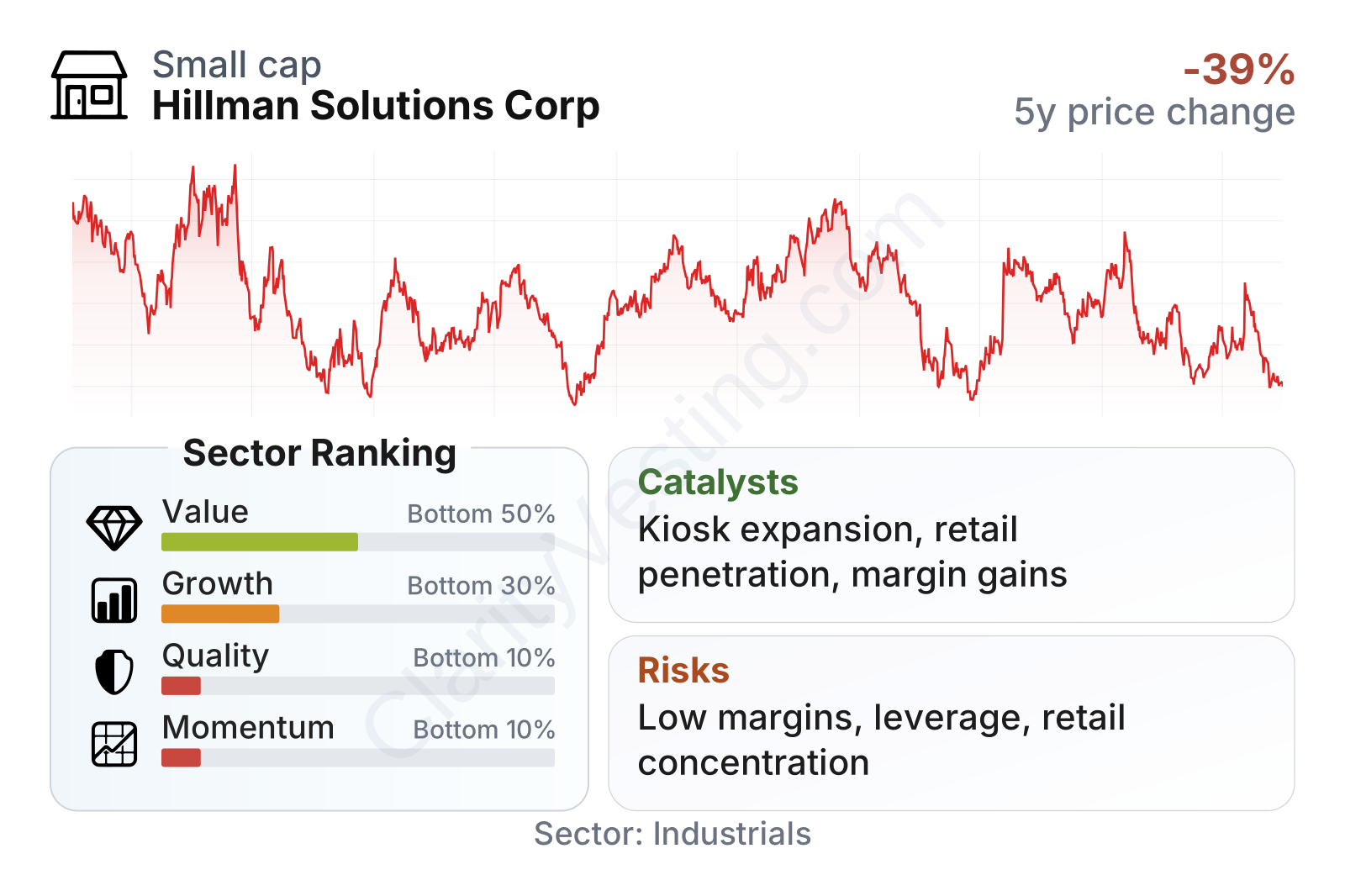
Hillman is a small-cap industrial company with a stock that has been volatile and generally weak over the past few years. The metrics table points to a mixed profile: valuation is not especially cheap on earnings, growth ranks toward the lower end of the sector over longer periods, quality measures are weak versus peers, and recent market momentum has been poor. At the same time, the company does generate positive free cash flow and has shown some improvement in operating performance, which keeps the picture from being entirely negative.
Growth
Hillman operates in a sector that is not high-growth in the way software or semiconductors can be, but it does benefit from durable demand drivers. Repair, maintenance, home improvement, and small project spending tend to persist over time because homes, buildings, and facilities constantly need upkeep. The company’s exposure to hardware replenishment and retail service also gives it a more recurring profile than many product-only manufacturers.
Its growth strategy appears sensible for this type of business. Rather than relying on one breakthrough product, Hillman is trying to expand through better category management, product innovation in niche hardware areas, digital and automated kiosk solutions, and selective acquisitions. The kiosk and digital solutions business is particularly notable because it adds a service and convenience angle that is harder to replicate than basic commodity fasteners. That part of the portfolio may support better customer stickiness and somewhat better margins over time.
Recent revenue growth has reaccelerated. After a softer period in 2023 and much of 2024, year-over-year growth moved back into positive territory and most recently approached 10%, slightly ahead of the sector median. That does not make Hillman a rapid-growth company, but it does suggest the business has regained momentum after a sluggish stretch.
Free cash flow deserves close attention because it is one of the clearest ways to judge a business like Hillman. Cash generation turned positive after earlier weakness, rose strongly through 2024, and then moderated again into 2026. That pattern suggests the company can produce cash, but not yet with the consistency that would remove all concerns about leverage and execution. For a long-term view, the most important question is whether operating gains can translate into steadier cash conversion.
A meaningful catalyst is the continued buildout of the company’s higher-value retail service model. Retailers value vendors that can manage inventory, maintain displays, and support automated solutions inside stores. If Hillman continues winning space with large chains, improving digital kiosk penetration, and integrating acquisitions effectively, growth could remain ahead of what its mature end markets alone would imply.
Risks
This article is for informational purposes only and does not constitute financial advice. Some content is AI-generated. See Disclaimer