Stock Analysis · Halma plc (HLMAF)
Overview
Halma plc is a British industrial group focused on specialized technology products that improve safety, health, and environmental outcomes. Rather than relying on one large flagship product, the company owns a broad portfolio of smaller businesses that sell mission-critical equipment such as fire detection systems, water analysis instruments, medical devices, and sensors used in industrial settings. This structure makes Halma look less like a traditional conglomerate and more like a collection of niche leaders operating in regulated or technically demanding markets.
Revenue is mainly generated through three operating segments. Based on the latest annual reporting for the year ended March 31, 2026, the mix is approximately as follows:
- Safety – about 43%: fire detection, fire suppression, elevator safety, pressure management, door safety, and other products designed to protect people and infrastructure.
- Environmental & Analysis – about 32%: water quality testing, environmental monitoring, optical analysis, and related tools used by utilities, laboratories, and industrial customers.
- Healthcare – about 25%: devices and components used in ophthalmology, patient assessment, minimally invasive procedures, and other medical applications.
Geographically, Halma is also diversified, with meaningful sales exposure across mainland Europe, the United States, the United Kingdom, Asia Pacific, and other international markets. That reduces dependence on a single economy and gives the group multiple paths for expansion. Another important characteristic is that a large share of its products are embedded in customers’ workflows, compliance needs, or safety procedures, which can support recurring demand even when industrial spending slows.
The business flow over recent years shows a favorable pattern: revenue has been rising steadily, gross profit has grown along with it, and operating income has expanded faster than sales. That points to improving efficiency and pricing strength rather than growth being driven only by volume.
Key Figures
| Metric | Value | Sector ⓘ |
|---|---|---|
| Date | Oct 17, 2026 | |
| Context | ||
| Sector | Industrials | |
| Industry | Conglomerates | |
| Market Cap ⓘ | $17.38B | |
| Beta ⓘ | 0.96 | |
Value (Cheapness) | ||
| P/E Ratio ⓘ | 35.41 | 22.10 |
| P/B Ratio ⓘ | 8.04 | 1.97 |
| FCF Yield ⓘ | 4.08% | 6.38% |
| Dividend Yield ⓘ | 0.53% | 1.94% |
| EBIT / EV ⓘ | N/A | 4.79% |
| PEG ⓘ | 1.78 | |
Growth (Business expansion) | ||
| Revenue Growth ⓘ | 14.60% | 9.30% |
| RPS Growth (5Y CAGR) ⓘ | 14.16% | 7.81% |
| EPS Growth (5Y CAGR) ⓘ | -2.54% | -13.06% |
| BVPS Growth (5Y CAGR) ⓘ | 11.59% | 6.14% |
| Margin Growth (5Y Trend) ⓘ | 1.69% | 0.88% |
| FCF Growth (5Y CAGR) ⓘ | 19.30% | 11.01% |
| DPS Growth (5Y CAGR) ⓘ | 6.98% | 9.48% |
Quality (Business durability) | ||
| ROIC (Latest) ⓘ | 23.74% | 10.84% |
| ROA (Latest) ⓘ | 17.53% | 5.41% |
| ROIC (5Y Median) ⓘ | 12.64% | 9.38% |
| ROA (5Y Median) ⓘ | 9.47% | 4.95% |
| Net Debt / EBIT (Latest) ⓘ | 0.92 | 2.08 |
| Net Debt / EBIT (5Y Median) ⓘ | 1.46 | 2.27 |
| Net Debt / EBITDA (Latest) ⓘ | 0.70 | 1.39 |
| Net Debt / Assets ⓘ | 20.74% | 19.28% |
| EBITDA / Interest ⓘ | 16.18 | 9.58 |
| Operating Margin (Latest) ⓘ | 19.79% | 10.50% |
| Operating Margin (5Y Median) ⓘ | 18.55% | 10.29% |
| Debt to Equity (Latest) ⓘ | 42.13% | 65.48% |
| Profit Margin (Latest) ⓘ | 14.42% | 6.67% |
| Free Cash Flow (Latest) ⓘ | $709.01M | |
Momentum (Price trend) | ||
| 3Y Return ⓘ | +106.62% | +61.68% |
| 12M Return (excl. last month) ⓘ | +5.13% | +12.58% |
| 6M Return ⓘ | -19.07% | 0.00% |
| Price vs. 200-Day MA ⓘ | -11.55% | +0.02% |
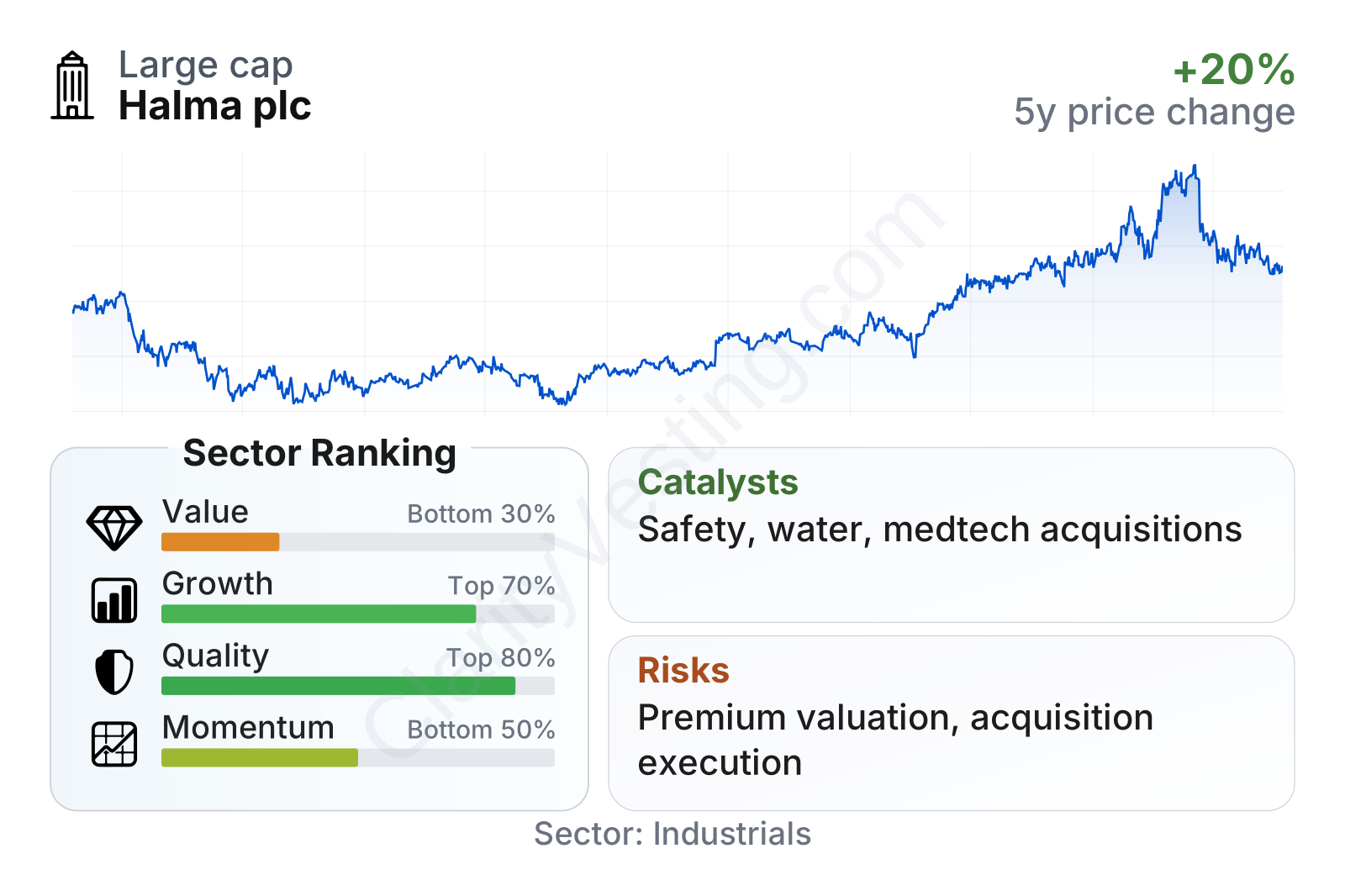
Halma stands out more on quality and consistency than on conventional cheapness. Profitability is well above the industrial sector median, returns on capital are strong, and leverage remains controlled. Growth metrics are also solid, with revenue, free cash flow, and book value compounding faster than many peers over the last five years. The weaker area is valuation: earnings multiples, book value multiples, and cash flow yield all point to a premium market rating. Recent share-price momentum has also cooled after a strong longer-term run.
Growth
Halma operates in areas with durable long-term demand drivers. Safety rules tend to tighten over time, water quality and environmental monitoring remain essential public priorities, and healthcare systems continue to require specialized devices that improve diagnosis and treatment. These are not markets driven only by short-lived fashion or discretionary spending. They are supported by regulation, aging infrastructure, healthcare needs, and a broader push for resilience and compliance.
The company’s strategy is built around acquiring niche technology businesses, keeping local management in place, and then using Halma’s capital, operating discipline, and international reach to help them grow. This model has worked for many years because it focuses on markets where technical reliability matters more than lowest price. It also avoids the risks of relying on one giant merger. Instead, Halma compounds through a steady pipeline of smaller acquisitions and organic growth.
Recent performance supports that growth case. Revenue growth has been running above the sector median, and the longer-term trend in revenue per share and free cash flow has also been stronger than many industrial peers. Margin progression adds another positive layer, suggesting expansion has not come at the expense of business quality.
Free cash flow has been moving higher, which matters because it gives the group flexibility to keep acquiring businesses, invest in product development, and maintain its dividend without putting pressure on the balance sheet. In a model like Halma’s, cash generation is especially important because acquisitions are part of the operating playbook rather than an occasional event.
A meaningful catalyst is the company’s continued exposure to structurally attractive niches such as fire safety, water analytics, photonics, and medical technology. Another is expansion in the United States and other international markets where regulatory standards and infrastructure investment can support demand for high-specification products. The company also reported record revenue and profit in its latest annual results for fiscal 2026, which reinforces the view that the underlying end markets remain healthy and that the acquisition model is still functioning effectively.
Risks
This article is for informational purposes only and does not constitute financial advice. Some content is AI-generated. See Disclaimer


