Stock Analysis · Helios Technologies Inc (HLIO)
Overview
Helios Technologies is an industrial company that makes motion and electronic control products used in equipment rather than sold directly to consumers. Its components help machines move, control fluid power, monitor performance, and operate more precisely. The company serves end markets such as construction equipment, agriculture, material handling, recreation, marine, health and wellness equipment, and other industrial applications.
Its business is organized around two main segments: Hydraulics and Electronics. Hydraulics includes cartridge valves, manifolds, quick-release couplings, and other fluid-power components. Electronics includes display systems, controls, joysticks, sensors, connectivity products, and software-enabled interfaces that are increasingly important as off-highway and specialty equipment becomes more automated and electronically managed.
Based on recent company reporting, Helios’ revenue mix is approximately:
- Hydraulics: about 63% to 67% of revenue. This is the company’s largest activity and includes hydraulic cartridge valve technology, integrated manifolds, and quick-release coupling solutions used in mobile and industrial equipment.
- Electronics: about 33% to 37% of revenue. This includes human-machine interfaces, control systems, displays, joysticks, sensors, and related electronic solutions.
Geographically, Helios is diversified across North America, Europe, and other international markets, which helps reduce dependence on any single region, although North America remains its largest market. The business model is also supported by a meaningful aftermarket and replacement component base, but original equipment manufacturers remain the core customer group.
The long-term investment case is fairly easy to understand: Helios provides specialized “behind-the-scenes” components that are hard to replace once designed into a machine, and it aims to expand by combining hydraulics with electronics to offer more complete control systems.
The financial flow over the last several years shows a business that has maintained a fairly stable gross profit base despite softer revenue after 2022. The more notable pressure came below the gross profit line, where higher operating costs and interest expense reduced net income. More recently, profit conversion has started to improve again.
Key Figures
| Metric | Value | Sector ⓘ |
|---|---|---|
| Date | Oct 03, 2026 | |
| Context | ||
| Sector | Industrials | |
| Industry | Specialty Industrial Machinery | |
| Market Cap ⓘ | $2.26B | |
| Beta ⓘ | 1.26 | |
Value (Cheapness) | ||
| P/E Ratio ⓘ | 32.03 | 22.45 |
| P/B Ratio ⓘ | 2.38 | 1.98 |
| FCF Yield ⓘ | 4.73% | 6.31% |
| Dividend Yield ⓘ | 0.61% | 1.96% |
| EBIT / EV ⓘ | 4.32% | 4.81% |
| PEG ⓘ | 1.03 | |
Growth (Business expansion) | ||
| Revenue Growth ⓘ | 9.10% | 9.10% |
| RPS Growth (5Y CAGR) ⓘ | -1.50% | 7.75% |
| EPS Growth (5Y CAGR) ⓘ | -20.87% | -13.59% |
| BVPS Growth (5Y CAGR) ⓘ | 6.39% | 6.22% |
| Margin Growth (5Y Trend) ⓘ | -6.99% | 0.72% |
| FCF Growth (5Y CAGR) ⓘ | 4.48% | 10.98% |
| DPS Growth (5Y CAGR) ⓘ | 0.20% | 9.48% |
Quality (Business durability) | ||
| ROIC (Latest) ⓘ | 6.54% | 10.92% |
| ROA (Latest) ⓘ | 4.65% | 5.41% |
| ROIC (5Y Median) ⓘ | 5.04% | 9.21% |
| ROA (5Y Median) ⓘ | 3.21% | 4.94% |
| Net Debt / EBIT (Latest) ⓘ | -0.49 | 2.07 |
| Net Debt / EBIT (5Y Median) ⓘ | 3.04 | 2.28 |
| Net Debt / EBITDA (Latest) ⓘ | -0.31 | 1.43 |
| Net Debt / Assets ⓘ | -3.50% | 19.27% |
| EBITDA / Interest ⓘ | 9.84 | 9.53 |
| Operating Margin (Latest) ⓘ | 12.23% | 10.50% |
| Operating Margin (5Y Median) ⓘ | 10.46% | 10.27% |
| Debt to Equity (Latest) ⓘ | 1.58% | 65.48% |
| Profit Margin (Latest) ⓘ | 8.01% | 6.62% |
| Free Cash Flow (Latest) ⓘ | $106.90M | |
Momentum (Price trend) | ||
| 3Y Return ⓘ | +25.37% | +58.56% |
| 12M Return (excl. last month) ⓘ | +35.49% | +15.63% |
| 6M Return ⓘ | +5.30% | +4.19% |
| Price vs. 200-Day MA ⓘ | -5.69% | +0.93% |
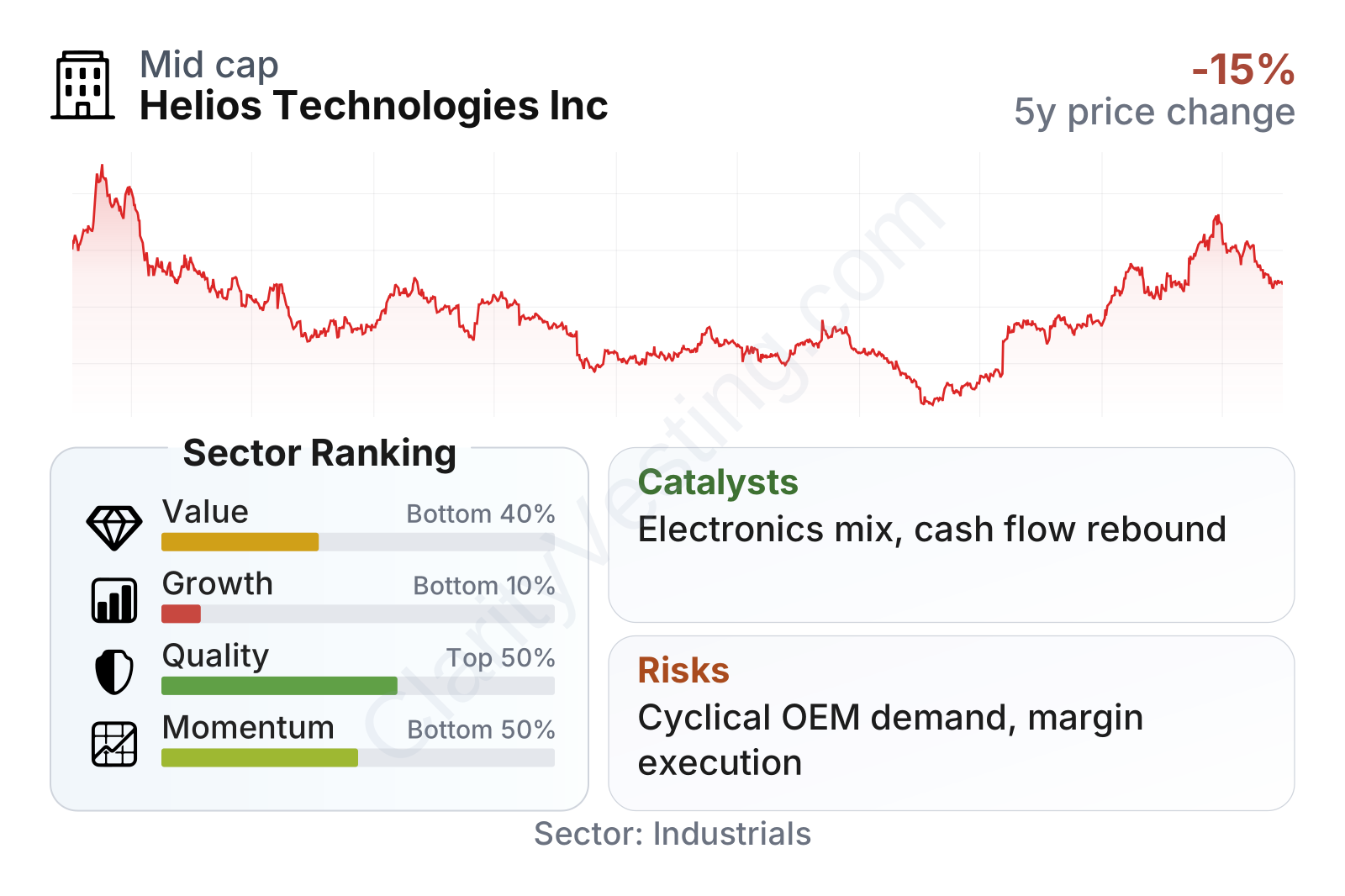
Helios is a mid-sized industrial company with a share price that has been volatile over the last few years, falling sharply during the downturn and then recovering strongly into 2026. In the latest factor snapshot, valuation sits below the sector on attractiveness, largely because earnings multiples remain above the industry median and cash flow yield is somewhat lower. Growth metrics are the weakest part of the profile because the last five years include a meaningful earnings and margin reset. Quality is more mixed: profitability is not exceptional versus the sector, but the balance sheet has improved dramatically and is now a clear point of strength.
Growth
Helios operates in areas that should benefit from long-term industrial trends rather than fast-changing consumer demand. The broad sector backdrop is favorable: equipment makers are adding more automation, electrification, digital controls, monitoring, and precision functionality. That is especially relevant for Helios because its electronics products are exposed to exactly those trends, while its hydraulics products remain essential in many heavy-duty applications where hydraulic power is still difficult to replace.
The company’s strategy also makes industrial sense. Instead of being only a parts supplier in one narrow niche, Helios has been building a broader controls platform through acquisitions and cross-selling. The logic is straightforward: a machine maker that already buys hydraulic components may also need displays, joysticks, sensors, or electronic controls. If Helios can supply more of that system, it can deepen customer relationships and potentially improve pricing power over time.
Revenue performance has been uneven. After a strong period earlier in the cycle, growth turned negative for an extended stretch before returning to positive territory. The more recent pattern is encouraging because year-over-year sales growth moved back into positive single-digit to mid-teen ranges in late 2025 and early 2026, suggesting that demand may be stabilizing and that comparisons are becoming easier.
Cash generation has improved more clearly than earnings headlines might suggest. Free cash flow had weakened materially, but the trailing trend has recovered to above $100 million. For a company of Helios’ size, that matters because it creates room for debt reduction, bolt-on acquisitions, and continued investment in product development without putting heavy stress on the balance sheet.
A meaningful catalyst is the company’s effort to simplify operations, improve margin discipline, and focus capital allocation more carefully after a period of weaker returns. Another potential support is any rebound in off-highway equipment demand, especially if construction, agriculture, and industrial customers resume ordering after a slower patch. Helios does not need a dramatic boom for results to improve; better volume absorption and steadier mix could already make a noticeable difference.
Recent company updates in 2026 have pointed to continued integration work, balance-sheet improvement, and stronger profitability trends relative to the low point reached in 2023 and 2024. That does not remove cyclicality, but it does suggest the company is emerging from a difficult stretch in better shape.
Risks
This article is for informational purposes only and does not constitute financial advice. Some content is AI-generated. See Disclaimer