Stock Analysis · Hilton Food Group plc (HLFGY)
Overview
Hilton Food Group plc is a food packing and distribution specialist that works mainly behind the scenes for large grocery retailers. Instead of selling a consumer-facing brand, it processes, packs, and supplies fresh food products that supermarkets place on their own shelves, often under private-label arrangements. The group started in meat packing and has expanded into seafood, vegan and vegetarian food, and convenience categories in several international markets.
This business model matters because it usually creates long-term retail relationships, high production volumes, and recurring demand linked to everyday food consumption rather than discretionary spending. At the same time, it also means margins are typically thin, so execution, efficiency, and customer retention are central to results.
Based on recent company reporting, Hilton Food’s revenue mix is still led by meat, with growing contributions from newer categories and services.
- Meat: approximately 70% to 80% of revenue. This includes red meat and other fresh meat products packed for major supermarket partners.
- Seafood: approximately 10% to 15% of revenue. This covers salmon, whitefish, shellfish, and other seafood processing and packing activities.
- Convenience, plant-based, and other food categories: approximately 10% to 15% of revenue. This includes vegetarian and vegan products, prepared or convenience food lines, and some added-value food solutions.
- Logistics and supply-chain related services: a small share of revenue, usually embedded within broader customer contracts rather than reported as a large standalone segment.
Geographically, the company is concentrated in Europe, the U.K., Ireland, and Australia-New Zealand, with retailer partnerships forming the backbone of demand. Its customer base is therefore relatively concentrated, but the relationships are often operationally integrated and difficult to replace quickly.
The business flow over recent years shows a familiar pattern for food processors: very high input costs relative to revenue, modest operating margins, and earnings that can move sharply when raw material costs, financing costs, or execution issues shift even slightly. Revenue has generally expanded over time, while operating profit and net income have been more uneven.
The long-term picture is one of a large-volume, low-margin operator. Sales have trended upward from roughly $3.3 billion in 2021 to just above $4.1 billion in 2025, but the share of revenue retained as profit remains narrow. That makes scale and efficiency improvements especially important for shareholder returns.
Key Figures
| Metric | Value | Sector ⓘ |
|---|---|---|
| Date | Oct 17, 2026 | |
| Context | ||
| Sector | Consumer Defensive | |
| Industry | Packaged Foods | |
| Market Cap ⓘ | $1.39B | |
| Beta ⓘ | 0.70 | |
Value (Cheapness) | ||
| P/E Ratio ⓘ | 25.34 | 17.88 |
| P/B Ratio ⓘ | 4.28 | 1.29 |
| FCF Yield ⓘ | -3.20% | 12.39% |
| Dividend Yield ⓘ | 2.39% | 2.85% |
| EBIT / EV ⓘ | N/A | 6.43% |
| PEG ⓘ | N/A | |
Growth (Business expansion) | ||
| Revenue Growth ⓘ | 15.30% | 4.10% |
| RPS Growth (5Y CAGR) ⓘ | 3.64% | 6.18% |
| EPS Growth (5Y CAGR) ⓘ | -3.86% | -13.59% |
| BVPS Growth (5Y CAGR) ⓘ | 2.43% | 3.20% |
| Margin Growth (5Y Trend) ⓘ | -0.32% | -0.15% |
| FCF Growth (5Y CAGR) ⓘ | N/A | 4.10% |
| DPS Growth (5Y CAGR) ⓘ | 6.30% | 6.79% |
Quality (Business durability) | ||
| ROIC (Latest) ⓘ | 18.68% | 12.34% |
| ROA (Latest) ⓘ | 5.03% | 6.30% |
| ROIC (5Y Median) ⓘ | 10.05% | 10.49% |
| ROA (5Y Median) ⓘ | 3.11% | 5.44% |
| Net Debt / EBIT (Latest) ⓘ | 2.41 | 1.96 |
| Net Debt / EBIT (5Y Median) ⓘ | 5.20 | 2.35 |
| Net Debt / EBITDA (Latest) ⓘ | 1.24 | 1.38 |
| Net Debt / Assets ⓘ | 29.46% | 21.51% |
| EBITDA / Interest ⓘ | N/A | 9.46 |
| Operating Margin (Latest) ⓘ | 1.89% | 8.87% |
| Operating Margin (5Y Median) ⓘ | 1.83% | 9.53% |
| Debt to Equity (Latest) ⓘ | 157.02% | 72.35% |
| Profit Margin (Latest) ⓘ | 1.14% | 5.40% |
| Free Cash Flow (Latest) ⓘ | -$44.54M | |
Momentum (Price trend) | ||
| 3Y Return ⓘ | +9.11% | +20.92% |
| 12M Return (excl. last month) ⓘ | +3.11% | +2.13% |
| 6M Return ⓘ | +2.22% | +1.26% |
| Price vs. 200-Day MA ⓘ | +1.17% | +1.39% |
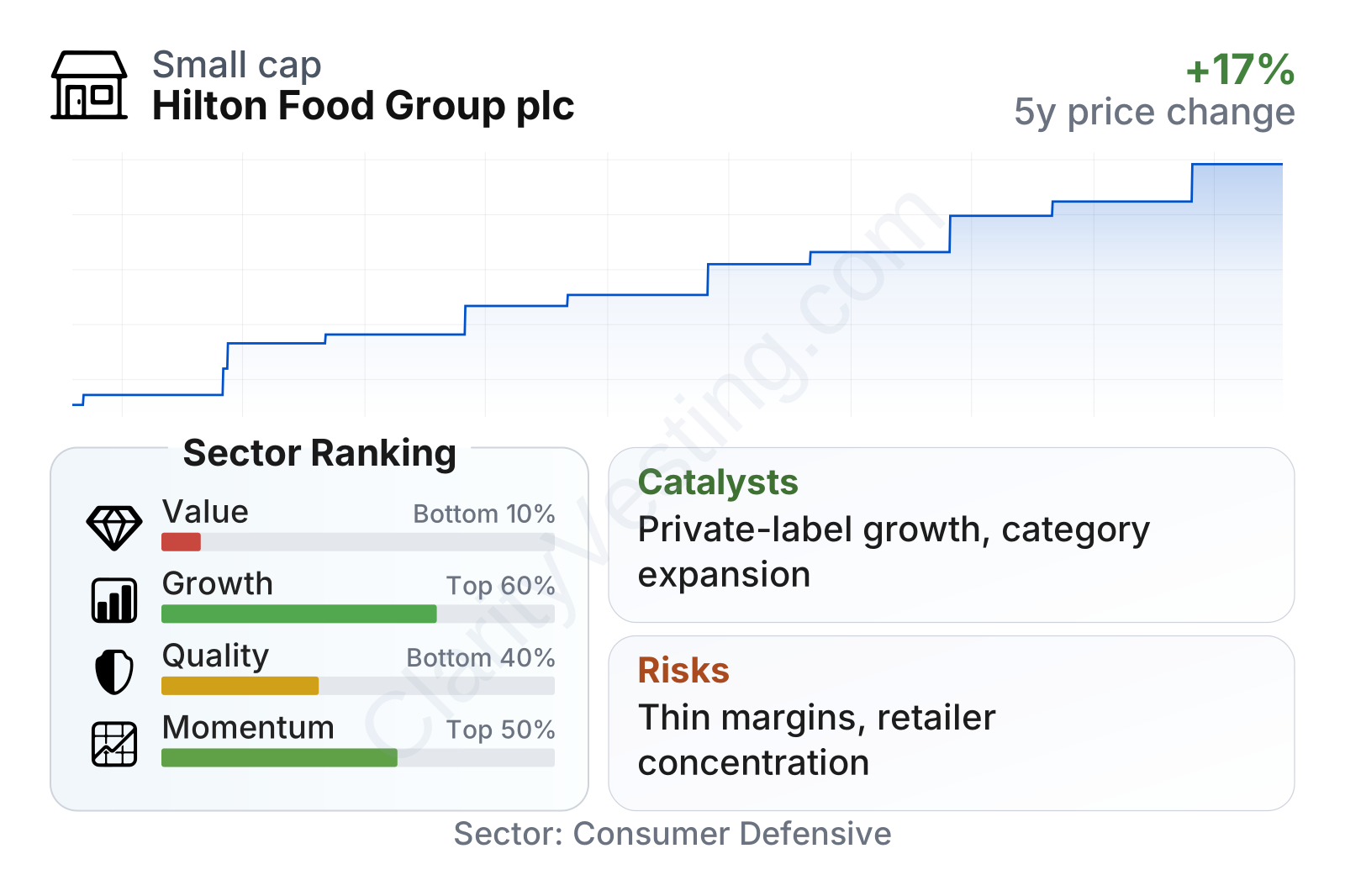
The market currently treats Hilton Food as a mid-sized defensive food company with relatively low share-price volatility. Recent revenue growth has been stronger than the sector median, and returns on invested capital are healthy on a trailing basis. However, the weak points are also clear: valuation multiples sit above sector norms, free cash flow is negative, leverage is elevated versus many peers, and profit margins are much thinner than the broader packaged-food group. Share-price performance has been steady rather than spectacular, with a gradual upward trend over the past several years.
Growth
Hilton Food operates in a sector that is mature but still relevant for long-term growth: outsourced food preparation, packing, and private-label supply for major retailers. Food demand itself is stable, and supermarkets continue to look for dependable partners that can deliver scale, food safety, traceability, and lower operating complexity. That does not create explosive growth, but it can support durable expansion when a supplier wins new contracts or broadens its role with existing customers.
The company’s strategy is logical for this setting. It has moved beyond its original meat focus into seafood, alternative proteins, and convenience foods, which broadens the addressable market and reduces dependence on a single category. It also fits with retailer demand for one supplier to handle multiple fresh-food categories. If Hilton Food can keep cross-selling these services to established supermarket customers, growth can come from both volume and category expansion rather than just opening new sites.
A meaningful catalyst is the ongoing shift toward private-label products in grocery retail. When consumers become more price-conscious, supermarket own-brand ranges often gain share, and Hilton Food is positioned as an enabling supplier rather than a branded food company fighting for shelf space. That can be particularly helpful in periods of household budget pressure.
Another positive factor is the company’s international footprint. Expansion in markets outside its original U.K. base gives it room to grow with retail partners across regions. Recent company updates have also pointed to continued investment in automation, production capacity, and operational efficiency. In a low-margin business, those improvements can have an outsized impact on earnings if executed well.
Recent trading and annual reporting indicate that management continues to focus on broadening category exposure and improving operational delivery. The broad opportunity is not a sudden single event but a combination of retailer outsourcing, private-label growth, and deeper partnerships in fresh-food categories where scale and reliability matter.
Risks
This article is for informational purposes only and does not constitute financial advice. Some content is AI-generated. See Disclaimer


