Stock Analysis · Herbalife Nutrition Ltd (HLF)
Overview
Herbalife Nutrition Ltd is a global nutrition company that sells weight management, sports nutrition, wellness, and personal care products through a direct selling model. Instead of relying mainly on supermarkets or large retail chains, the company distributes its products through a network of independent distributors and preferred customers. Its portfolio includes protein shakes, meal replacement products, supplements, hydration products, teas, snack items, and skin and hair care.
The business is geographically diversified, with sales spread across North America, Latin America, Europe, Asia Pacific, China, and other international markets. That matters because no single country fully defines the company, although regional demand shifts, currency moves, and local regulations can have a meaningful impact on results.
Based on recent annual reporting structure, Herbalife’s revenue is primarily generated by product categories rather than service income or licensing. The main sources of revenue can be summarized as follows.
- Weight management products: approximately 55% to 60% of revenue. This usually includes meal replacement shakes, protein-based nutrition, bars, and products aimed at weight control.
- Targeted nutrition: approximately 20% to 25% of revenue. This generally includes vitamins, minerals, herbal supplements, digestive health products, and other condition-focused nutrition items.
- Energy, sports, and fitness nutrition: approximately 10% to 15% of revenue. This includes hydration, performance, recovery, and active lifestyle products.
- Outer nutrition and personal care: approximately 5% to 10% of revenue. This includes skin care, body care, and hair care products.
The financial profile shows a business with high gross margins, meaningful selling and administrative expenses, and a model that depends heavily on distributor activity and retention. Revenue has come down from the peak reached earlier in the decade, but gross profit has remained sizable, showing that the business still has strong pricing and product economics even after slower demand.
The income flow highlights a company that still converts a large share of sales into gross profit, but interest costs absorb a noticeable part of earnings. Operating expenses have been reduced from earlier peaks, which helped profitability recover even without a full revenue rebound.
Key Figures
| Metric | Value | Sector ⓘ |
|---|---|---|
| Date | Oct 17, 2026 | |
| Context | ||
| Sector | Consumer Defensive | |
| Industry | Packaged Foods | |
| Market Cap ⓘ | $1.41B | |
| Beta ⓘ | 0.79 | |
Value (Cheapness) | ||
| P/E Ratio ⓘ | 8.67 | 17.88 |
| P/B Ratio ⓘ | N/A | 1.29 |
| FCF Yield ⓘ | 30.14% | 12.39% |
| Dividend Yield ⓘ | N/A | 2.85% |
| EBIT / EV ⓘ | 13.07% | 6.43% |
| PEG ⓘ | 0.61 | |
Growth (Business expansion) | ||
| Revenue Growth ⓘ | 5.40% | 4.10% |
| RPS Growth (5Y CAGR) ⓘ | -2.40% | 6.18% |
| EPS Growth (5Y CAGR) ⓘ | -25.06% | -13.59% |
| BVPS Growth (5Y CAGR) ⓘ | -20.91% | 3.20% |
| Margin Growth (5Y Trend) ⓘ | -2.59% | -0.15% |
| FCF Growth (5Y CAGR) ⓘ | -4.88% | 4.10% |
| DPS Growth (5Y CAGR) ⓘ | N/A | 6.79% |
Quality (Business durability) | ||
| ROIC (Latest) ⓘ | 24.70% | 12.34% |
| ROA (Latest) ⓘ | 5.91% | 6.30% |
| ROIC (5Y Median) ⓘ | 30.53% | 10.49% |
| ROA (5Y Median) ⓘ | 9.18% | 5.44% |
| Net Debt / EBIT (Latest) ⓘ | 4.50 | 1.96 |
| Net Debt / EBIT (5Y Median) ⓘ | 4.28 | 2.35 |
| Net Debt / EBITDA (Latest) ⓘ | 3.47 | 1.38 |
| Net Debt / Assets ⓘ | 64.15% | 21.51% |
| EBITDA / Interest ⓘ | 2.72 | 9.46 |
| Operating Margin (Latest) ⓘ | 7.83% | 8.87% |
| Operating Margin (5Y Median) ⓘ | 9.72% | 9.53% |
| Debt to Equity (Latest) ⓘ | -464.45% | 72.35% |
| Profit Margin (Latest) ⓘ | 3.16% | 5.40% |
| Free Cash Flow (Latest) ⓘ | $425.20M | |
Momentum (Price trend) | ||
| 3Y Return ⓘ | +3.95% | +20.92% |
| 12M Return (excl. last month) ⓘ | +25.73% | +2.13% |
| 6M Return ⓘ | -8.50% | +1.26% |
| Price vs. 200-Day MA ⓘ | +1.28% | +1.39% |
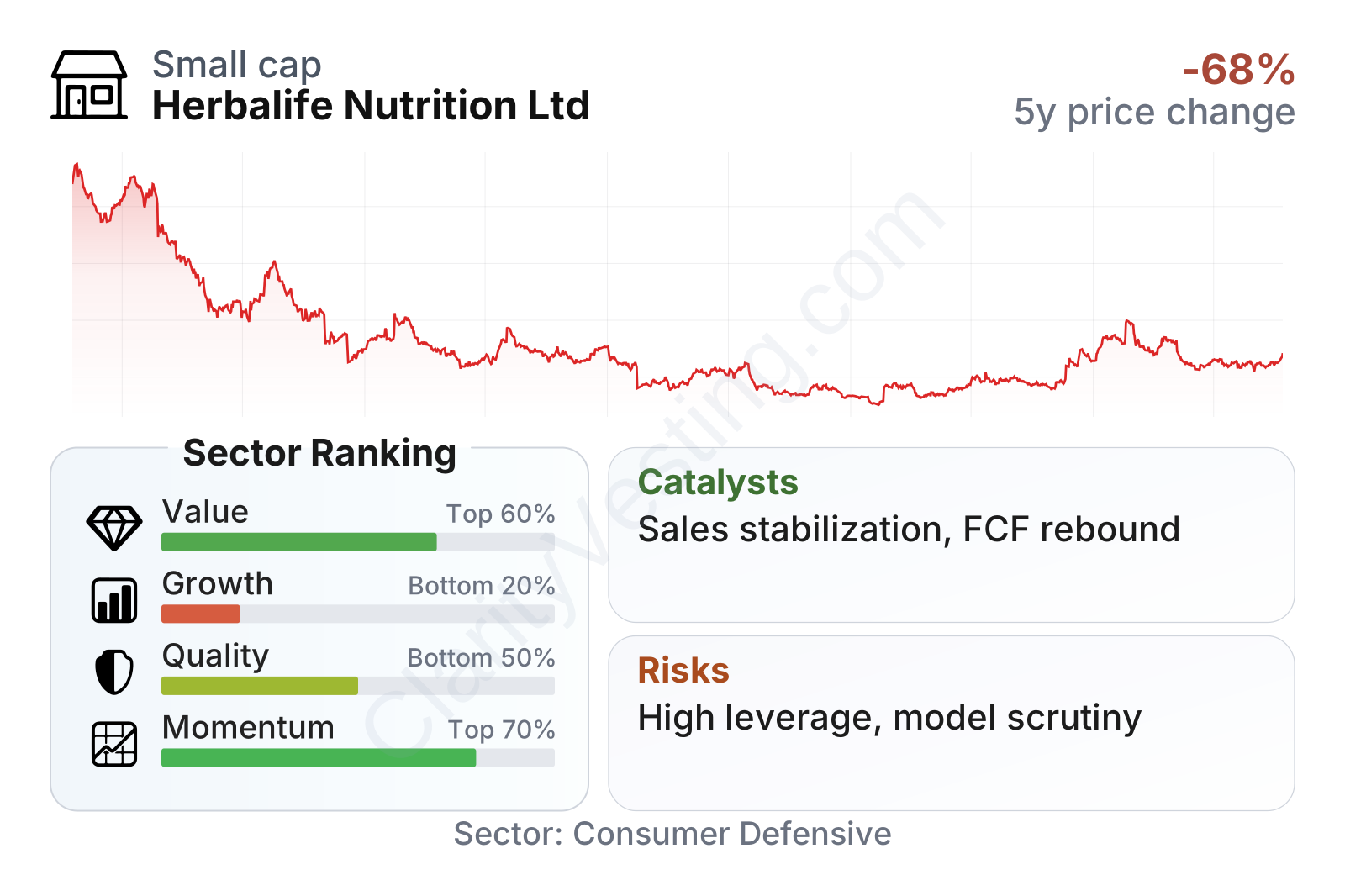
Herbalife is now a relatively small public company by market value, and its share price has been very volatile over the last several years. The stock remains far below its 2021 level, even after a rebound into 2026. In the latest factor snapshot, valuation looks inexpensive compared with much of the consumer defensive sector, while growth and balance-sheet-related quality measures are less favorable. The contrast is important: the market is assigning a low earnings multiple, but that low multiple comes with clear concerns around leverage, margin pressure, and longer-term growth consistency.
Growth
Herbalife operates in a broad wellness and nutrition market that still has structural growth drivers. Consumers continue to spend on protein, active lifestyle products, meal replacements, vitamins, and personalized wellness. Aging populations, rising obesity concerns, and greater focus on daily health habits all support long-term demand for nutrition products. So the sector itself is not the main problem. The bigger question is whether Herbalife’s direct selling model can capture that demand as effectively as digital-first brands, large retail consumer health companies, and e-commerce-focused supplement sellers.
The company’s current strategy has a clear logic. Management has been focusing on distributor productivity, preferred customer growth, product innovation, digital tools, and a simpler operating structure. If that works, Herbalife does not need explosive sales growth to improve results; even moderate top-line improvement can matter because the company already has a large installed distributor base and has been working on cost discipline.
Recent revenue trends suggest that the business has at least stabilized after a long stretch of contraction. Year-over-year sales declines that dominated 2022 through much of 2025 have turned into positive growth in recent quarters, with current growth running in the mid-single-digit range. That does not erase the weak five-year record, but it does indicate that the decline phase may have passed.
Cash generation has also improved meaningfully. Trailing free cash flow has recovered from much lower levels and moved back into a strong range for a company of this size. That matters because free cash flow gives Herbalife flexibility to manage debt, fund operations, and support product and digital initiatives without needing rapid external financing.
One potentially important catalyst is execution around operational efficiency. The company has already shown it can reduce operating expenses, and if revenue keeps improving modestly, those savings can flow through earnings faster than sales alone would suggest. Another opportunity comes from continued expansion of customer-oriented tools rather than relying only on classic distributor recruitment. If Herbalife can broaden recurring customer demand beyond the traditional network marketing dynamic, its business model could become more durable.
Recent company updates have also pointed to improving trends in some regions and continued focus on modernization of the sales platform. None of this changes the nature of the business overnight, but it does support the idea that Herbalife is moving from a reset phase toward a more stable operating period.
Risks
This article is for informational purposes only and does not constitute financial advice. Some content is AI-generated. See Disclaimer


