Stock Analysis · HeidelbergCement AG (HLBZF)
Overview
HeidelbergCement AG, now operating under the Heidelberg Materials name, is one of the world’s largest producers of heavy building materials. Its products are the basic inputs used in construction and infrastructure: cement, aggregates such as sand and gravel, ready-mixed concrete, and asphalt. The business is closely tied to housing, commercial construction, public works, and renovation activity, which makes it an important supplier to the broader economy rather than a niche industrial company.
The company’s revenue mix is led by cement and clinker, followed by aggregates and ready-mixed concrete. Exact shares move by year and region, but the latest annual reporting indicates a business mix that can be described approximately as follows:
- Cement and clinker: about 40% to 45% — the core product used to make concrete and other building materials.
- Aggregates: about 20% to 25% — crushed stone, sand, and gravel used in roads, buildings, and infrastructure projects.
- Ready-mixed concrete: about 20% to 25% — concrete delivered directly to construction sites.
- Asphalt and other activities: about 10% to 15% — includes asphalt, recycling-related products, transport, trading, and service activities depending on the market.
Geographically, Heidelberg Materials is broadly diversified across Europe, North America, and selected markets in Asia-Pacific, Africa, and the Mediterranean basin. That spread matters because construction cycles are local. Weakness in one country can be partly offset by strength in another, although the business still remains cyclical overall.
Over the last several years, the company has shown an ability to protect profitability even when volumes were uneven. Revenue has been relatively stable around the low-€20 billion range, while operating income and net income have held up better than many investors might expect for a materials producer. That pattern suggests pricing discipline, cost control, and a favorable asset base in several markets.
The longer-term picture shows a company with fairly steady sales but improving operating efficiency. Gross profit and operating income strengthened from 2021 through 2024 even without major top-line expansion, which points to better pricing and mix. Net income has been more variable, but the underlying earnings profile looks more resilient than raw revenue growth alone would suggest.
Key Figures
| Metric | Value | Sector ⓘ |
|---|---|---|
| Date | Oct 03, 2026 | |
| Context | ||
| Sector | Basic Materials | |
| Industry | Building Materials | |
| Market Cap ⓘ | $28.52B | |
| Beta ⓘ | 0.91 | |
Value (Cheapness) | ||
| P/E Ratio ⓘ | 12.40 | 17.61 |
| P/B Ratio ⓘ | 1.66 | 1.77 |
| FCF Yield ⓘ | 6.63% | 5.87% |
| Dividend Yield ⓘ | 2.20% | 2.06% |
| EBIT / EV ⓘ | N/A | 6.43% |
| PEG ⓘ | 1.27 | |
Growth (Business expansion) | ||
| Revenue Growth ⓘ | 1.70% | 11.30% |
| RPS Growth (5Y CAGR) ⓘ | 6.10% | 4.46% |
| EPS Growth (5Y CAGR) ⓘ | -5.99% | -13.11% |
| BVPS Growth (5Y CAGR) ⓘ | 5.09% | 5.51% |
| Margin Growth (5Y Trend) ⓘ | 2.51% | -1.57% |
| FCF Growth (5Y CAGR) ⓘ | 17.94% | 0.55% |
| DPS Growth (5Y CAGR) ⓘ | 10.51% | 6.02% |
Quality (Business durability) | ||
| ROIC (Latest) ⓘ | N/A | 9.31% |
| ROA (Latest) ⓘ | 5.48% | 4.94% |
| ROIC (5Y Median) ⓘ | 8.28% | 7.91% |
| ROA (5Y Median) ⓘ | 5.28% | 3.93% |
| Net Debt / EBIT (Latest) ⓘ | 1.78 | 1.40 |
| Net Debt / EBIT (5Y Median) ⓘ | 1.83 | 1.70 |
| Net Debt / EBITDA (Latest) ⓘ | 1.33 | 0.91 |
| Net Debt / Assets ⓘ | 15.18% | 13.69% |
| EBITDA / Interest ⓘ | N/A | 11.93 |
| Operating Margin (Latest) ⓘ | 14.28% | 13.07% |
| Operating Margin (5Y Median) ⓘ | 13.51% | 11.86% |
| Debt to Equity (Latest) ⓘ | 44.66% | 40.43% |
| Profit Margin (Latest) ⓘ | 9.17% | 6.57% |
| Free Cash Flow (Latest) ⓘ | $1.89B | |
Momentum (Price trend) | ||
| 3Y Return ⓘ | +121.51% | +65.06% |
| 12M Return (excl. last month) ⓘ | -20.12% | +36.05% |
| 6M Return ⓘ | -23.96% | +1.89% |
| Price vs. 200-Day MA ⓘ | -24.88% | +1.03% |
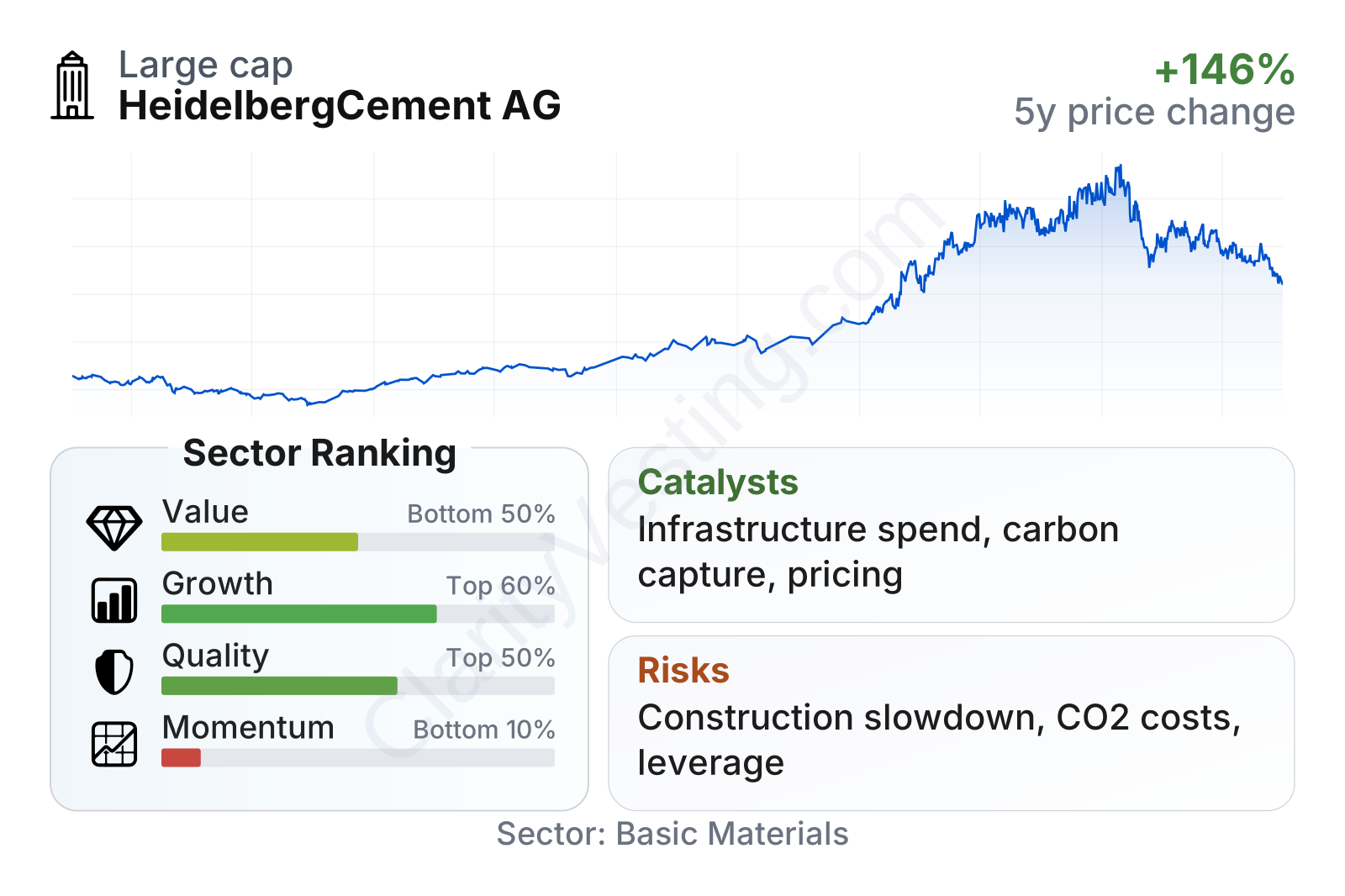
Heidelberg Materials is a large building materials company with a market value around $30 billion and a beta slightly below 1, which means its share price has not been unusually volatile relative to the broader market. On valuation, the shares screen somewhat cheaper than the sector median on earnings and book value, while free cash flow yield and dividend yield are modestly better than average. Growth is more mixed: recent year-over-year revenue expansion has been soft, but five-year trends in revenue per share, free cash flow, margins, and dividends compare well with much of the sector. Quality is not standout across every measure because leverage is somewhat above the sector median, yet profitability metrics such as operating margin and profit margin are solid. Momentum is currently the weakest area, with the stock having pulled back over the last 6 to 12 months despite a very strong multiyear run.
Growth
Heidelberg Materials operates in a mature sector, not a high-growth one. Cement and aggregates demand usually grows roughly in line with urbanization, population, infrastructure renewal, and public investment rather than through sudden technological disruption. That may sound unexciting, but it can still support attractive long-term outcomes when a company has scale, local market density, and pricing power. In this industry, steady compounding often comes less from rapid volume growth and more from margin improvement, disciplined capital allocation, and cash generation.
The company’s strategy for future growth appears practical. Management has focused on higher-value products, operational efficiency, recycling and circular materials, and carbon-reduction technologies such as carbon capture. This matters because cement is one of the most carbon-intensive building materials in the world, and regulation is pushing producers to reduce emissions. Companies that can adapt early may be better positioned to defend margins, preserve market access, and win large infrastructure or public-sector projects where sustainability criteria increasingly matter.
Near-term revenue growth has been modest, with recent annual expansion running well below the sector median. Still, the longer trend is more encouraging than the latest snapshot suggests. Revenue per share has grown at a mid-single-digit annual pace over five years, and operating margin has improved meaningfully over the same period. That indicates the business has been creating more value from each euro of sales rather than depending only on volume growth.
Cash generation is one of the more attractive parts of the profile. Free cash flow has increased strongly over the last five years, far faster than the sector median, although the latest trailing figure is below the very strong 2024 level. Even with that moderation, the company remains a significant cash producer. In a capital-intensive business, that is important because cash funds plant upgrades, environmental investments, debt reduction, dividends, and acquisitions without requiring constant external financing.
Potential catalysts exist on several fronts. Public infrastructure spending in Europe and North America can support demand for cement, aggregates, and asphalt. Price discipline across local markets can continue lifting profitability even if construction volumes are only moderate. In addition, progress on carbon capture, low-carbon cement, and recycled materials could create a competitive edge as regulations tighten and customers look for lower-emission building solutions.
Recent company communication has also emphasized decarbonization projects and portfolio optimization. Those are not overnight drivers, but they are significant because they can improve the quality of earnings over time: better assets, lower energy intensity, and products better suited to the next generation of construction standards.
Risks
This article is for informational purposes only and does not constitute financial advice. Some content is AI-generated. See Disclaimer