Stock Analysis · Hecla Mining Company (HL)
Overview
Hecla Mining Company is a U.S.-based precious metals producer focused mainly on silver, with meaningful exposure to gold and smaller by-product contributions from lead and zinc. Its mining operations are concentrated in politically stable North American jurisdictions, especially the United States and Canada. That matters because long-life mines in safer jurisdictions are often valued more highly than similar assets in riskier countries.
Hecla’s business model is straightforward: it extracts ore, processes it into metal concentrates or doré, and sells those metals into commodity markets. Financial results are driven mostly by three things: metal prices, production volumes, and operating costs at each mine.
The company’s revenue mix changes with metal prices and mine output, but recent filings show a business still centered on silver, with gold as the second pillar and base metals adding useful by-product credits.
- Silver: approximately 45% to 55% of revenue. This is Hecla’s core exposure and comes mainly from mines such as Greens Creek and Lucky Friday.
- Gold: approximately 30% to 40% of revenue. Gold is an important earnings stabilizer, especially when silver production or prices fluctuate.
- Lead: approximately 5% to 10% of revenue. Lead is largely a by-product from polymetallic ore bodies.
- Zinc: approximately 5% to 10% of revenue. Like lead, zinc helps offset mining costs and can improve margins when prices are supportive.
Operationally, Hecla is best understood as a mid-to-large precious metals miner with a particular identity as a primary silver producer. That gives it a more focused profile than diversified giants, but also makes results more sensitive to the silver cycle.
The financial flow over the last several years shows a cyclical business that went through margin pressure in 2022 and 2023, then improved sharply in 2024 and especially 2025 as revenue expanded and operating income recovered strongly. That recent rebound is an important part of the current investment case.
Key Figures
| Metric | Value | Sector ⓘ |
|---|---|---|
| Date | Oct 03, 2026 | |
| Context | ||
| Sector | Basic Materials | |
| Industry | Other Precious Metals & Mining | |
| Market Cap ⓘ | $11.52B | |
| Beta ⓘ | 1.38 | |
Value (Cheapness) | ||
| P/E Ratio ⓘ | 20.66 | 17.61 |
| P/B Ratio ⓘ | 4.30 | 1.77 |
| FCF Yield ⓘ | 4.48% | 5.87% |
| Dividend Yield ⓘ | 0.09% | 2.06% |
| EBIT / EV ⓘ | 6.24% | 6.43% |
| PEG ⓘ | 5.64 | |
Growth (Business expansion) | ||
| Revenue Growth ⓘ | 52.40% | 11.30% |
| RPS Growth (5Y CAGR) ⓘ | 9.87% | 4.46% |
| EPS Growth (5Y CAGR) ⓘ | 66.99% | -13.11% |
| BVPS Growth (5Y CAGR) ⓘ | 5.03% | 5.51% |
| Margin Growth (5Y Trend) ⓘ | 30.72% | -1.57% |
| FCF Growth (5Y CAGR) ⓘ | 29.22% | 0.55% |
| DPS Growth (5Y CAGR) ⓘ | -19.74% | 6.02% |
Quality (Business durability) | ||
| ROIC (Latest) ⓘ | 19.76% | 9.31% |
| ROA (Latest) ⓘ | 10.42% | 4.94% |
| ROIC (5Y Median) ⓘ | 2.41% | 7.91% |
| ROA (5Y Median) ⓘ | 1.19% | 3.93% |
| Net Debt / EBIT (Latest) ⓘ | -0.64 | 1.40 |
| Net Debt / EBIT (5Y Median) ⓘ | 4.51 | 1.70 |
| Net Debt / EBITDA (Latest) ⓘ | -0.53 | 0.91 |
| Net Debt / Assets ⓘ | -14.78% | 13.69% |
| EBITDA / Interest ⓘ | 33.17 | 11.93 |
| Operating Margin (Latest) ⓘ | 45.94% | 13.07% |
| Operating Margin (5Y Median) ⓘ | 5.88% | 11.86% |
| Debt to Equity (Latest) ⓘ | 0.48% | 40.43% |
| Profit Margin (Latest) ⓘ | 19.15% | 6.57% |
| Free Cash Flow (Latest) ⓘ | $515.61M | |
Momentum (Price trend) | ||
| 3Y Return ⓘ | +340.59% | +65.06% |
| 12M Return (excl. last month) ⓘ | +133.70% | +36.05% |
| 6M Return ⓘ | -8.55% | +1.89% |
| Price vs. 200-Day MA ⓘ | -11.28% | +1.03% |
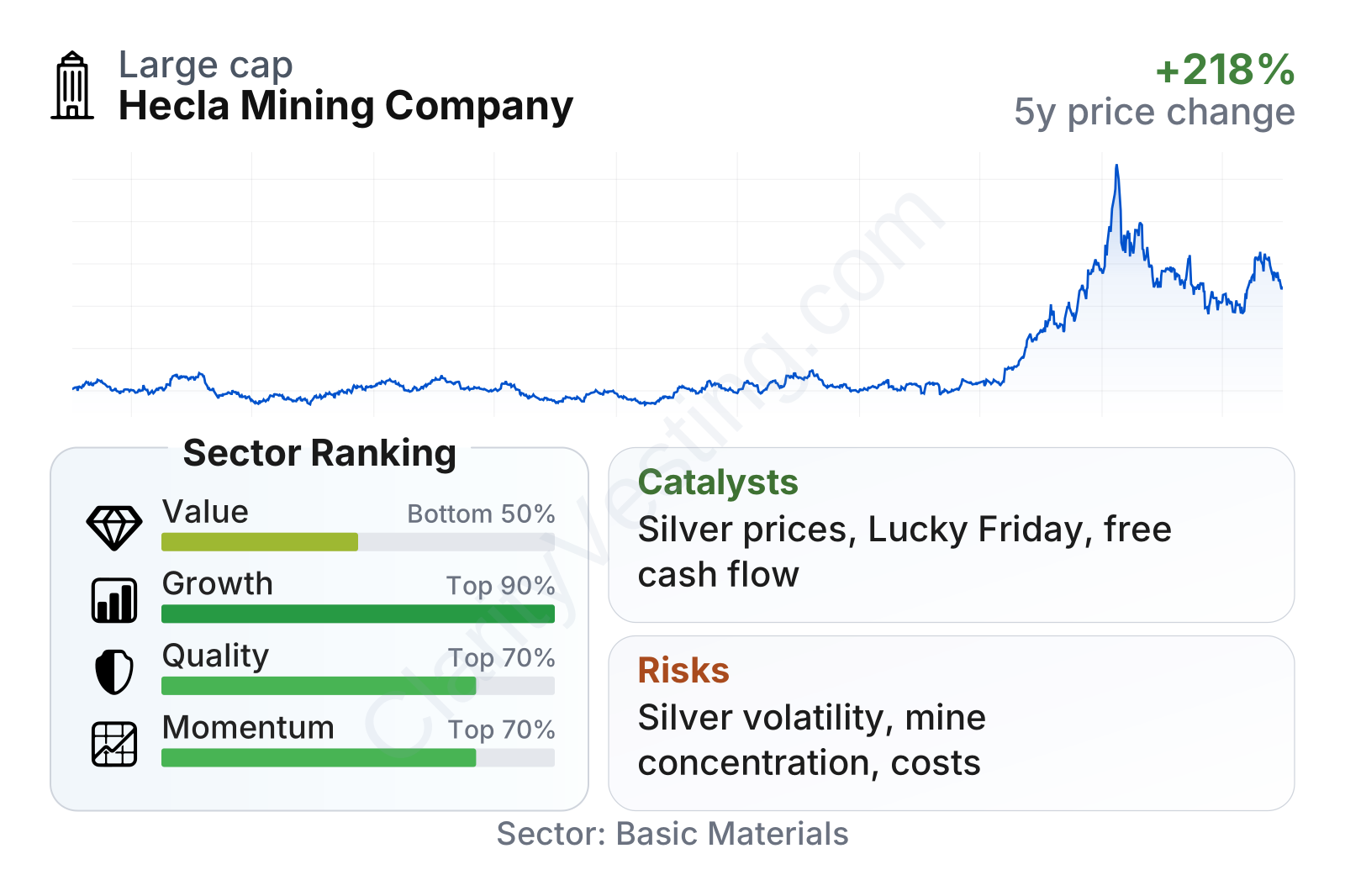
Hecla currently sits in the top tier for growth within its sector and in the upper range for quality, while its valuation looks more mixed. Profitability and returns on capital have improved materially, and the balance sheet is much stronger than many mining peers. On the other hand, the stock no longer looks plainly cheap on book value and some traditional value ratios are only average to below average versus the sector. Price behavior has been powerful over the last three years, although the shorter-term trend has cooled after a major run-up.
Growth
Hecla operates in a sector with durable long-term relevance. Silver benefits from both precious-metals demand and industrial use, including electronics, solar applications, and electrification trends. Gold remains important as a store-of-value asset and tends to attract capital during periods of macro uncertainty, inflation concerns, or geopolitical stress. That means the company is exposed to metals with both cyclical and structural support.
Its recent growth profile has become much stronger. Revenue growth accelerated sharply from 2024 into 2025, and even after that surge the latest year-over-year comparison still remains positive. Relative to the sector, Hecla’s recent revenue expansion has been exceptionally strong, placing it near the top of its peer group.
What makes that more meaningful is that growth has not only shown up in sales. Free cash flow has also improved dramatically after a weak period, moving from negative territory to a very substantial positive level. For a mining company, that is a key signal because it suggests stronger operations, better price realizations, and more flexibility to fund projects, strengthen the balance sheet, or navigate downturns.
Hecla’s strategy also has a reasonable industrial logic. The company focuses on established mining districts, long-life underground assets, and jurisdictions where property rights and permitting frameworks are more predictable than in many emerging markets. That does not remove risk, but it can support steadier long-term planning. The company has also continued investing in mine life extension and operational improvements, which is critical in mining because depletion is constant and reserves must be replaced over time.
A major catalyst is straightforward: higher silver and gold prices can have an outsized effect on earnings and cash generation. Because many mining costs are relatively fixed in the short run, price increases can flow through to profits quickly. Another catalyst is continued optimization at core mines, especially if production levels remain strong while unit costs stay under control. The recent jump in operating margin suggests this leverage is already visible.
Recent company communications have also highlighted production progress, cost discipline, and exploration work around existing operations. For long-term analysis, that matters more than short-term market noise because extending mine life and improving productivity are often the difference between a miner that compounds value and one that merely rides metal cycles.
Risks
This article is for informational purposes only and does not constitute financial advice. Some content is AI-generated. See Disclaimer


