Stock Analysis · HK Electric Investments and HK Electric Investments Limited (HKVTY)
Overview
HK Electric Investments and HK Electric Investments Limited is a regulated electricity business focused on Hong Kong. Through The Hongkong Electric Company, Limited, it generates, transmits, distributes, and supplies electricity to Hong Kong Island and Lamma Island. In practical terms, this is an essential infrastructure operator: it runs power generation assets, the grid network, customer connections, and related services for a defined service area.
The business model is unusually straightforward because it is centered on one regulated utility franchise. Revenue is mainly tied to electricity sales and related charges under Hong Kong’s Scheme of Control framework, which sets the allowed return on the utility’s regulated assets and governs tariff adjustments.
The main sources of revenue are concentrated in a small number of utility activities:
- Electricity sales and related utility charges: likely well above 90% of revenue. This includes power supplied to residential, commercial, and industrial customers, plus tariff-related collections embedded in the regulated utility model.
- Connection, meter, and other customer or network services: a small share of revenue. These typically include service fees associated with grid access, installations, and related utility operations.
- Other non-core items: limited contribution, generally linked to incidental utility activities rather than a separate operating segment.
The revenue mix is therefore much less diversified than that of multi-state or multi-country utilities, but that concentration is partly balanced by the predictability of a monopoly-like regulated service territory. Over the last several years, revenue has been fairly stable with a modest upward trend, while operating profit has remained strong. One visible pattern is that interest expense has increased meaningfully since 2021, which matters because utilities depend heavily on borrowing to finance large infrastructure assets.
The operating picture shows a resilient utility franchise: revenue has edged upward since 2022, gross profit has stayed solid, and operating margins have remained high. The main pressure point is below operating profit, where financing costs absorb a larger share of earnings than a few years ago.
Key Figures
| Metric | Value | Sector ⓘ |
|---|---|---|
| Date | Oct 03, 2026 | |
| Context | ||
| Sector | Utilities | |
| Industry | Utilities - Regulated Electric | |
| Market Cap ⓘ | $7.27B | |
| Beta ⓘ | 0.60 | |
Value (Cheapness) | ||
| P/E Ratio ⓘ | 16.80 | 16.80 |
| P/B Ratio ⓘ | 0.14 | 1.48 |
| FCF Yield ⓘ | 78.70% | 0.64% |
| Dividend Yield ⓘ | 5.24% | 3.91% |
| EBIT / EV ⓘ | 78.42% | 5.01% |
| PEG ⓘ | N/A | |
Growth (Business expansion) | ||
| Revenue Growth ⓘ | 6.70% | 6.00% |
| RPS Growth (5Y CAGR) ⓘ | 1.64% | 4.14% |
| EPS Growth (5Y CAGR) ⓘ | -46.30% | -11.39% |
| BVPS Growth (5Y CAGR) ⓘ | 0.47% | 4.29% |
| Margin Growth (5Y Trend) ⓘ | -1.71% | 3.55% |
| FCF Growth (5Y CAGR) ⓘ | 25.53% | -9.10% |
| DPS Growth (5Y CAGR) ⓘ | -0.04% | 4.51% |
Quality (Business durability) | ||
| ROIC (Latest) ⓘ | N/A | 6.53% |
| ROA (Latest) ⓘ | 5.50% | 3.19% |
| ROIC (5Y Median) ⓘ | 4.10% | 6.12% |
| ROA (5Y Median) ⓘ | 2.59% | 2.76% |
| Net Debt / EBIT (Latest) ⓘ | N/A | 7.15 |
| Net Debt / EBIT (5Y Median) ⓘ | 10.08 | 7.24 |
| Net Debt / EBITDA (Latest) ⓘ | N/A | 4.40 |
| Net Debt / Assets ⓘ | 42.84% | 39.16% |
| EBITDA / Interest ⓘ | 7.99 | 4.41 |
| Operating Margin (Latest) ⓘ | 43.31% | 20.93% |
| Operating Margin (5Y Median) ⓘ | 42.71% | 20.18% |
| Debt to Equity (Latest) ⓘ | 104.16% | 140.88% |
| Profit Margin (Latest) ⓘ | 25.21% | 11.32% |
| Free Cash Flow (Latest) ⓘ | $5.72B | |
Momentum (Price trend) | ||
| 3Y Return ⓘ | +55.59% | +48.75% |
| 12M Return (excl. last month) ⓘ | +6.30% | +11.24% |
| 6M Return ⓘ | +6.30% | -3.69% |
| Price vs. 200-Day MA ⓘ | +3.90% | -1.97% |
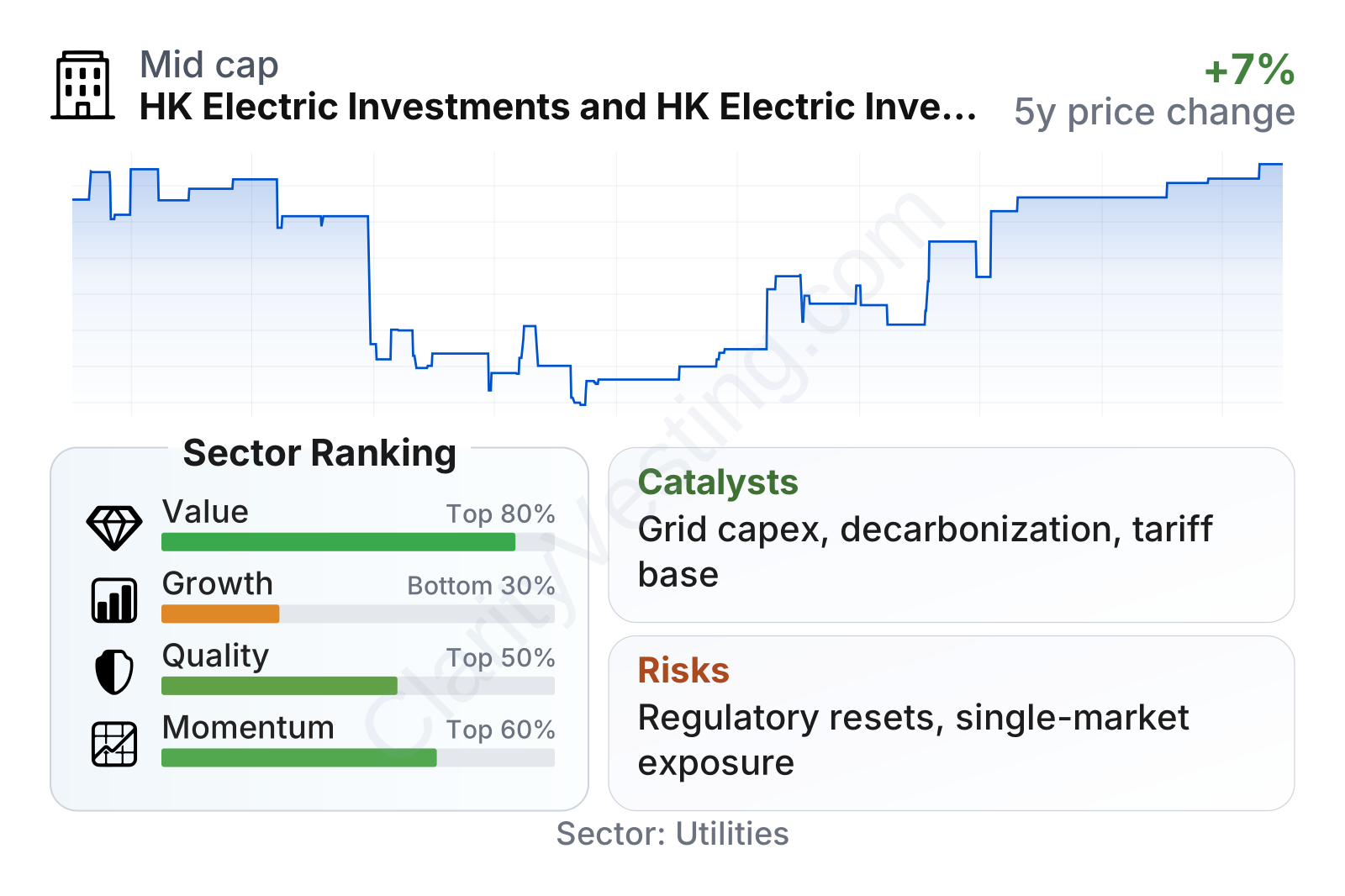
HK Electric sits in the middle of the utility pack on earnings valuation, with a P/E ratio close to the sector median, but it stands out on asset valuation because its price-to-book ratio is far lower than the sector norm. Profitability is strong for a regulated utility, with operating margin above 40% and net margin around 25%, both well ahead of many peers. Balance-sheet leverage is meaningful, which is normal for the industry, but interest coverage remains comfortable at roughly 8 times, suggesting debt service is manageable at current earnings levels.
The company’s growth profile is weaker than its quality profile. Recent annual revenue growth has been positive, yet the longer-term record for revenue per share, earnings per share, and book value expansion trails much of the sector. Market behavior has been relatively calm, consistent with a defensive utility name: volatility is lower than the broader market, and the stock’s multi-year performance has been positive even if shorter-term moves have been uneven.
Growth
Electric utilities are not high-growth businesses in the usual sense, and HK Electric is even more mature than most because it serves a developed, geographically limited market. That said, the sector remains structurally important. Electricity demand is supported by urban density, commercial activity, electrification trends, data usage, and the need for highly reliable power systems. In Hong Kong, a dependable power supply is especially valuable because the economy depends heavily on dense residential and commercial infrastructure.
For HK Electric, future expansion is less about entering new markets and more about growing its regulated asset base, investing in network upgrades, and adapting generation and grid infrastructure to cleaner energy requirements. Within a regulated framework, that strategy is logical: capital spending can support earnings if it is recognized within the permitted asset base and if regulators continue to allow a reasonable return.
Revenue per share has risen gradually over the last five years after a dip in 2022, which fits the picture of a steady but low-growth utility. This is not the profile of a business being transformed by rapid volume expansion; it is the profile of a company that can inch forward through tariff adjustments, infrastructure investment, and stable demand.
A meaningful long-term catalyst is the decarbonization of power systems. Hong Kong’s energy transition requires ongoing investment in cleaner generation, grid resilience, and efficiency. For a regulated operator, these projects can be favorable if they enlarge the asset base on which returns are calculated. Another catalyst is the continued need for supply reliability in a dense urban center, which supports persistent investment in transmission, distribution, and backup capacity.
Recent corporate reporting has also pointed to continuing capital investment in power infrastructure and system reliability. That does not automatically create fast earnings growth, but it can reinforce the durability of cash generation if the regulatory structure remains supportive. In short, the company is positioned in a necessary sector with visible demand, but its likely growth path remains incremental rather than dramatic.
Risks
This article is for informational purposes only and does not constitute financial advice. Some content is AI-generated. See Disclaimer