Stock Analysis · The Hongkong and Shanghai Hotels Limited (HKSHF)
Overview
The Hongkong and Shanghai Hotels Limited is a luxury hospitality and property company best known for owning and operating The Peninsula hotel brand. Its business is centered on high-end hotels, commercial properties, clubs and services tied to luxury travel and real estate. The group has roots going back to the 19th century and remains closely associated with landmark assets in Hong Kong and other major gateway cities.
The company’s revenue is mainly generated from three business areas. Based on the latest annual reporting mix, the breakdown is approximately as follows:
- Hotels: about 68% of revenue. This includes room revenue, food and beverage, banqueting, spa, retail arcade activity within hotels, and other hotel-related services across The Peninsula portfolio.
- Commercial properties: about 23% of revenue. This includes office, retail and residential leasing income from investment properties, with Hong Kong being especially important.
- Clubs and services: about 9% of revenue. This includes The Peak Tram, the Peak Tower, St. John’s Building operations, club management, and other tourism and service activities.
What makes the company unusual is that it is not only a hotel operator. It also owns a collection of prime real estate, which means part of its earnings profile depends on tourism and room demand, while another part depends on rental markets and the long-term value of scarce urban property assets. That mix can add resilience, but it also makes reported results sensitive to financing costs and property cycles.
The recent operating picture has been mixed. Revenue recovered strongly from the pandemic period, but profit remained pressured by high interest expense and uneven property conditions. Over the last several years, the business moved from losses during the travel disruption to a return of positive operating income, showing that the core assets still attract demand when travel normalizes.
The broad trend is a sharp rebound in revenue from 2021 through 2024, followed by some pullback afterward, while profitability remained much more volatile than sales. That gap suggests the company’s premium assets can recover revenue, but earnings are still heavily influenced by cost structure and financing burden.
Key Figures
| Metric | Value | Sector ⓘ |
|---|---|---|
| Date | Nov 21, 2026 | |
| Context | ||
| Sector | Consumer Cyclical | |
| Industry | Lodging | |
| Market Cap ⓘ | $1.20B | |
| Beta ⓘ | 0.29 | |
Value (Cheapness) | ||
| P/E Ratio ⓘ | 36.09 | 17.13 |
| P/B Ratio ⓘ | N/A | 2.72 |
| FCF Yield ⓘ | 34.71% | 7.52% |
| Dividend Yield ⓘ | N/A | 2.43% |
| EBIT / EV ⓘ | 5.46% | 7.11% |
| PEG ⓘ | N/A | |
Growth (Business expansion) | ||
| Revenue Growth ⓘ | 19.80% | 5.30% |
| RPS Growth (5Y CAGR) ⓘ | 22.88% | 8.77% |
| EPS Growth (5Y CAGR) ⓘ | N/A | -11.05% |
| BVPS Growth (5Y CAGR) ⓘ | -0.75% | 5.47% |
| Margin Growth (5Y Trend) ⓘ | 17.56% | -0.16% |
| FCF Growth (5Y CAGR) ⓘ | N/A | 5.66% |
| DPS Growth (5Y CAGR) ⓘ | -17.28% | 9.76% |
Quality (Business durability) | ||
| ROIC (Latest) ⓘ | 1.55% | 11.36% |
| ROA (Latest) ⓘ | -0.29% | 5.53% |
| ROIC (5Y Median) ⓘ | -0.10% | 10.58% |
| ROA (5Y Median) ⓘ | -0.22% | 5.35% |
| Net Debt / EBIT (Latest) ⓘ | 11.91 | 2.11 |
| Net Debt / EBIT (5Y Median) ⓘ | N/A | 2.24 |
| Net Debt / EBITDA (Latest) ⓘ | 5.56 | 1.51 |
| Net Debt / Assets ⓘ | 27.03% | 21.74% |
| EBITDA / Interest ⓘ | 1.65 | 9.63 |
| Operating Margin (Latest) ⓘ | 7.06% | 9.20% |
| Operating Margin (5Y Median) ⓘ | 0.69% | 9.64% |
| Debt to Equity (Latest) ⓘ | 42.80% | 74.26% |
| Profit Margin (Latest) ⓘ | 7.33% | 5.47% |
| Free Cash Flow (Latest) ⓘ | $417.61M | |
Momentum (Price trend) | ||
| 3Y Return ⓘ | +1.42% | +15.79% |
| 12M Return (excl. last month) ⓘ | +1.27% | -0.63% |
| 6M Return ⓘ | 0.00% | +1.17% |
| Price vs. 200-Day MA ⓘ | 0.00% | +0.36% |
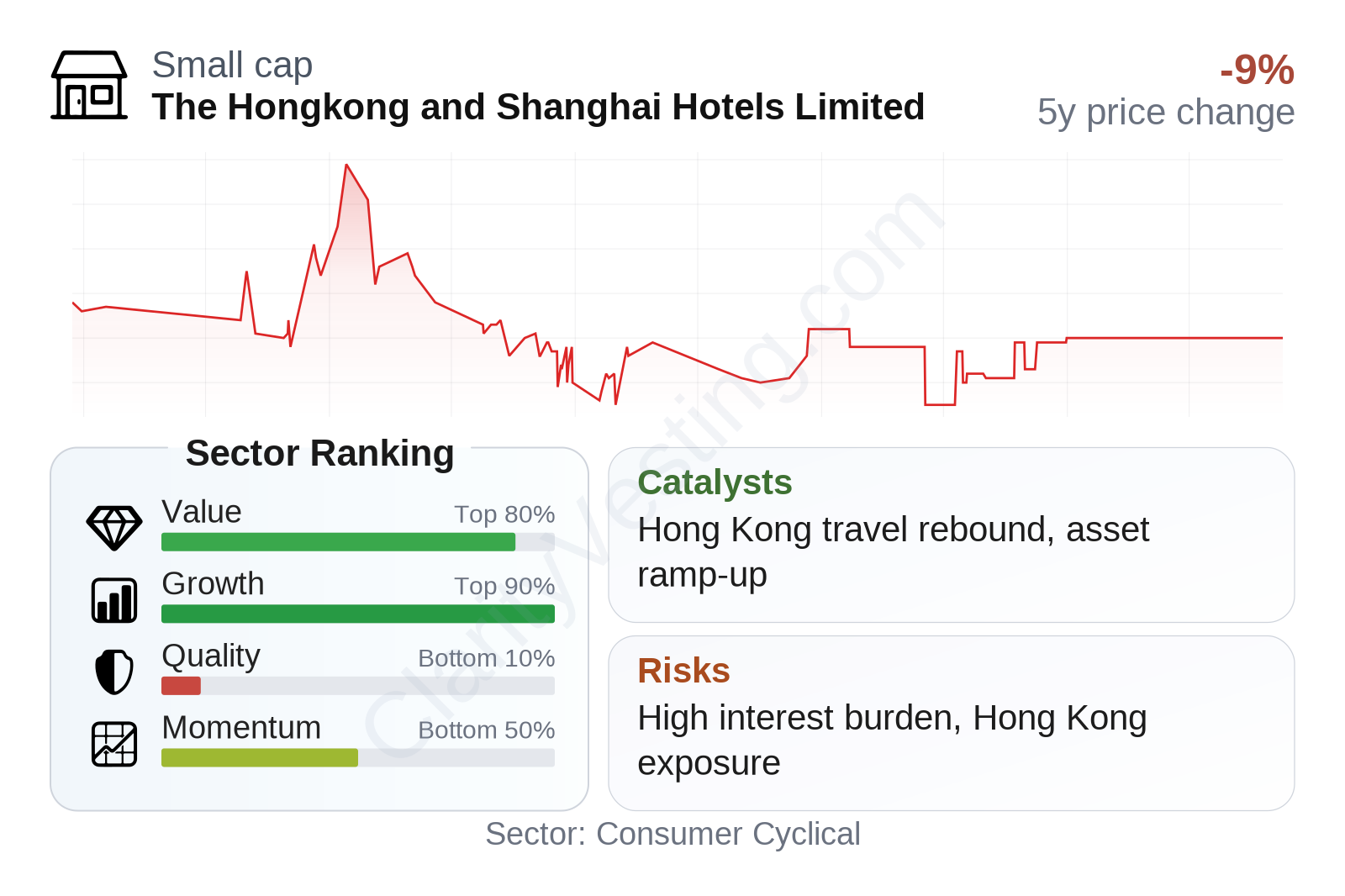
The company is a relatively small listed lodging name by market value, and its share price has been fairly stable recently after a weaker multi-year stretch. Growth measures look strong versus the broader consumer cyclical group, helped by post-pandemic normalization and a better operating margin trend. However, quality measures are weak: returns on assets and invested capital are low, leverage is elevated relative to operating earnings, and interest coverage remains thin. Free cash flow is positive, which is important, but the balance between asset quality and earnings efficiency is still uneven.
Growth
The company operates in a sector with favorable long-term drivers: international travel, luxury experiences, and premium urban real estate. Over long periods, wealth creation in Asia and the Middle East, combined with the recovery of cross-border tourism, supports demand for high-end hospitality. Luxury hotels in major cities tend to benefit from pricing power, brand value, and limited supply in the most prestigious locations.
The company’s strategy is coherent for that environment. The Peninsula brand occupies the very top end of the market, where customer expectations are high but direct competition is narrower than in mainstream lodging. HSH also combines hotel ownership with long-held real estate, which can create strategic flexibility: hotels build brand prestige, while commercial properties can generate recurring rental income.
A visible catalyst is the continued normalization of travel into Hong Kong and other key cities where the group operates. The return of business travel, premium leisure demand, and event activity can lift hotel occupancy and room rates. Another catalyst is the operating ramp-up of newer or redeveloped assets, which can improve returns once early-stage costs fade and utilization rises.
The Peak Tram and other tourism-linked assets are also relevant. These are not the largest earnings contributors, but they give the company added exposure to visitor flows in Hong Kong beyond hotel rooms alone. If tourism in Hong Kong continues to recover, that can support multiple parts of the portfolio at the same time.
Recent company reporting also points to active asset enhancement and a focus on efficiency after a period of heavy disruption. For a business with iconic properties, even moderate improvement in occupancy, average room rates, and retail leasing can have an outsized effect on operating profit because the asset base is already in place.
Risks
This article is for informational purposes only and does not constitute financial advice. Some content is AI-generated. See Disclaimer