Stock Analysis · Hongkong Land Holdings Limited (HKHGF)
Overview
Hongkong Land Holdings Limited is a large Asian property company focused on owning, developing, and managing premium real estate. Its best-known assets are office, retail, and mixed-use properties in Hong Kong, Singapore, and several major cities in mainland China and Southeast Asia. The group is part of the Jardine Matheson network, which adds corporate backing and long-standing regional relationships.
Its business has two main engines. The first is investment properties, meaning office buildings, retail space, and mixed-use assets that generate rental income and management fees. The second is development properties, where the company builds and sells residential or mixed-use projects, mainly in mainland China and Southeast Asia. Results can swing materially from year to year because development income depends on project completions and because property companies often record non-cash valuation gains or losses on their real estate portfolio.
Based on recent annual reporting, revenue is mainly split between the following sources:
- Development properties: about 55% to 65% of revenue in recent years. This includes sales of residential units and mixed-use projects, especially in mainland China and other Asian markets.
- Investment properties: about 35% to 45% of revenue. This includes office rent, retail rent, and related property management income, with Hong Kong Central remaining a core contributor.
Within the investment property segment, office leasing is typically the largest recurring contributor, followed by retail leasing. Within development properties, mainland China has historically been important, although the company has been increasing its exposure to Singapore and other Southeast Asian markets to diversify earnings sources.
The broad financial flow shows a business with meaningful recurring rent, but also with reported profit that has been highly affected by property revaluation swings. Revenue has generally trended lower over the last few years, while interest expense stayed significant, which helps explain why accounting earnings have looked much more volatile than cash generation.
Key Figures
| Metric | Value | Sector ⓘ |
|---|---|---|
| Date | Oct 03, 2026 | |
| Context | ||
| Sector | Real Estate | |
| Industry | Real Estate - Development | |
| Market Cap ⓘ | $18.26B | |
| Beta ⓘ | 0.35 | |
Value (Cheapness) | ||
| P/E Ratio ⓘ | 8.08 | 17.35 |
| P/B Ratio ⓘ | 0.59 | 0.86 |
| FCF Yield ⓘ | 4.83% | 7.47% |
| Dividend Yield ⓘ | 3.15% | 4.75% |
| EBIT / EV ⓘ | N/A | 3.81% |
| PEG ⓘ | 1.82 | |
Growth (Business expansion) | ||
| Revenue Growth ⓘ | -15.80% | 5.30% |
| RPS Growth (5Y CAGR) ⓘ | -9.76% | 5.96% |
| EPS Growth (5Y CAGR) ⓘ | N/A | -11.41% |
| BVPS Growth (5Y CAGR) ⓘ | -1.39% | 0.41% |
| Margin Growth (5Y Trend) ⓘ | 73.32% | 0.53% |
| FCF Growth (5Y CAGR) ⓘ | -0.47% | 5.40% |
| DPS Growth (5Y CAGR) ⓘ | 1.22% | 5.02% |
Quality (Business durability) | ||
| ROIC (Latest) ⓘ | N/A | 5.77% |
| ROE (Latest) ⓘ | N/A | 7.64% |
| ROA (Latest) ⓘ | N/A | 2.85% |
| ROIC (5Y Median) ⓘ | 1.28% | 4.20% |
| ROE (5Y Median) ⓘ | -0.99% | 6.03% |
| ROA (5Y Median) ⓘ | -0.79% | 2.45% |
| Net Debt / EBIT (Latest) ⓘ | N/A | 7.57 |
| Net Debt / EBIT (5Y Median) ⓘ | 5.62 | 8.41 |
| Net Debt / EBITDA (Latest) ⓘ | 0.97 | 5.12 |
| Net Debt / Assets ⓘ | 8.39% | 37.84% |
| EBITDA / Interest ⓘ | N/A | 4.11 |
| Operating Margin (Latest) ⓘ | N/A | 35.40% |
| Operating Margin (5Y Median) ⓘ | 37.66% | 36.59% |
| Debt to Equity (Latest) ⓘ | 19.35% | 89.06% |
| Profit Margin (Latest) ⓘ | 173.11% | 19.99% |
| Free Cash Flow (Latest) ⓘ | $882.70M | |
Momentum (Price trend) | ||
| 3Y Return ⓘ | +197.68% | +30.60% |
| 12M Return (excl. last month) ⓘ | +38.91% | +7.55% |
| 6M Return ⓘ | +5.28% | +0.69% |
| Price vs. 200-Day MA ⓘ | +54.30% | -2.30% |
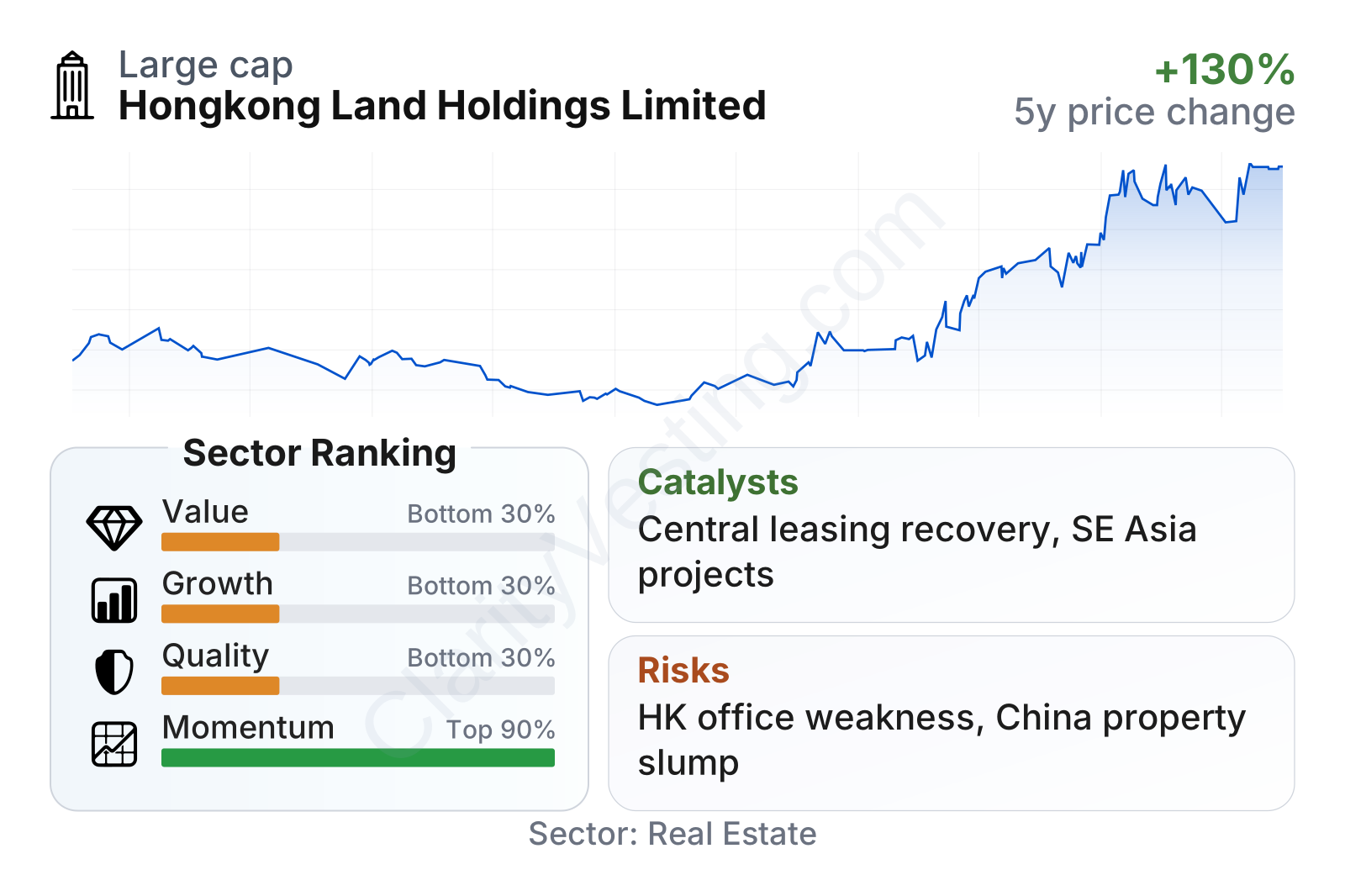
Hongkong Land is a large real estate group with a market value around the large-cap range for listed property developers, and its beta of roughly 0.35 suggests the shares have moved less than the broader market. On valuation, the stock screens low on earnings and book value multiples versus the sector median, but that headline cheapness comes with weak recent growth and below-sector profitability measures on several long-term averages.
Balance-sheet risk looks more controlled than for many property peers. Debt to equity is near 19%, well below the sector median, net debt to assets is below 10%, and net debt to EBITDA is also much lighter than the typical real estate company in the comparison group. Free cash flow remains positive, at roughly $0.9 billion on a trailing basis, which is an important stabilizer for a property company operating through a difficult regional cycle.
Share-price performance has been very strong over the past three years and remains stronger than most sector peers across multiple time frames. That momentum contrasts with the company’s weak recent revenue trend, which means the market has already rerated the shares materially even though the operating recovery is still uneven.
Growth
Hongkong Land operates in a sector that should benefit over the long run from urbanization, limited supply of prime land in major Asian business districts, and continuing demand for high-quality mixed-use developments. However, the sector is not in a uniformly strong phase today. Office markets in Hong Kong face pressure from slower leasing demand, while mainland China’s residential property market remains soft. In other words, the long-term backdrop is attractive for prime assets, but the near-term environment is mixed.
The company’s strategy appears sensible for that setting. It combines recurring rental income from established commercial assets with development projects that can create value over time. It has also been broadening its development footprint beyond mainland China, especially toward Singapore and selected Southeast Asian cities. That matters because it reduces dependence on one troubled housing market and shifts more of the growth case toward markets with firmer demand and stronger household balance sheets.
Revenue per share has been under pressure over the last five years, reflecting weaker development recognition and a tougher property cycle. That is the clearest sign that growth has not yet become consistent. Even so, one positive feature is that the company still owns a portfolio of prime assets that can recover in value and rental performance when leasing markets improve.
A key catalyst is the normalization of earnings after large non-cash valuation losses in recent years. Because property values can move sharply from year to year, reported profit can change much faster than the underlying rental stream. If leasing improves in Hong Kong offices, if luxury retail activity stays resilient, or if residential project completions in Southeast Asia accelerate, the gap between depressed accounting results and operating cash generation could narrow.
The dividend per share has been relatively steady, with only modest growth over five years. That steadiness fits the company’s profile: not a high-growth operator today, but one with recurring cash flows and a balance sheet that has so far remained more conservative than many regional peers. Recent company updates have also emphasized project launches, asset enhancement, and continued capital recycling, all of which can support future growth if property demand stabilizes.
Risks
This article is for informational purposes only and does not constitute financial advice. Some content is AI-generated. See Disclaimer


