Stock Analysis · HKBN Ltd (HKBNF)
Overview
HKBN Ltd is a Hong Kong telecommunications and technology services provider. The company sells broadband, mobile, voice, Wi-Fi, enterprise connectivity, cloud, cybersecurity, data center, and systems integration services. Its business serves both households and corporate customers, which gives it exposure to recurring subscription revenue as well as project-based technology work.
Based on the company’s recent annual reporting structure, revenue mainly comes from two broad customer groups:
- Enterprise solutions and telecom services: approximately 60% to 65% of revenue. This includes connectivity, cloud, managed services, cybersecurity, digital transformation projects, and telecom services for business customers.
- Residential services: approximately 35% to 40% of revenue. This includes home broadband, home Wi-Fi, mobile plans, entertainment-related offers, and other household communications services.
That mix matters because enterprise contracts can be larger and stickier, while residential services provide a broad recurring subscriber base. HKBN is not a pure mobile operator on the scale of the largest regional telecom groups; instead, it positions itself as a challenger brand with bundled connectivity and ICT services, especially in Hong Kong’s dense urban market.
The business profile also shows a company that has been defending revenue in a mature market rather than expanding rapidly. Over the last several years, sales have stayed around a similar range, while profitability has been more volatile because financing costs and operating pressures moved around meaningfully. The visual breakdown of revenue and profit flow highlights this pattern: revenue has been relatively stable, but interest expense has taken a sizable share of earnings, and net profit has been much less consistent than top-line sales.
Key Figures
| Metric | Value | Sector ⓘ |
|---|---|---|
| Date | Oct 03, 2026 | |
| Context | ||
| Sector | Communication Services | |
| Industry | Telecom Services | |
| Market Cap ⓘ | $1.35B | |
| Beta ⓘ | 0.54 | |
Value (Cheapness) | ||
| P/E Ratio ⓘ | 45.67 | 18.20 |
| FCF Yield ⓘ | N/A | 14.71% |
| Dividend Yield ⓘ | 37.66% | 2.86% |
| EBIT / EV ⓘ | 31.92% | 4.85% |
| PEG ⓘ | N/A | |
Growth (Business expansion) | ||
| Revenue Growth ⓘ | 5.10% | 5.50% |
| RPS Growth (5Y CAGR) ⓘ | -3.67% | 4.55% |
| EPS Growth (5Y CAGR) ⓘ | -8.22% | -18.01% |
| Margin Growth (5Y Trend) ⓘ | 0.84% | 1.32% |
| FCF Growth (5Y CAGR) ⓘ | -5.85% | 5.96% |
| DPS Growth (5Y CAGR) ⓘ | -22.08% | 5.09% |
Quality (Business durability) | ||
| ROIC (Latest) ⓘ | N/A | 8.64% |
| ROIC (5Y Median) ⓘ | 5.03% | 8.11% |
| Net Debt / EBIT (Latest) ⓘ | N/A | 1.92 |
| Net Debt / EBIT (5Y Median) ⓘ | N/A | 2.85 |
| Net Debt / EBITDA (Latest) ⓘ | N/A | 1.25 |
| Net Debt / Assets ⓘ | 58.93% | 18.77% |
| EBITDA / Interest ⓘ | N/A | 8.75 |
| Operating Margin (Latest) ⓘ | N/A | 15.58% |
| Operating Margin (5Y Median) ⓘ | 7.95% | 13.53% |
| Debt to Equity (Latest) ⓘ | N/A | 59.53% |
| Profit Margin (Latest) ⓘ | 1.81% | 8.78% |
| Free Cash Flow (Latest) ⓘ | N/A | |
Momentum (Price trend) | ||
| 3Y Return ⓘ | +125.22% | +43.39% |
| 12M Return (excl. last month) ⓘ | +147.90% | +1.92% |
| 6M Return ⓘ | +132.86% | +2.94% |
| Price vs. 200-Day MA ⓘ | +42.10% | +0.74% |
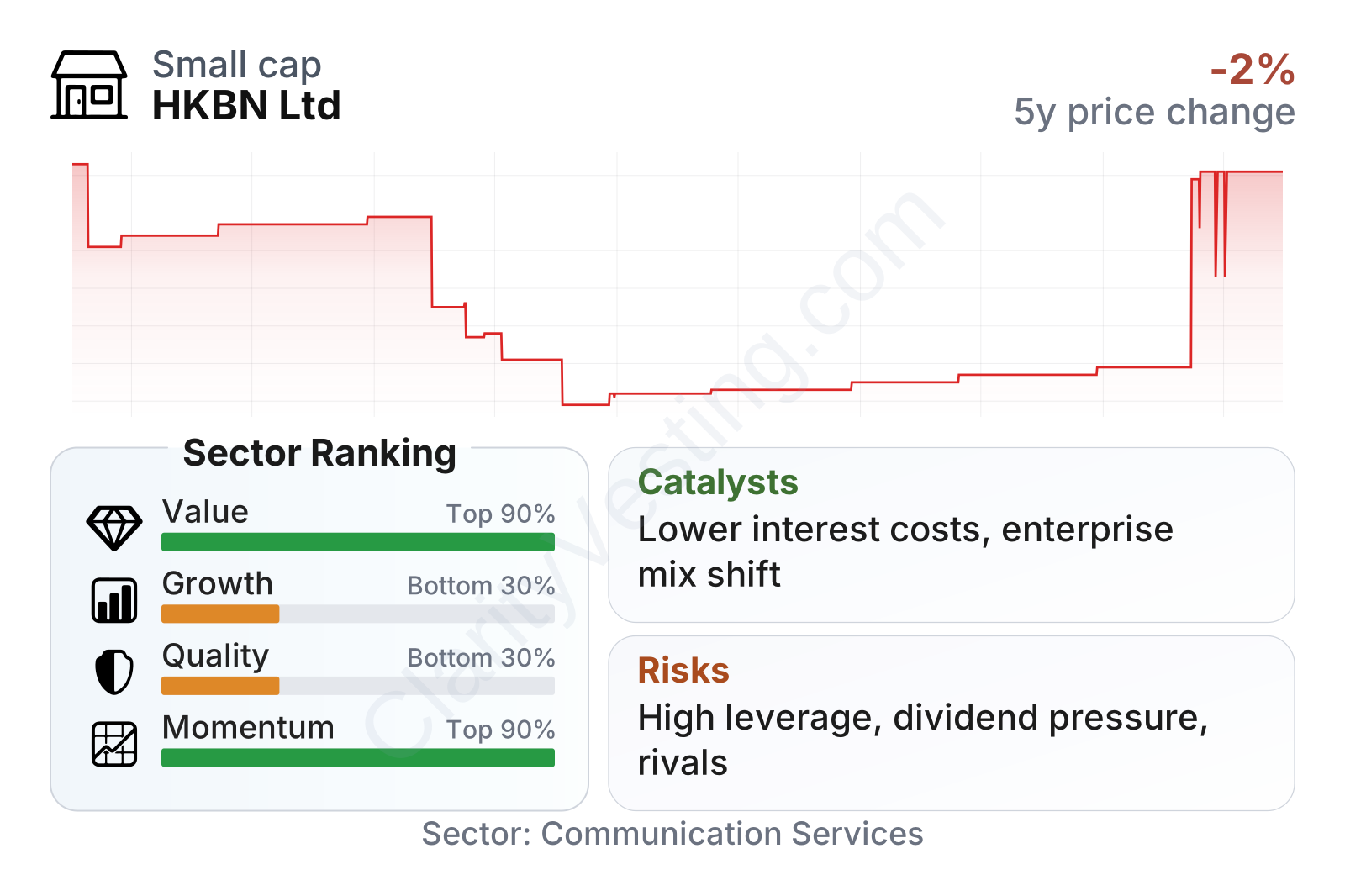
HKBN currently sits in an unusual position: its value metrics look very strong on several measures, but its growth and quality profile rank weakly against much of the communication services sector. The market capitalization places it in the smaller end of listed telecom-related companies, and the stock’s beta of about 0.54 suggests price swings have historically been less sensitive than the broader market.
The recent share-price chart shows a long decline from 2021 into early 2024 followed by a sharp rebound in 2026. That helps explain why momentum metrics now rank near the top of the sector. However, long-term operating trends remain more mixed than the recent stock move suggests.
On valuation factors, the picture is split. The trailing dividend yield is extremely high at roughly 38%, and EBIT relative to enterprise value is also far above the sector median, both of which usually point to a low market valuation versus operating earnings. At the same time, the P/E ratio is elevated, which reflects how thin net profit remains after interest and other costs. In other words, the stock can look inexpensive at the operating level while still looking expensive on earnings left for shareholders.
Quality measures are weaker. Profit margin is about 2% versus a sector median near 9%, and net debt as a share of assets is close to 59% versus about 19% for the median peer. Operating margins over time have also been below sector norms. Growth indicators are similarly soft: five-year revenue per share, free cash flow, and dividend per share trends have all moved in the wrong direction, even though recent year-over-year revenue growth was slightly positive at about 5%.
Growth
HKBN operates in a sector that is essential but mature. Broadband, mobile connectivity, enterprise networking, cloud migration, and cybersecurity remain important long-term needs, so the underlying market is not disappearing. The challenge is that Hong Kong telecom is already highly penetrated, which limits easy subscriber growth. That means future progress depends less on adding large numbers of new users and more on upselling, bundling, enterprise execution, and margin improvement.
The company’s strategy still makes industrial sense. Residential broadband and mobile can anchor customer relationships, while enterprise telecom and technology services can deepen revenue per client. Business customers increasingly need secure connectivity, cloud support, data solutions, and outsourcing help, which gives HKBN a path to stay relevant beyond basic internet access. This is especially important because plain connectivity tends to become commoditized over time.
A notable potential catalyst is any sustained improvement in financing pressure. Interest expense rose sharply in recent years and weighed heavily on profits, but the latest annual figures showed a clear improvement versus the prior year. If borrowing costs continue to ease or debt is refinanced on better terms, the same level of operating income could translate into much better net earnings.
Another possible opening comes from consolidation or strategic interest around telecom infrastructure and recurring cash-generating assets. Smaller telecom operators with established networks, enterprise accounts, and predictable customer billing can attract attention when public-market valuations remain subdued. Recent stock strength suggests the market may be reassessing that possibility or giving more credit to operating stabilization.
There is also a simpler operational catalyst: HKBN does not need explosive revenue growth to improve results. Because revenue has stayed broadly steady, even moderate gains in margin, product mix, or financing costs could have an outsized impact on earnings and cash generation.
Risks
This article is for informational purposes only and does not constitute financial advice. Some content is AI-generated. See Disclaimer